RehearseAI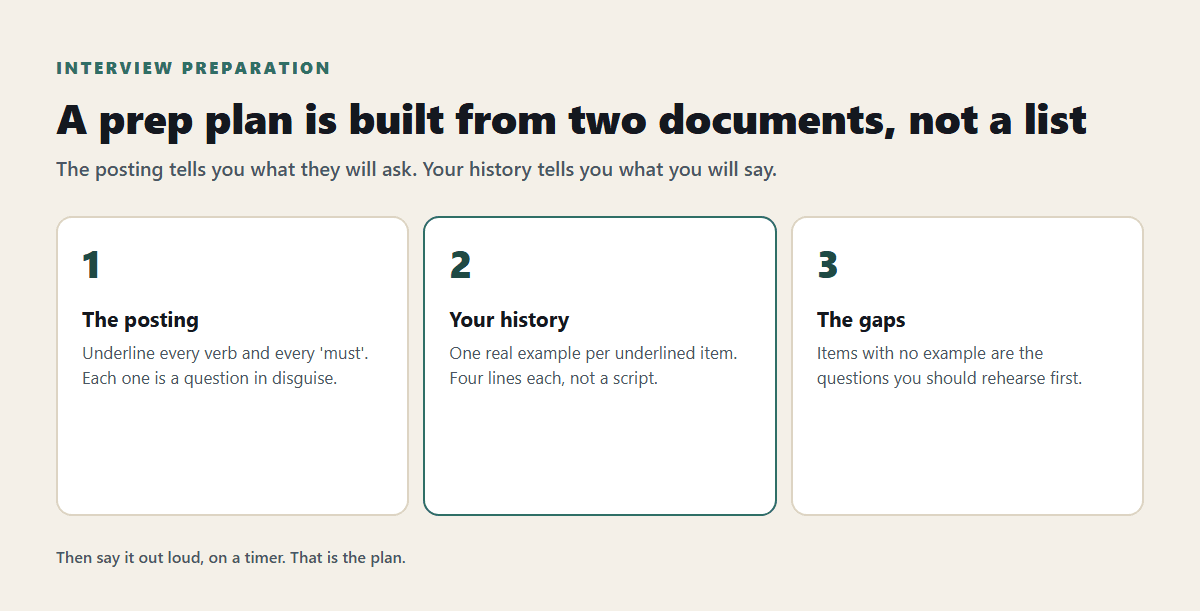
Most interview preparation plans are the same plan. Read about the company. Review common questions. Prepare some examples. Get a good night's sleep.
None of that is wrong, and none of it is personal. It would be the same plan for a nurse, a data engineer and a store manager, which is exactly why it does not help much. The questions you will actually be asked come from one document: the job description. The answers you will actually give come from another: your own history. A personalized interview preparation plan is what you get when you put those two side by side.
Here is how to build one in an evening, the seven-day schedule that runs it, and how to change its shape if interviews make you nervous.
Start with the posting, not with question lists
Print the job description or paste it into a document, and underline three kinds of things:
- Every verb. "Manage a team of six." "Reconcile monthly accounts." "Present findings to leadership." Each verb is something they will ask you to prove you have done.
- Every "must" and "required". These are the screening questions. If the posting says "must have experience with regulated environments", someone on the panel has been told to check.
- Every adjective about the person. "Self-starter." "Comfortable with ambiguity." "Calm under pressure." These become behavioral questions: "tell me about a time you had to work without clear direction."
A typical posting gives you twelve to fifteen underlined phrases. That is your question list, and it is a far better one than any generic list, because it was written by the people who will interview you. If you want the questions spelled out in full, the free question generator does exactly this from a pasted posting. If the posting itself is hard to read, there is a separate post on preparing when the job description is unfamiliar.
Match each phrase to your own history
Now go down the list and, for each phrase, write one real example from your past. Four short lines each: where you were, what was yours to do, what you did, what changed. Not a paragraph. Four lines you could rebuild live.
Two things happen when you do this honestly.
First, you find that three or four situations cover most of the list. The project that went sideways in month two covers "ambiguity", "conflict", "prioritizing" and "communicating with leadership" all at once. That is your story bank, and it is the most valuable page in the whole plan. The STAR method is the shape those stories should take.
Second, you find gaps: phrases where you have no example, or only a weak one. Write "gap" next to them. The gaps are the questions most likely to go badly, and knowing them in advance is the entire point of personalizing the plan. For each one, decide now what you will say: an adjacent example ("I have not managed a budget, but I decided how a team spent its time for a quarter"), a learning answer ("I have not done that, here is the closest thing, here is how I would get up to speed"), or a question back about how much of the role it really is.
The seven-day schedule that runs it
A plan is a document until you have said the answers out loud. This is the week that turns one into the other. Two days of building, three of speaking, one of review, one of nothing. Thirty to forty-five minutes a day; longer is not better.
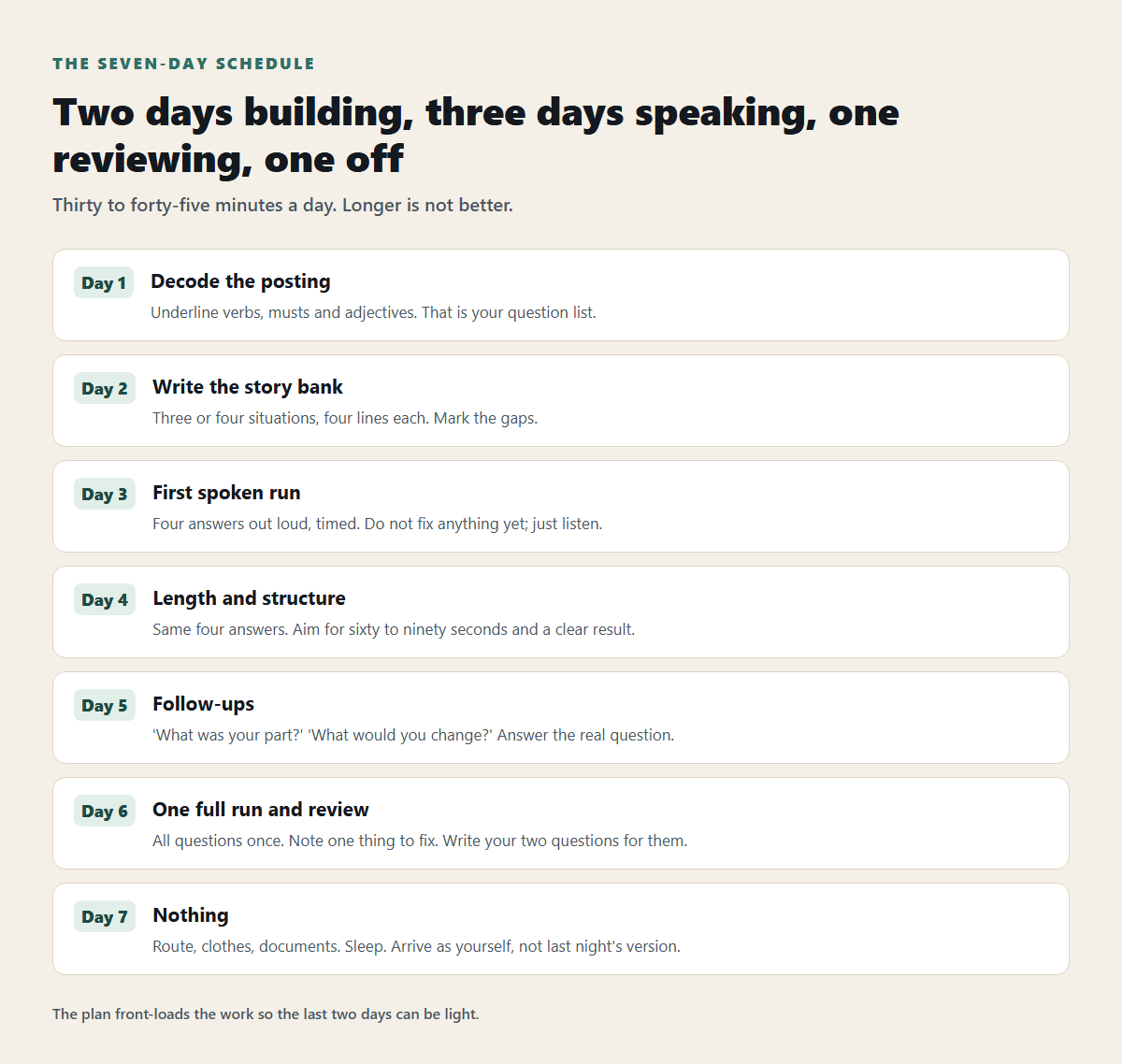
Days 1 and 2 are the two steps above: decode the posting, then write the story bank and mark the gaps. If either takes more than forty-five minutes, you are writing scripts. Four lines, not paragraphs.
Day 3 is the first spoken run. Pick the four questions that worry you most, usually the gaps and the biggest "must", and answer each one out loud, on a timer. Do not fix anything yet. Just listen for where the sentence falls apart and write it down.
Day 4 is length and structure. Same four answers, aiming for sixty to ninety seconds with a clear result at the end. Under thirty seconds reads as thin; past two minutes the interviewer has stopped taking notes. Cut setup, not substance.
Day 5 is follow-ups. After each answer, ask yourself the three questions that expose vagueness: "What was your part specifically?" "What did your manager think?" "What would you do differently?" Two or three sentences each, then back to the outcome. If your stories survive those, they will survive most panels.
Day 6 is one full run through the whole list, then one fix, not three. It is also when you write your two questions for them, about the work rather than the brochure.
Day 7 is nothing but logistics. Do not practice the night before. Late rehearsal makes people rigid rather than ready; you arrive trying to reproduce last night's version instead of having a conversation.
With fewer than seven days, compress from the reading end, never from the speaking end. Three days: build, speak, one light run. One day: an hour on the story bank, then four answers out loud, twice.
If you are nervous, change the shape, not the plan
If interviews make you anxious, the standard week can make it worse: long sessions build dread, and "prepare for everything" becomes a list you can never finish. Keep the same plan and change three things about how you run it.
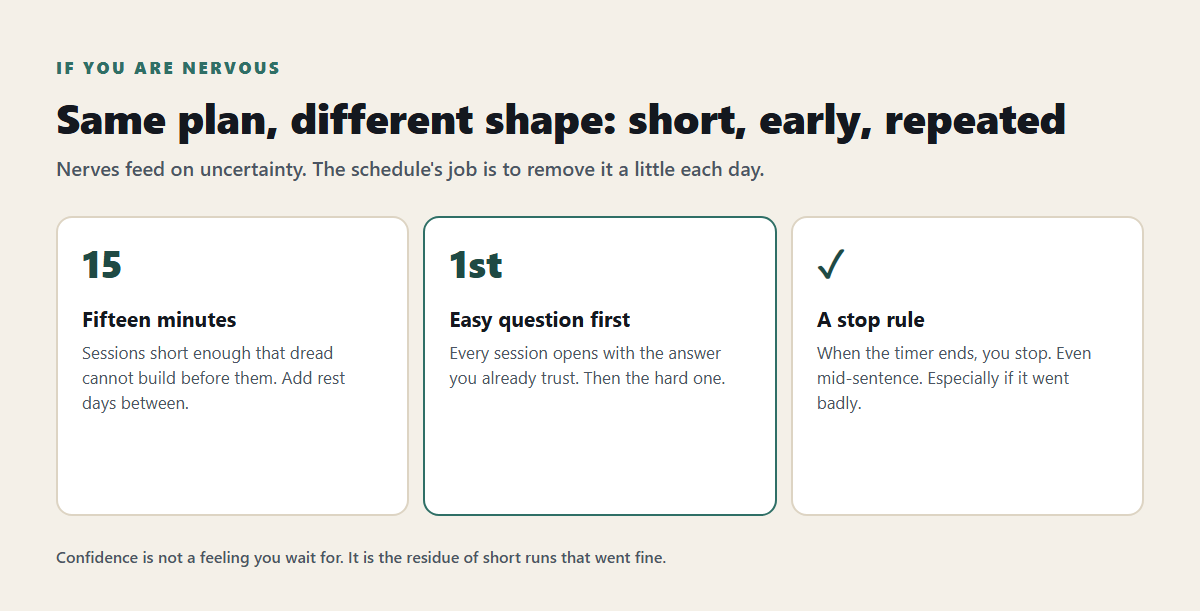
Fifteen minutes, not forty-five. Nerves build in the gap between deciding to practice and starting. A short session leaves no room for that gap, and a short session that went fine is exactly the memory confidence is made of. Put a rest day between sessions; the point of the rest day is that you come back.
The easy question comes first, every time. Open every session with the one answer you already tell well. It is proof, to the part of you that is scared, that the room is safe. Cold-starting into your hardest question teaches you that you are bad at it.
When the timer ends, stop. Even mid-sentence, even if the last answer was terrible. Nervous people over-practice, and over-practice is where stiffness comes from. Write one line about what to fix, close the notebook, and let tomorrow's easy question reopen it.
The nerves will still show up a little on the day, and that is fine; the schedule was never going to remove them, only stop them from running the preparation. Breathe out slowly before you answer, and if you lose the thread, say "let me think about that for a second" and take it. There is more on the day itself in interview anxiety, and what actually helps.
What a finished plan looks like
One page. At the top, the twelve to fifteen phrases from the posting. Next to each, four lines of your own example, or the word "gap" and the answer you chose for it. At the bottom, three or four story titles, two questions you want to ask them, and the seven days written in a column with a tick box each.
That is the whole plan. Anyone can build it for any job in an evening, and no two people's will look alike, which is what "personalized" is supposed to mean.
If you would rather have someone ask the questions than read them to yourself, RehearseAI runs the interview out loud for the exact posting, follows up when you dodge, and tells you afterwards how long you took and where the answer sagged. Every account gets one free 5-minute interview a month, no credit card required, which is enough for day 3 or day 6.
Quick answers
How long should a personalized interview preparation plan take to build? One evening for the plan, then the week above. If building it is taking days, you are writing scripts instead of four-line examples.
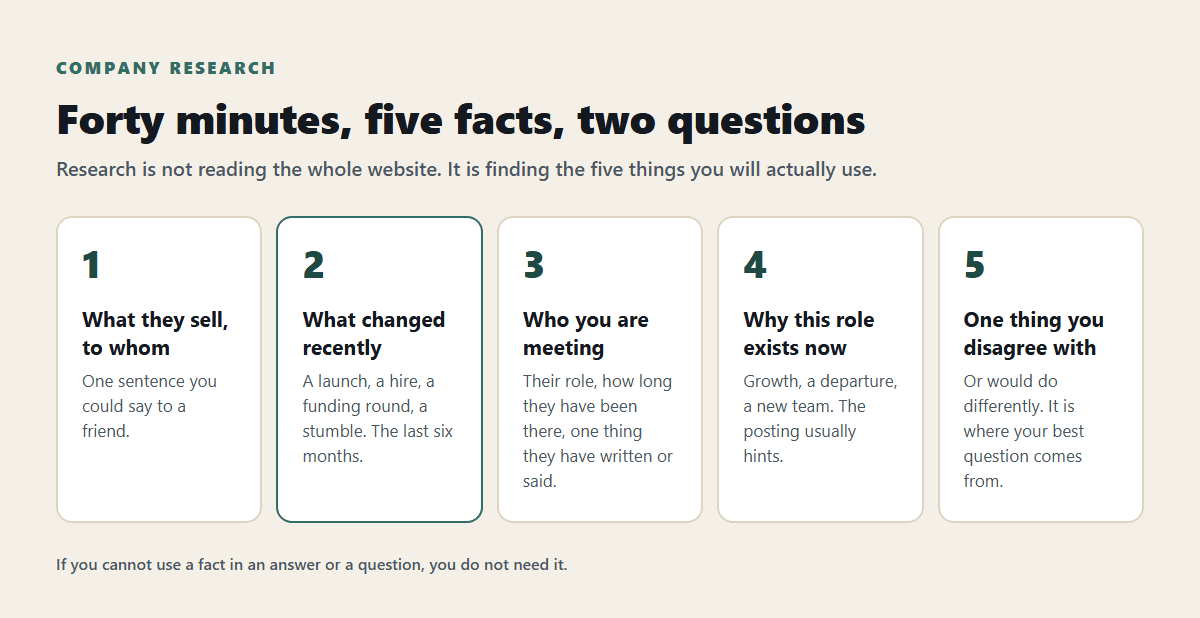
Should the plan include company research? A little, on day 1 or 2: one specific detail for "why us" and one real question to ask. It should not be the bulk of any day.
How many hours a day should I prepare? Thirty to forty-five minutes, or fifteen if you are nervous. The improvement comes from speaking and sleeping on it, not from long sessions.
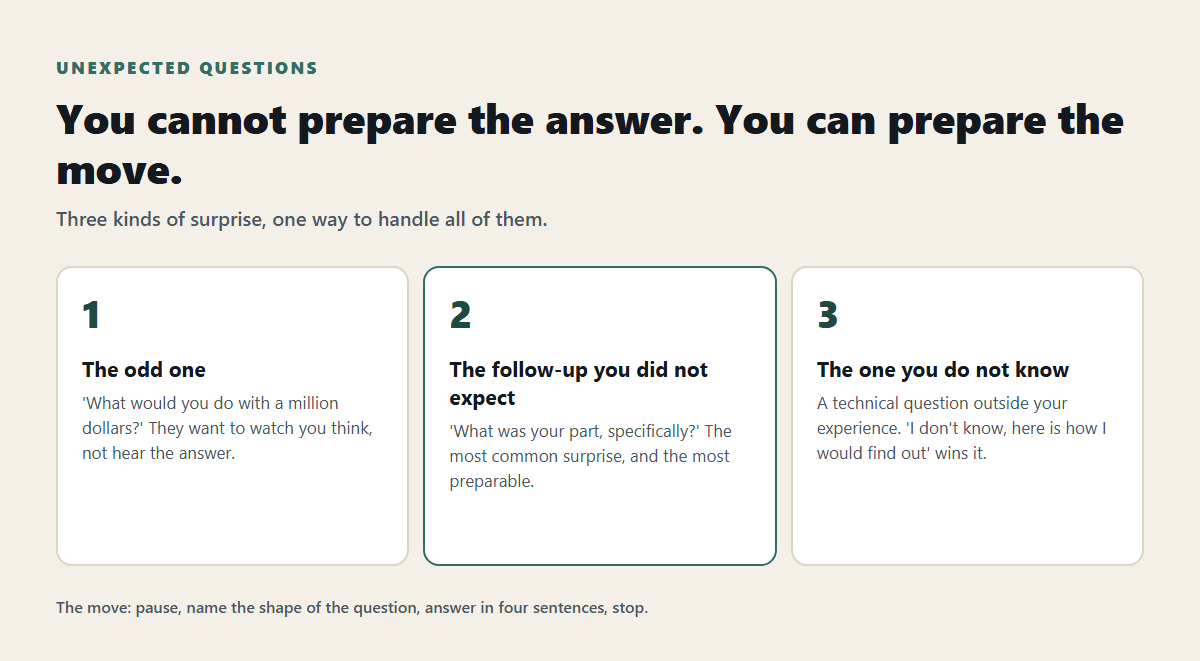
How many examples do I need? Three or four good situations, told from different angles, cover most postings. Fifteen separate answers do not survive a follow-up.
Sources
The approach above lines up with what university career centers publish on interview preparation; these are the ones I checked it against:
- Interview Preparation — Career Engagement, University of California, Berkeley
- Interview Preparation Guide — UConn Center for Career Readiness
- Mock Interviews — Pomerantz Career Center, University of Iowa
Behavioral answers here follow the STAR method. More on why I built this.
Want the question list written for you? The free question generator builds it from the posting — no account needed.