RehearseAI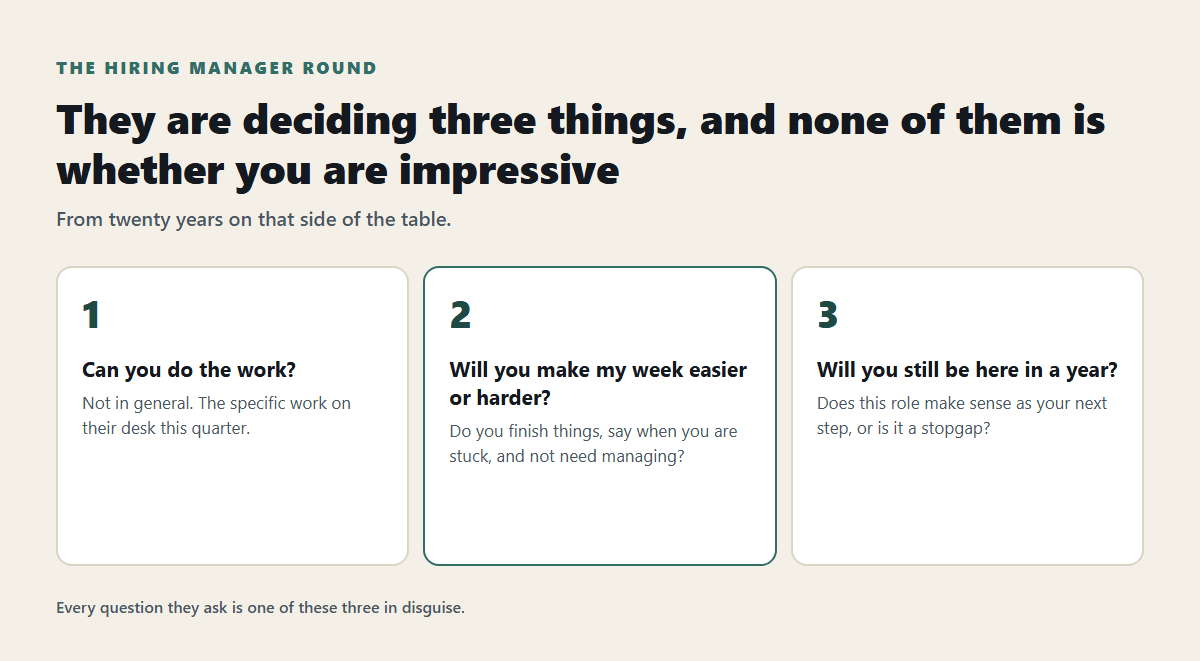
The hiring manager interview is the one that decides it. The recruiter screen checks you are real; the panel checks you are safe; the hiring manager decides whether they want to sit next to you for the next two years. I was that person for twenty years, across a lot of hires, and the thing candidates most often got wrong was preparing to be impressive.
Hiring managers are not looking for impressive. They are deciding three specific things, and once you know what they are, the questions become predictable and the answers become easy to tailor.
The three things a hiring manager is deciding
1. Can you do the work on my desk this quarter? Not "are you capable" in the abstract. Is there a specific project, backlog or problem this hire is meant to absorb, and can you absorb it? The job posting is usually a lightly edited description of that desk.
2. Will you make my week easier or harder? This is the one nobody tells you about, and it is the one that most often decides. Do you finish things? Do you say when you are stuck, early, or do you go quiet? Do you need managing, or do you manage yourself? A brilliant candidate who needs a daily check-in is a harder week. A solid candidate who runs on their own is an easier one. Easier usually wins.
3. Will you still be here in a year? Hiring takes months and costs the manager real time. They want to know this role is a sensible next step for you, not a stopgap while you wait for something better.
Every question in the round is one of these three wearing different clothes.
Predicting the questions
Once you have the three, you can write the question list yourself.
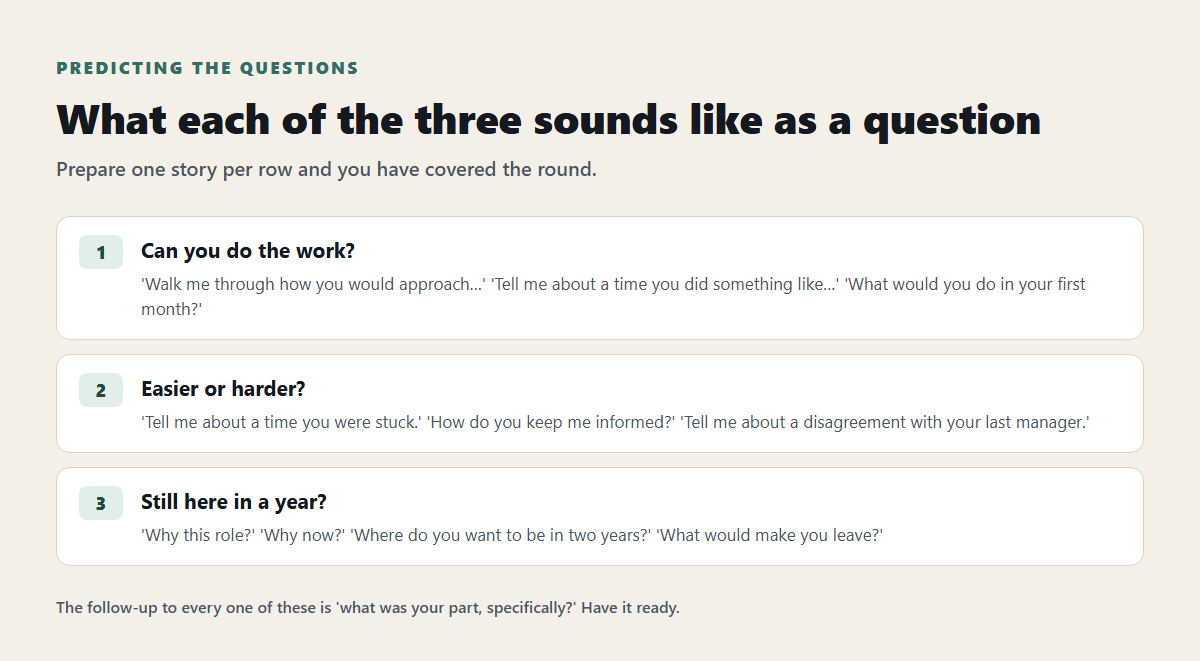
For the work: "Walk me through how you would approach…" "Tell me about a time you did something like this." "What would you focus on in your first month?" These are answered with a specific example that resembles the desk, or an honest plan if you have never done it.
For easier or harder: "Tell me about a time you were stuck." "How do you like to be managed?" "How do you keep your manager informed?" "Tell me about a disagreement with a previous manager." These are answered with stories that show you finish, you flag early, and you disagree without drama.
For a year from now: "Why this role?" "Why now?" "Where do you want to be in two years?" "What would make you leave?" These are answered with a thread: what you were doing, what you want more of, why this role has it.
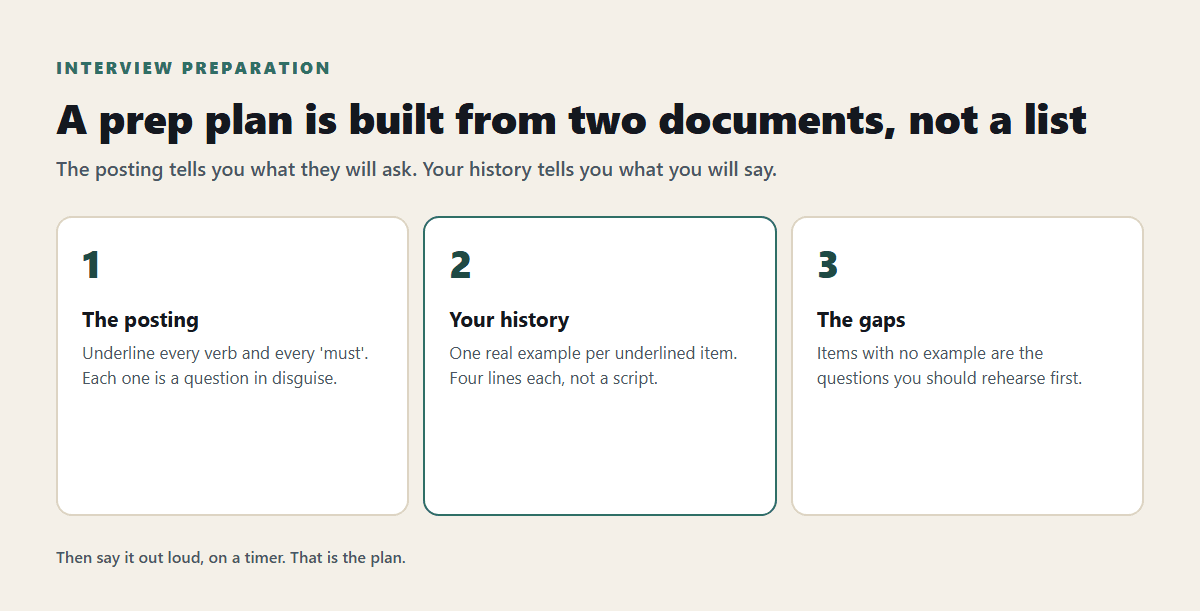
Write one four-line story for each row, where you were, what was yours, what you did, what changed. The STAR method is that shape. Three stories, told from different angles, cover the round.
Tailoring the answers to the person
"Tailor your answers to the hiring manager" usually gets translated as "flatter them." It means something more useful: answer the question they are actually asking, which depends on who they are.
Look them up before the interview. A manager who joined three months ago is building a team and wants to hear that you can operate without much structure. One who has run the same team for eight years is protecting something that works and wants to hear that you will not break it. A manager whose previous job was the role you are applying for will ask detailed questions about the work; one who came from a different discipline will ask more about how you communicate. Same stories, different emphasis.
And listen to how they describe the role in the first five minutes. Managers nearly always tell you what is wrong with the current setup ("we have been stretched", "the last person left in a hurry", "we are trying to get ahead of…"). Whatever they name is the thing to speak to in your answers, because it is the thing they are hiring to fix.
What loses the round
Three things, in my experience, and none of them is a wrong answer.
Talking about the job you want instead of the job they have. The manager has a desk to clear. A candidate who spends the interview on where they want to be in three years makes it obvious this desk is a stepping stone.
Answers that do not stop. Sixty to ninety seconds, then silence. A manager listening to a four-minute answer is already picturing the meetings.
Having no questions about the work. "What does the first month look like?" "What did the last person find hardest?" "What would make this hire a clear win a year in?" Those three questions do more for you than any answer, because they show you are thinking about their desk too.
Practice the round, not the answers
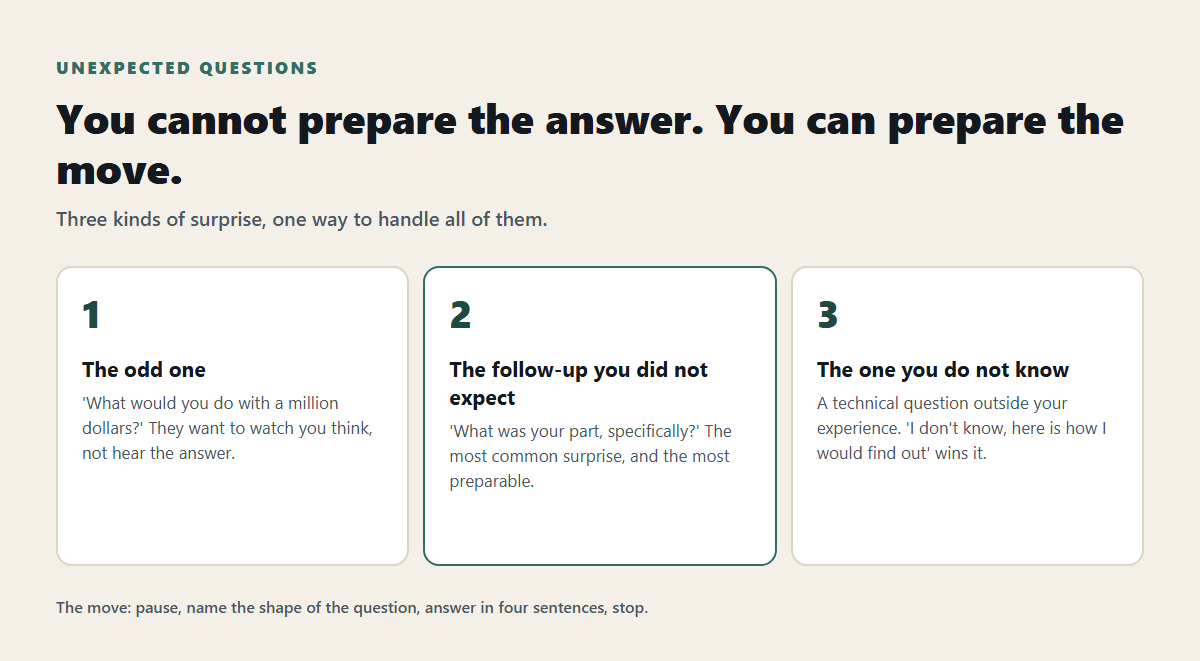
The hiring manager round is conversational, and the follow-ups are relentless: "what was your part, specifically?" comes after nearly every story. Rehearse the stories out loud, once, and answer that follow-up after each. If nobody is free to play a difficult manager, RehearseAI will: it runs the interview out loud for the role and stage, pushes past the first answer the way a hiring manager does, and tells you afterwards where the answer sagged. Every account gets one free 5-minute interview a month, no credit card required.
Quick answers
How is a hiring manager interview different from an HR screen? The screen checks facts and fit. The manager decides whether they want you on the team, so the questions are about the actual work and how you operate.
Should I ask the hiring manager about salary? Not in this round. Ask about the work. Salary belongs with the recruiter or the offer.
What if the manager seems distracted or unprepared? Common; they are busy. Answer shorter, ask a question about their week, and let them talk. Managers remember candidates who made the conversation easy.
How long should my answers be? Sixty to ninety seconds, ending on what changed. Then stop and let them follow up.
Sources
The approach above lines up with what university career centers publish on interviewing; these are the ones I checked it against:
- Interview Preparation — Career Engagement, University of California, Berkeley
- STAR Method of Interviewing — University of Washington Career & Internship Center
- Preparing for Interviews — Tufts University Career Center
The stories for each row follow the STAR method. Not sure you are ready for this round? How to tell whether you are ready. More on why I built this — the hiring manager's chair is where I spent most of those twenty years.
The free question generator writes the questions from the posting — no account needed.