RehearseAI
Someone has asked you to help them practice for an interview, or you teach a class and need to run mock interviews next week. Either way, you need the questions. This page is written for you, the person asking.
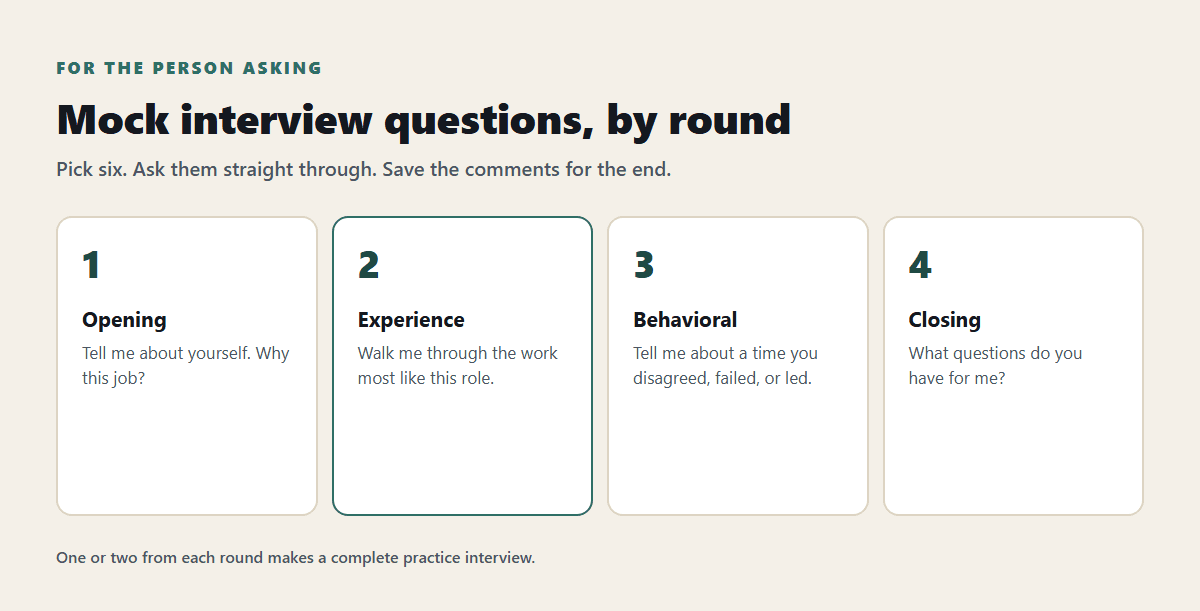
The list below is arranged by round, in the order a real interview usually goes. Pick about six, ask them straight through, and keep your comments for the end.
If you are the candidate looking for questions to rehearse on your own, interview practice questions is the page for that.
Round 1: opening questions
These settle the candidate and show whether they can summarize themselves.
- Tell me about yourself.
- Why are you interested in this role?
- What do you know about our organization?
- Why are you leaving your current job? (Or, for students: why this field?)
Listen for an answer under two minutes that ends by pointing at this job. A full life story is the common mistake.
Round 2: experience questions
These check whether the résumé holds up in conversation.
- Walk me through the experience most relevant to this job.
- What are you best at, and how do you know?
- Which part of this role would be new to you?
- What is the accomplishment on your résumé that you are proudest of?
Listen for specifics. "I managed the schedule for a team of six" beats "I have strong organizational skills."
Round 3: behavioral questions
These ask for a real story from the past, and they are where most candidates need the practice.
- Tell me about a time you disagreed with someone at work or school.
- Tell me about a mistake you made and what you did next.
- Describe a time you had too much to do and not enough time.
- Give me an example of a time you took the lead without being asked.
- Tell me about a time you had to learn something quickly.
Listen for one specific situation, the candidate's own part in it, and an ending. That shape is the STAR method. If you want to know what a strong answer sounds like, there are worked ones in STAR method examples.
Round 4: closing questions
- What is your biggest weakness?
- Where do you want to be in a few years?
- Why should we hire you?
- What questions do you have for me?
Always ask the last one. A candidate with no questions looks uninterested, and it is the easiest thing to fix in practice.
Mock interview questions for high school students
For a first job, a college program or a scholarship, the candidate has little work history, so ask about school, activities and character instead.
- Tell me a little about yourself.
- What is your favorite subject, and why?
- Tell me about a group project. What was your part?
- Describe a time something was hard for you. What did you do?
- What do you do outside of class?
- How would a teacher or coach describe you?
- Why do you want this job or this program?
- When are you available, and how will you get here? (For part-time jobs.)
With students, the goal of the first mock interview is simply to get through one. Keep it to ten minutes, find one thing they did well, and name one thing to try next time.
Topics to cover if you only have ten minutes
Ask one question from each of these and you have a complete short interview:
- Introduction: tell me about yourself.
- Motivation: why this job?
- A story: tell me about a time you solved a problem.
- Self-awareness: what is something you are working to get better at?
- Curiosity: what questions do you have for me?
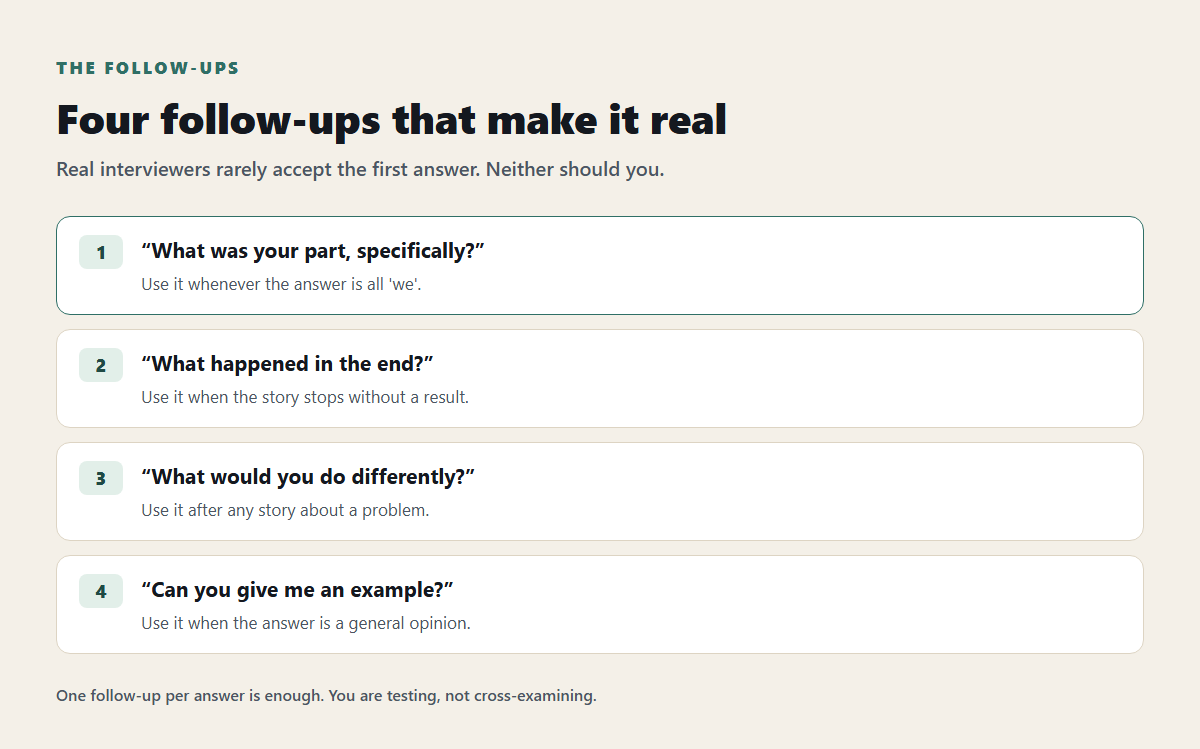
The follow-ups that make it real
A list of questions is only half of an interview. Real interviewers follow up, and that is the moment prepared answers come apart. Use one follow-up after most answers.
Questions to ask when you are the friend running it
If someone has asked you to interview them, you do not need to know their field. You need six questions that work for any role, asked in a steady voice, with one follow-up each.
- "Walk me through your background and why you applied." Watch the clock. If it passes two minutes, say so afterward.
- "What in the posting made you think you could do this job?" This checks whether they read it closely. Have the posting open yourself.
- "Tell me about a time something went wrong at work. What did you do?" Then: "What was the result?" If there is no result, that is the note to give.
- "What would your last manager say you need to work on?" Listen for a real answer, not a strength in disguise.
- "Why are you leaving, or why did you leave?" Keep a straight face. Tone matters more than wording here.
- "What questions do you have for me?" Having none is a fair thing to point out.
Ask for the job posting a day ahead, swap in two questions that fit it, and resist the urge to reassure them halfway through. The most useful thing you can do is stay quiet for a beat after each answer. Real interviewers do, and the silence is where over-talking starts.
How to run it
- Ask for the job posting first and swap in two or three questions that fit it. The free question generator writes them from the posting in under a minute.
- Stay in character. No coaching, no reassurance, no "good answer" until the end.
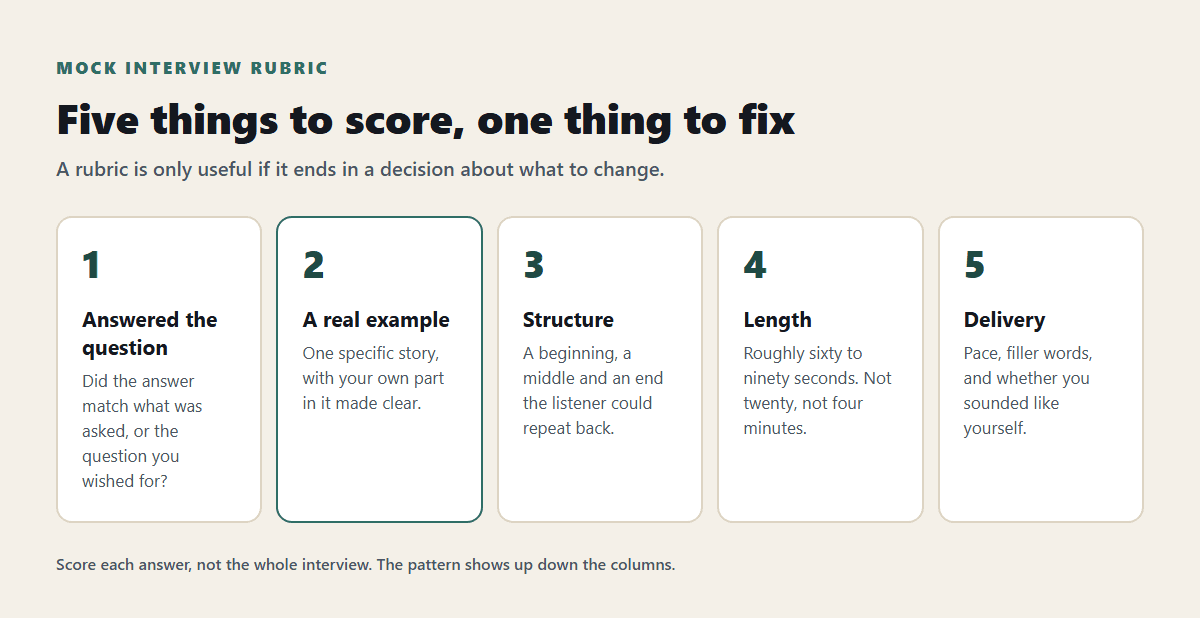
- Take notes on a simple scale. The mock interview rubric gives you five things to score.
- Finish with one or two changes, not a list of ten.
If you cannot spare the time, or the candidate wants more practice than you can give, point them to RehearseAI. An AI interviewer asks questions built from their job posting, follows up, and writes the report. Every account gets 10 free practice minutes a month — one 10-minute interview, or shorter sits whenever you like, no credit card required.
Quick answers
How many questions should a mock interview have? Five to eight for a thirty-minute session. Fewer, with follow-ups, beats more without.
Should I give the candidate the questions in advance? Not the exact ones. Tell them the rounds so they can prepare stories.
What if I do not know their field? Ask the behavioral and opening questions. They work for any job, and they are where most people struggle.
Should I be tough? Be neutral. A real interviewer is polite and hard to read. That is the feeling worth practicing.
<!-- related-guides -->Related guides
If this was useful, these are the next ones to read:
- Mock Interview Practice: How to Improve Your Answers and Timing: Most interviews are lost on pacing, not knowledge. How to get your answers into the sixty to ninety second window, and handle the follow-up without unraveling.
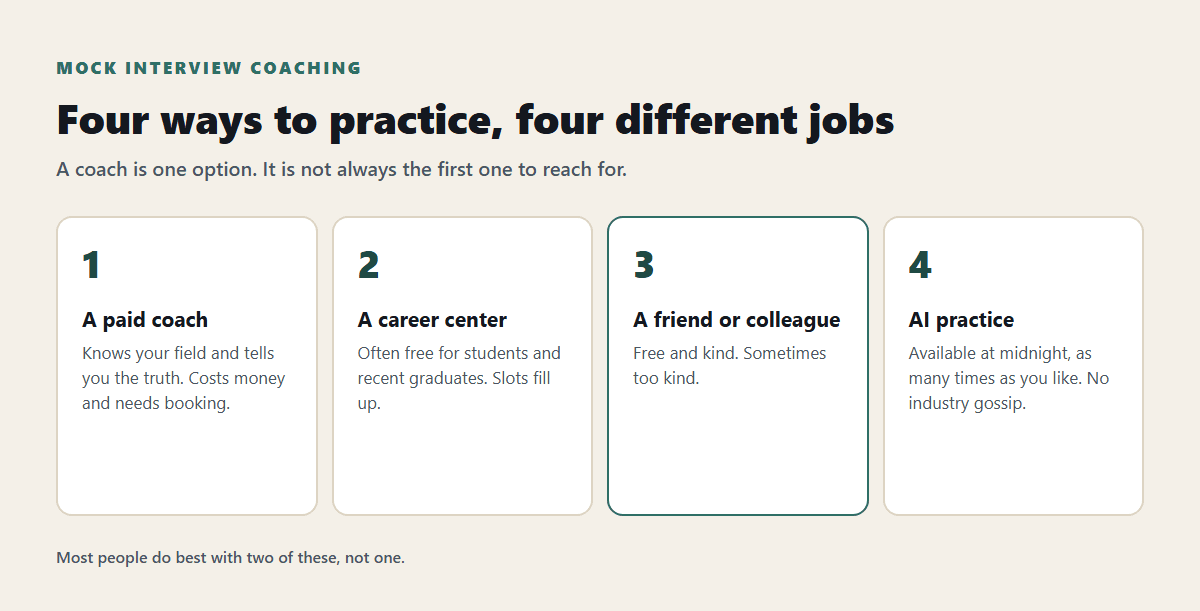
- Mock Interview Coaching: Is It Worth Paying For?: Mock interview coaching compared with a friend, a career center and AI practice: what a coach actually adds, when it is worth the money, and what to ask before you book.
Sources
University career centers that publish interview question lists and mock interview guidance:
- Interview Preparation — Career Engagement, University of California, Berkeley
- Interview Preparation Guide — UConn Center for Career Readiness
- Mock Interviews — The Career Center, University of Illinois
New to the idea? Start with what a mock interview is. More on why I built this.