RehearseAI
Near the end of every interview, someone says: "So, do you have any questions for us?"
Most people say no. Some produce something they read on a list that morning — where do you see the company in five years — and you can watch the interviewer's attention leave the room.
This is a strange thing to waste, because it is the only part of the hour where you are not being tested on recall. It is the part where you find out whether you actually want the job, and where a good question does more for their impression of you than another polished answer would have.
Here is what to ask, and why each one works.
About the job itself
"What does a normal week look like in this role?" Job descriptions describe an ideal. This asks what actually happens. Listen for whether they can answer it concretely.
"What are the first three months meant to look like?" Tells you whether there is a plan or whether you will be handed a laptop and wished luck.
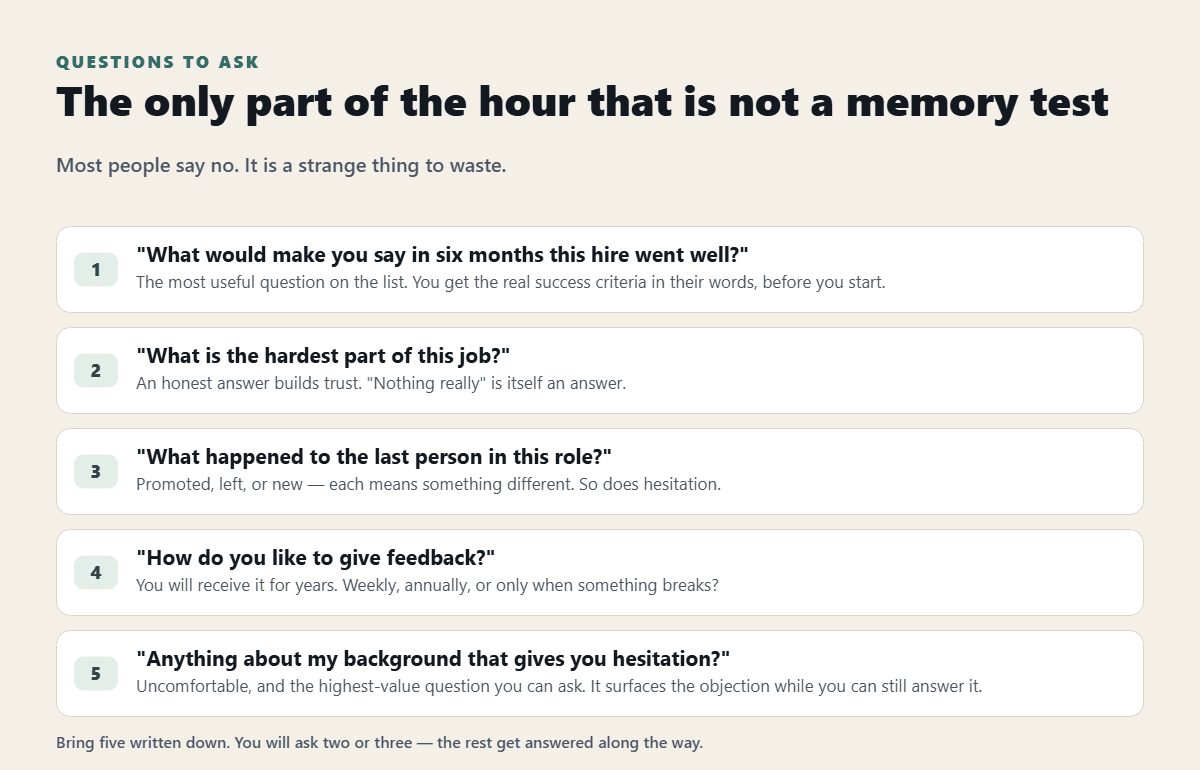
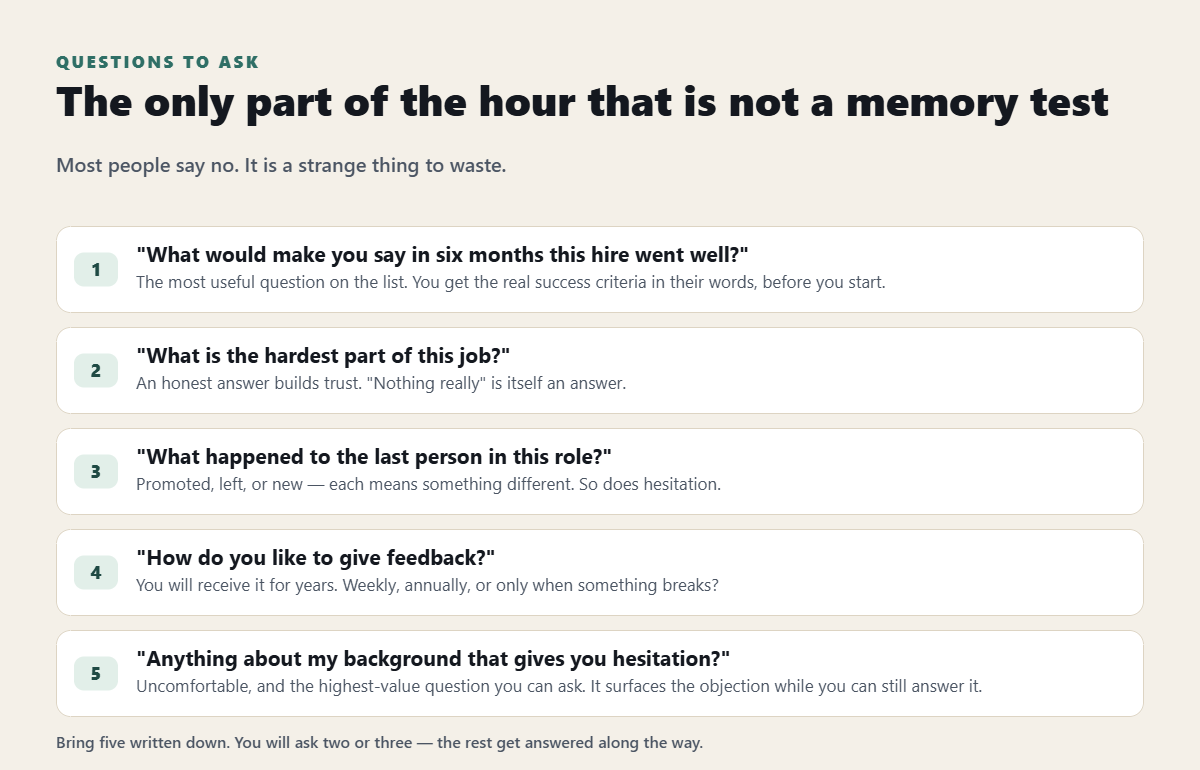
"What would make you look back in six months and say this hire went really well?" The single most useful question on this page. You get the real success criteria, in their words, before you start. Write down what they say.
"What is the hardest part of this job?" An honest answer builds trust. "Nothing really" is itself an answer — it usually means they have not thought about the role from the inside.
About the team
"Who would I work with most closely?" You are joining a small number of people, not a company. Find out who they are.
"How does the team handle disagreement about priorities?" Sounds soft, tells you an enormous amount. Every team has friction; the question is whether they have a way to resolve it.
"What happened to the last person in this role?" Slightly bold, entirely fair. Promoted, left, or the role is new — each answer means something different, and hesitation means something too.
About the manager
If you are speaking to the person you would report to, this is the most valuable ten minutes of the process.
"How do you like to give feedback?" You are going to receive it for years. Find out whether it comes weekly, annually, or only when something goes wrong.
"How often would we meet one to one?" Weekly and protected is a very different job from whenever there is time.
"What do you expect from someone in their first month — questions, or output?" Managers differ sharply on this, and mismatched expectations cause most early friction.
About the company, without the brochure
"What has changed here in the last year?" Better than asking about culture, because it produces something specific rather than a value statement.
"How are decisions usually made — who has to be in the room?" Tells you how quickly anything will move.
"What is the thing people here complain about most?" Ask this lightly. If they answer honestly, that is a good sign about the place. If they cannot name anything, be a little careful.
Two you should always ask at the end
"Is there anything about my background that gives you hesitation?" Slightly uncomfortable, and it is the highest-value question in the interview. It surfaces the objection while you are still in the room and can answer it. Most candidates never learn what quietly sank them.
"What are the next steps, and when should I expect to hear?" Practical, expected, and it saves you a week of refreshing your inbox.
What not to ask
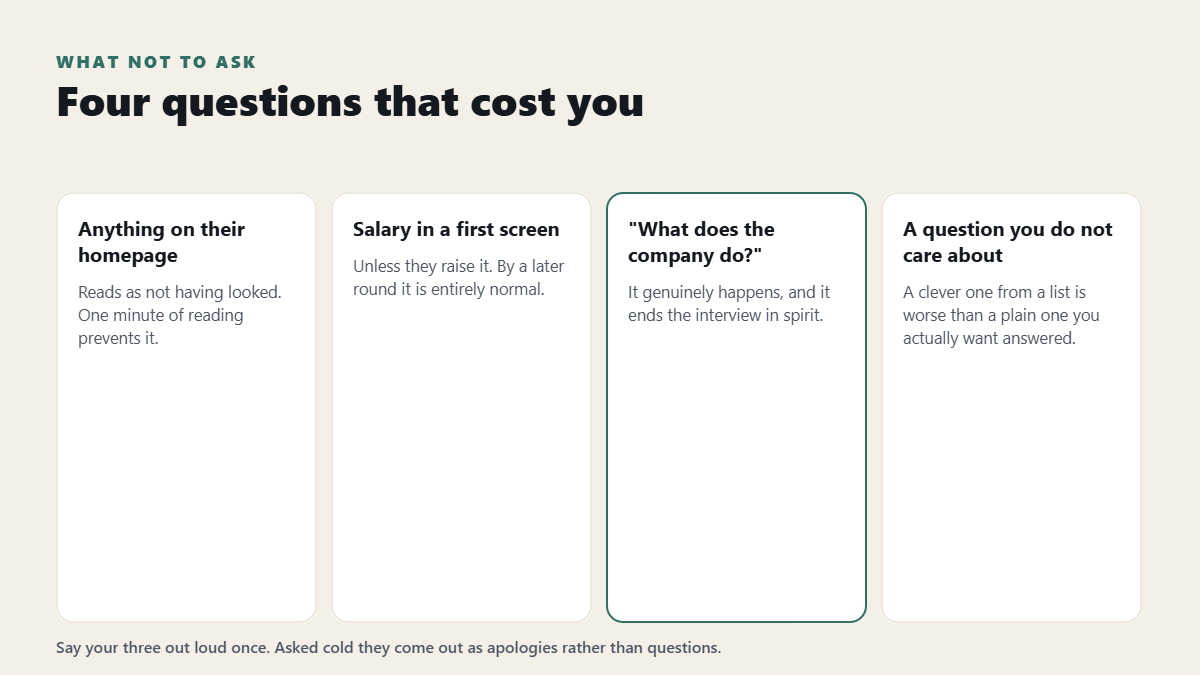
- Anything answered on the first page of their website. It reads as not having looked.
- Salary and holiday in a first-round screen, unless they raise it. Later is fine, and expected.
- "What does the company do?" — genuinely happens, and it ends the interview in spirit.
- A question you do not care about. Reciting a clever question you found online is worse than asking a plain one you actually want answered.
How many, and how to remember them
Bring five written down; you will likely ask two or three, because the rest get answered during the conversation.
Having them on paper is fine and looks prepared. Glancing at a note is not a weakness here — it signals you took the meeting seriously.
And if they genuinely answered everything, say so: "Most of what I had is covered — the one thing I would still like to know is…" That is a better response than inventing filler.
Practice saying them out loud
This sounds unnecessary. It is not. Questions asked cold come out apologetic and half-swallowed — "I was just wondering, if it's okay, maybe…" — which undercuts a good question entirely.
Say your three out loud once. They will come out as questions rather than apologies, and that is the whole difference.
If you want to run the full interview with the closing section included, RehearseAI does it out loud for the role and stage and gives you honest feedback afterward. Every account gets 10 free practice minutes a month — one 10-minute interview, or shorter sits whenever you like, no credit card required.
Quick answers
How many questions should I ask? Two or three. Five prepared, because several get answered along the way.
Is it OK to ask about salary? Yes, but usually not in the first screen unless they bring it up. By a later round it is entirely normal.
Can I ask about remote or hybrid working? Yes. It is a legitimate practical question and better answered before you accept than after.
What if they answered everything already? Say that, then ask one thing anyway — next steps, or what a good first six months looks like.
<!-- related-guides -->Related guides
If this was useful, these are the next ones to read:
- Interview Preparation Plan: Build Yours in a Week: A personalized interview preparation plan starts with the job description and your own history. How to build one in an evening, the seven-day schedule, and the nervous-candidate shape.
- How to Tell Whether You Are Ready for an Interview: How to tell whether you are ready for a job interview: four tests you can run tonight, the five skills a readiness assessment should measure, and the four numbers that show progress.
- Interview Readiness Checklist for Experienced Professionals: An interview readiness checklist for experienced professionals: the eight things that go wrong when you have not interviewed in years, and how to check each one.
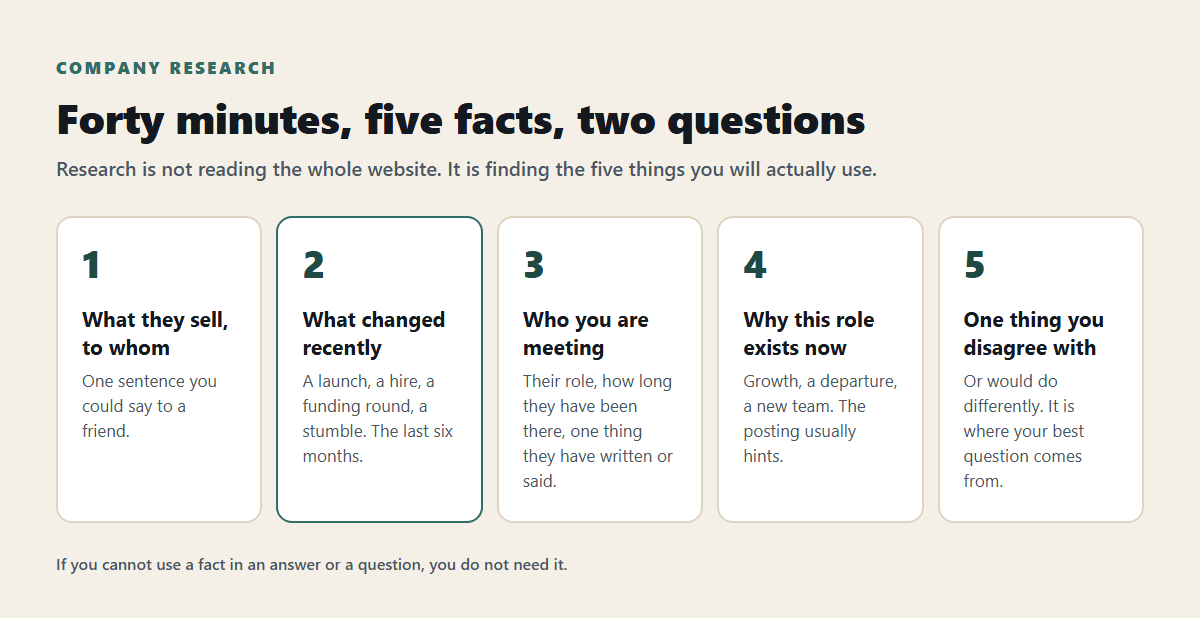
- How to Research a Company Before an Interview: How to research a company before a job interview in forty minutes: the five things worth knowing, where to find them, and how to use them without sounding like the brochure.
- Second Interview Questions and How to Prepare: A second interview has a different purpose from the first. What changes, the questions round two uses, and how to prepare for depth instead of breadth.
Sources
The advice above lines up with what university career centers publish; these are the pages I checked it against:
- Interview Preparation — Career Engagement, University of California, Berkeley
- Interviewing — MIT Career Advising & Professional Development
- Interview Preparation Guide — UConn Center for Career Readiness
Related: interview practice questions worth rehearsing and the STAR method. More on why I built this.
Preparing the answers too? The free question generator turns a job posting into the questions that role would ask.
For the full list of what gets asked, see common interview questions and how to answer them.