RehearseAI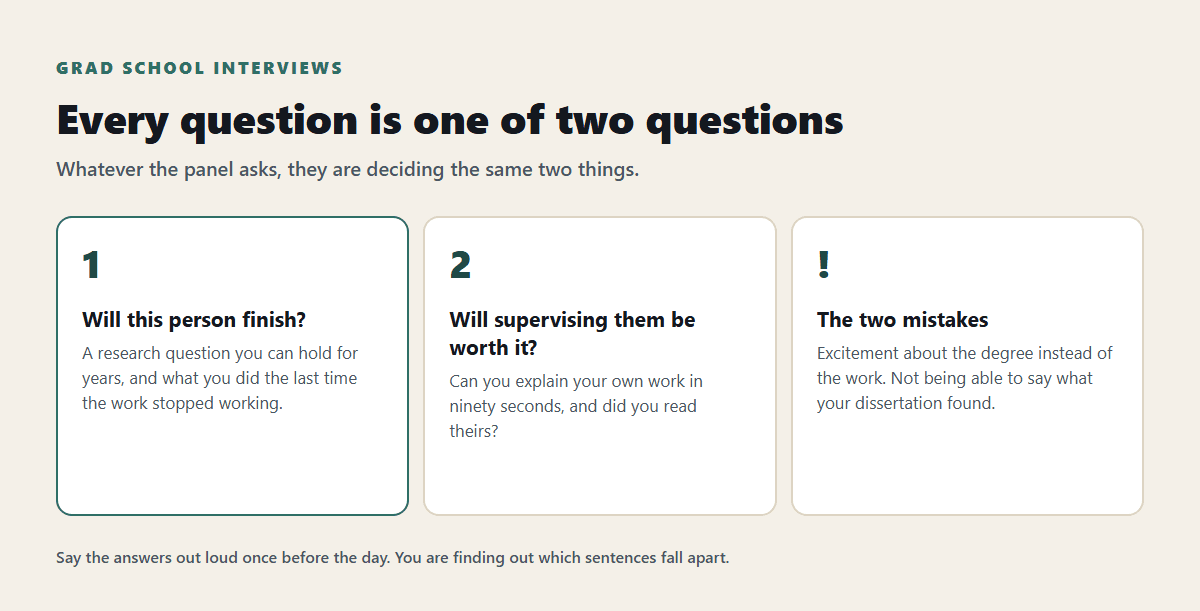
A graduate school interview is not a job interview wearing a gown. The people across the table are choosing someone they will supervise for several years, often in a small department where everyone will notice if it goes badly. They are not really asking "are you clever". They already have your transcript for that.
They are asking: will this person finish, and will working with them be a good use of my time?
Almost every grad school interview question is a different route to those two things. Once you see that, the questions stop feeling random.
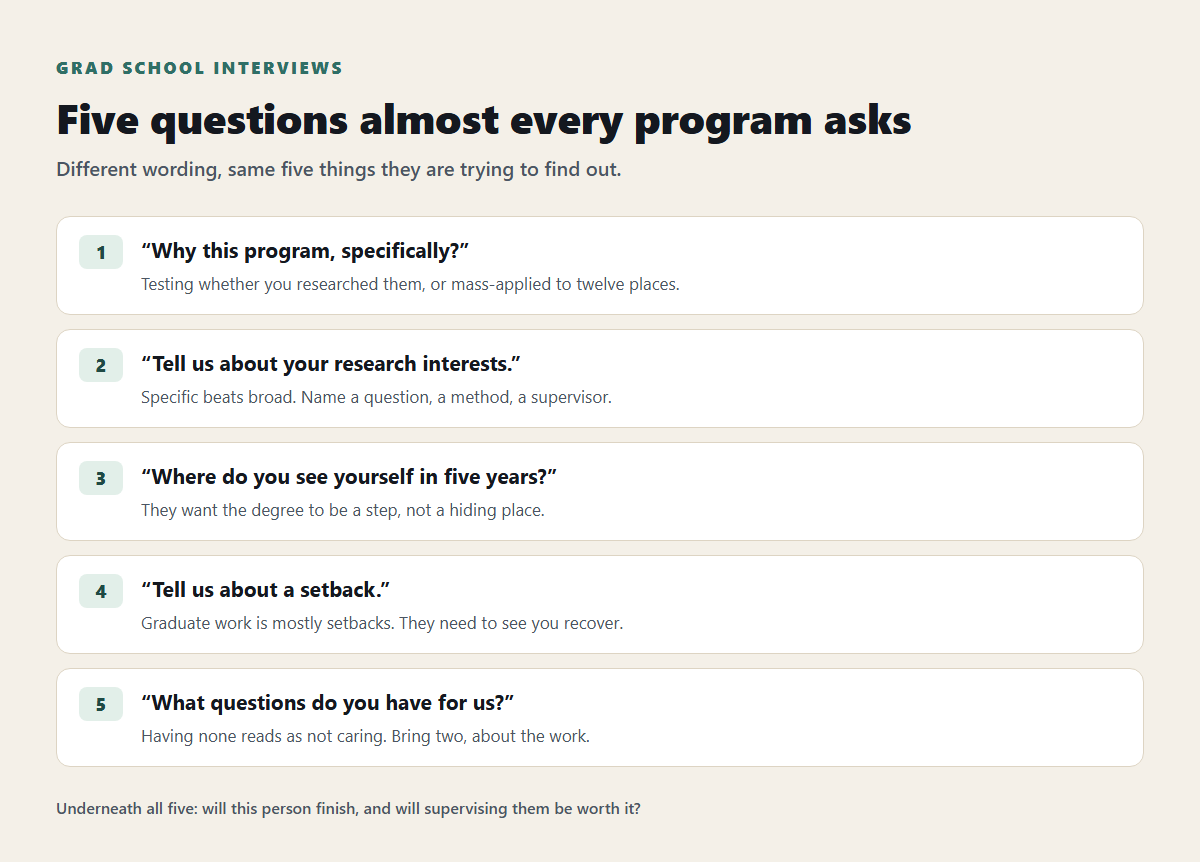
"Why this program, specifically?"
The most common opener, and the one most people fail without realizing.
A generic answer — strong reputation, excellent faculty, great fit — tells them you sent the same paragraph to twelve departments. They have read it a hundred times this month.
A good answer names something only true of them. A specific lab, a particular module, a paper somebody there published that changed how you were thinking about your own question. One concrete detail does more than three paragraphs of praise.
"I read Dr Whitfield's 2024 paper on measurement error in self-reported data, and it reframed the problem I ran into in my dissertation. That method is why I applied here rather than somewhere with a bigger department."
"Tell us about your research interests"
The trap here is breadth. Candidates think range shows capability, so they say they are interested in four fields, and it reads as not having chosen.
Narrow it deliberately. Name a question, a method, and why the question is unresolved. It is completely fine — expected, even — for your interests to shift once you are in. What they need is evidence you can hold a specific question long enough to make progress on it.
If you genuinely have two interests, say which one you would start with and why.
"Where do you see yourself in five years?"
They are checking that the degree is a step towards something, not a place to hide from the job market.
You do not need certainty. "Academic if the research goes well, industry research if it does not, and here is what would tip it" is a better answer than a confident lie in either direction. What they are listening for is that you have thought past graduation at all.
"Tell us about a setback"
Graduate study is largely setbacks — failed experiments, rejected papers, an argument that collapses in month fourteen. They need to know what you do when the work stops working.
Use a real one, and land on what you changed. A candidate who says they have never had a serious setback is telling the panel either that they have not tried anything hard or that they are not honest. Neither helps.
"My final-year data collection returned a third of the responses I planned for. I spent two weeks trying to rescue the original design, then accepted it would not work, switched to a smaller qualitative sample, and rewrote the analysis around what I actually had. The findings were narrower and the method was defensible."
"What questions do you have for us?"
Having none reads as not caring. This is also the only part of the interview where you learn whether you want to be there.
Ask about the work, not the brochure:
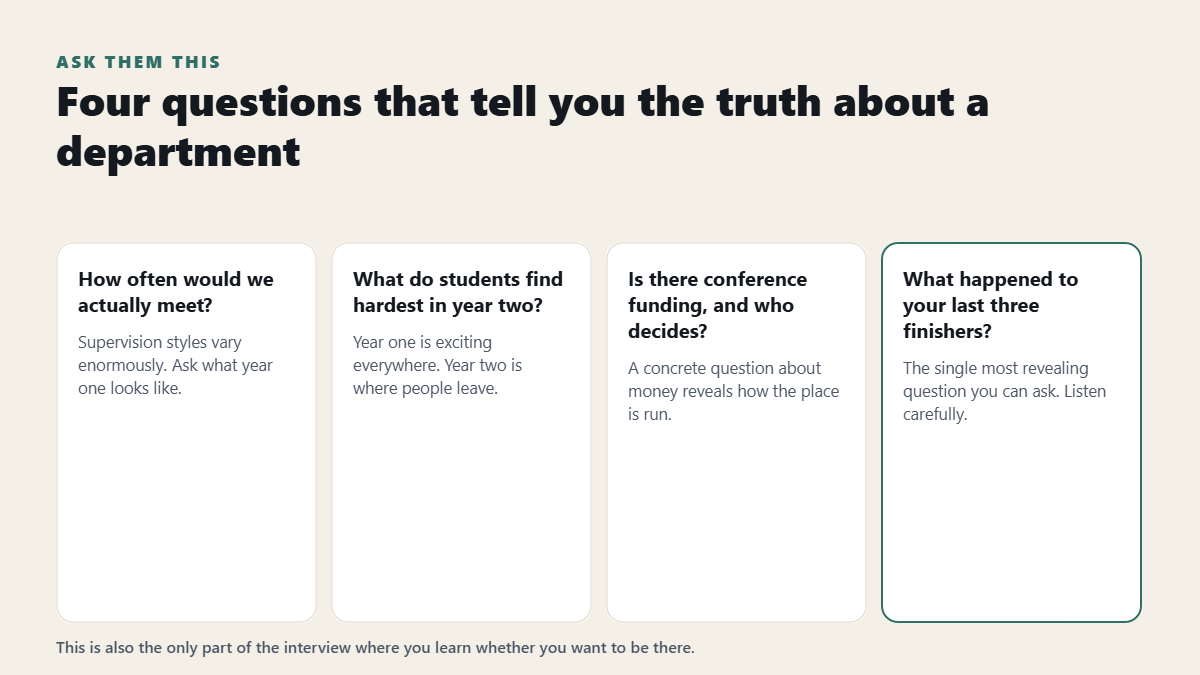
- How often would we actually meet, and what does supervision look like in the first year?
- What do students here find hardest in year two?
- Is there funding for conferences, and who decides?
- What happened to the last three people who finished?
That last one is worth asking. The answer tells you more about a department than any prospectus.
The two mistakes that cost people places
Talking about the degree instead of the work. Excitement about "being a researcher" is not the same as excitement about a research question. The panel can hear the difference immediately.
Not being able to explain your own dissertation simply. You will be asked. If you cannot say what you did, what you found, and what you would change in about ninety seconds, that is the thing to practice first — not the clever questions.
Practice the answers out loud, once
Everything above is easy to nod at and hard to do live. Academic panels have a particular way of asking a hard question in a very gentle voice, and it is disarming if you have never heard it.
So do one run before the day. Say the answers aloud — to a friend, to a recording, to an empty room. You are not memorizing; you are finding out which sentences fall apart when they leave your head.
If nobody is free at nine on a Tuesday, RehearseAI will run the interview for you: real questions for the program and stage, asked out loud, with feedback on what you said and how you said it. Every account gets one free 5-minute interview a month, no credit card required, enough to run the five questions above once.
Quick answers
How long should a grad school interview answer be? One to two minutes. Panels ask a lot of questions and will cut you off if you run long, which throws people.
Should I bring notes? A single page with your questions for them is fine and looks prepared. Reading your own answers is not.
What if I do not know something they ask? Say so, then say how you would find out. Bluffing in front of specialists ends badly.
Do they expect me to have read the supervisor's work? Yes, at least the recent, relevant pieces. Not all of it — but enough to ask one real question about it.
Sources
The advice above lines up with what university career centers publish; these are the ones I checked it against:
- Graduate School and Academic Interviews — Career Services, College of Natural Sciences, UT Austin
- Grad school interview questions and how to prepare — University of Cincinnati
- Common Graduate & Professional School Interview Questions — Tulane University Career Services
The STAR method works for the "tell us about a setback" style of question here too. More on why I built this.
Interviewing for a medical residency instead? Start with residency interview questions. Not sure where you stand yet? Take the two-minute interview quiz.