RehearseAI
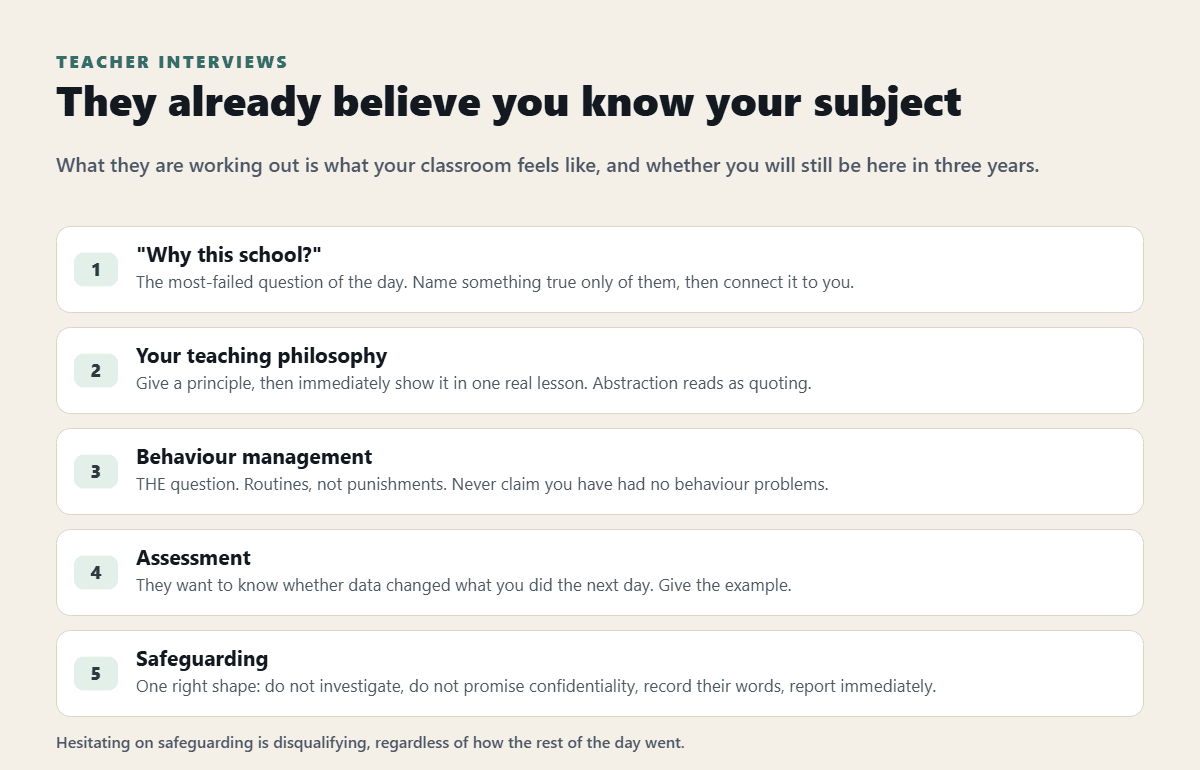
Teacher interviews are unusual in that the panel already believes you know your subject. Your qualification and your degree settled that before you walked in.
What they are working out is different: what your classroom actually feels like, and whether you will still be here in three years.
Almost every question is a route into one of those. Once you see that, the answers stop being about educational theory and start being about specifics.
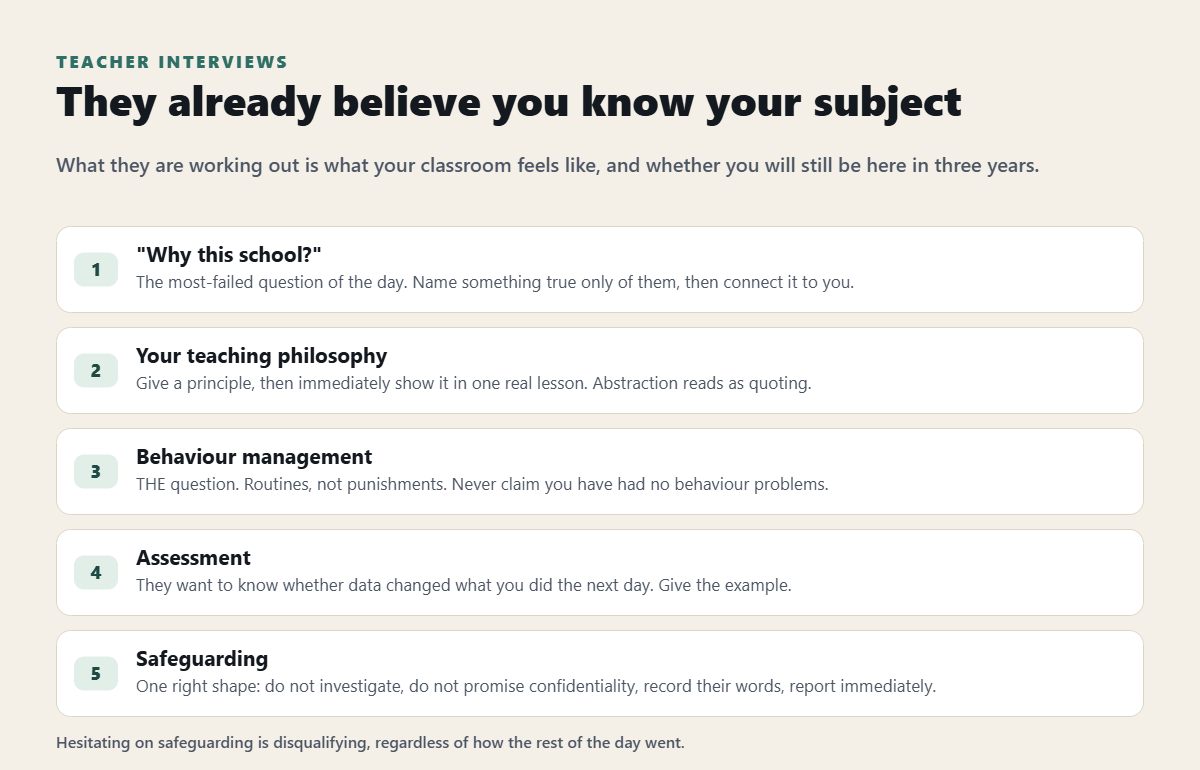
"Why do you want to teach here?"
The most-failed question on the day, because generic answers are transparent when a panel is seeing eight candidates.
Name something true only of this school. Their intake, a program they run, something in their most recent school report card, the fact that it is a particular kind of community. Then connect it to something specific about you.
If you have visited or done a tour, mention what you actually noticed. It is worth more than praise.
"Describe your teaching philosophy"
The trap here is abstraction. A panel that hears "student-centered learning" and "high expectations for all" with nothing underneath assumes you are quoting.
Give a principle, then immediately show it in a lesson:
"I plan backwards from what I want them to be able to do by Friday, not from an activity. Last semester with my ninth graders that meant cutting a group task I liked, because it was generating discussion but not the writing skill the unit was actually for."
The specific detail is what makes the principle credible.
"How do you manage behavior?"
This is the question. Every panel is quietly assessing whether your classroom will need someone else's help.
They want to hear routines rather than punishments: clear expectations set early, consistency, low-key interventions before formal ones, and relationships as the foundation rather than the discipline ladder. Give one real example of a difficult class or student and what changed over time.
Never suggest you have never had behavior problems. It reads either as inexperience or as not noticing.
"How do you use assessment?"
They want to know whether data changes what you do the next day.
Talk about the difference between checking understanding mid-lesson and formal assessment, and give an example where a result made you reteach something. "I marked a set of books and realized the misconception was mine to fix, not theirs" is a strong answer.
"How would you support a struggling student?"
Cover the practical layers: identifying it early, adapting within the lesson, looping in the special education team, contacting home, and tracking whether the support worked. Panels are checking that you act rather than refer and forget.
"How do you work with parents?"
Especially important for pastoral roles. Communicate early and about good things too, not only problems. Be factual and specific in a difficult conversation. Keep the school's line while being human.
The child-safety question
There will be one, and there is only one right shape of answer.
You do not investigate, you do not promise confidentiality, you do not delay. You record what was said in the student's own words, and you report it to your principal or designated child-protection contact immediately, because teachers are mandated reporters.
Say it in that order, plainly. Hesitation here is disqualifying regardless of how the rest of the day went.
If there is a lesson observation
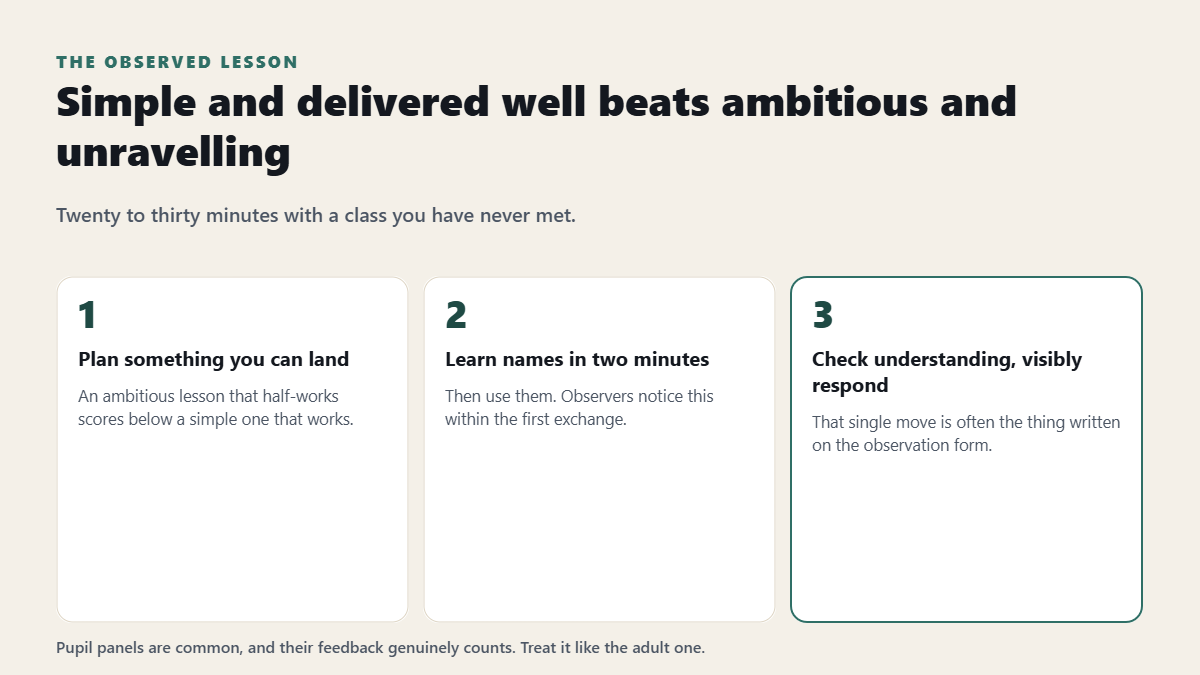
Most teaching interviews include one, usually twenty to thirty minutes with a class you have never met.
Plan something simple that you can deliver well rather than something ambitious that could unravel. Learn a few names in the first two minutes and use them. Build in a moment where you check understanding and visibly respond to what you find — that single move is often what observers write down.
Rehearse the three that decide it
Behavior management, child safety, and why this school. Out loud, ninety seconds each.
Those three carry most of the weight, and all three are ones where teachers know the content perfectly and still deliver it as a vague paragraph because they have never said it aloud under pressure.
If you want the follow-ups — "and what if the parent disagreed?" — RehearseAI asks them out loud for the role and stage and tells you afterward where the answer sagged. Every account gets 10 free practice minutes a month — one 10-minute interview, or shorter sits whenever you like, no credit card required.
Quick answers
How long is a teacher interview day? Often most of a day: a lesson observation, a tour, a student panel, then the formal interview.
Will students interview me? Frequently, and their feedback genuinely counts. Treat it as seriously as the adult panel.
What should I bring? A portfolio of lesson plans, assessments and student work if you have one. Panels rarely ask, and it helps when they do.
What if I am a first-year teacher? Lean on your placements with specifics. Panels expect new teachers to be developing, not finished.
<!-- related-guides -->Related guides
If this was useful, these are the next ones to read:
- Common Interview Questions and How to Answer Them: The 15 most common interview questions, what each one is really checking, and the answer shape that works for it, with links to the full answer for the hard ones.
- Flight Attendant Interview Questions: How cabin crew recruitment really works, why the group exercise cuts most people, and the safety answers that cannot be soft.
- Internship Interview Questions and Answers: What internship interviews are really assessing when everyone knows you have no experience, and how to convert that question instead of apologizing for it.
- Grad School Interview Questions, and How to Answer: The five questions almost every graduate program asks, what the panel is really assessing, and the four questions worth asking them back.
Sources
The advice above lines up with what university career centers and professional bodies publish; these are the pages I checked it against:
- Teacher Interview Questions — Washburn University Career Engagement
- Sample Interview Questions (Education section) — University of Toledo Rocket Career Center
- Mandatory Reporting of Child Abuse and Neglect — Child Welfare Information Gateway
Behavioral questions here fit the STAR method. More on why I built this.