RehearseAI
Flight attendant recruitment is unlike almost any other hiring process. It is competitive, it usually happens in groups, and the assessors are watching you continuously — including during the coffee break, which is not a break.
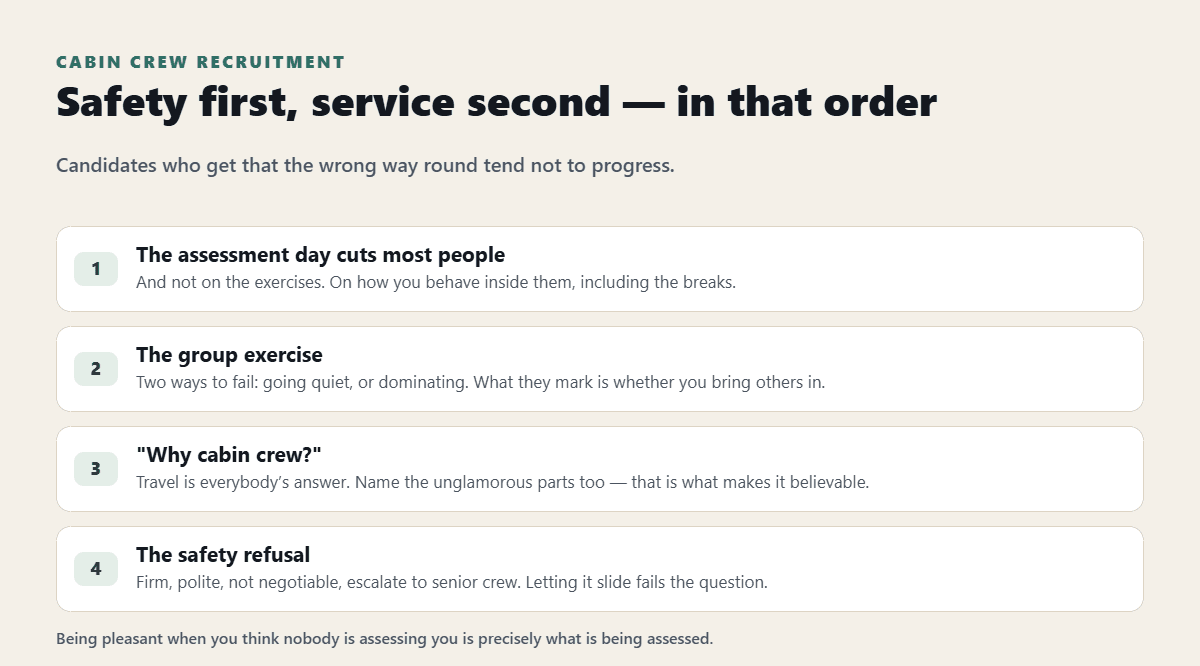
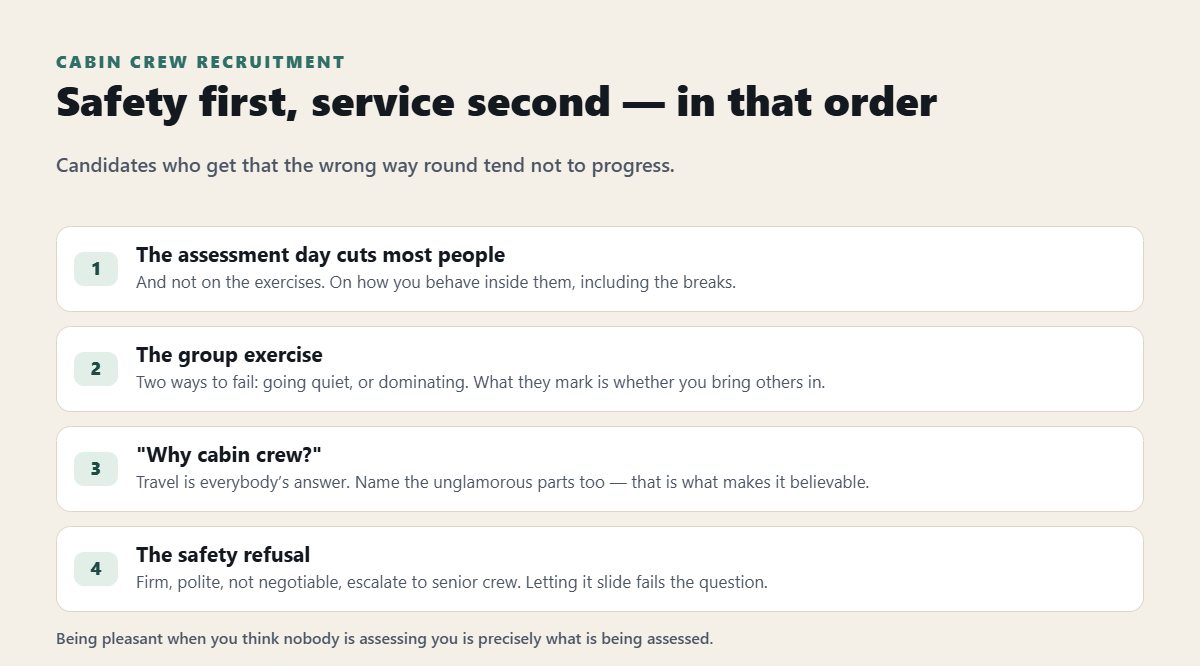
The role is safety first and service second, and candidates who get that the wrong way round tend not to progress. Everything below follows from it.
The format, so nothing surprises you
Most airlines run some version of: an online application and video interview, then an assessment day with group exercises, then a one-to-one interview. Some add a reach test and a swim test.
The assessment day is where most people are cut, and it is not really about the exercises. It is about how you behave inside them.
The group exercise, and how people fail it
You will be put in a group and given a task with no clean answer.
There are two reliable ways to fail. One is going quiet and letting it happen around you. The other, more common, is dominating — talking over people, pushing your solution, treating it as a competition with the other candidates.
What assessors actually mark is whether you bring other people in. Asking someone who has not spoken what they think scores better than having the best idea in the room. On an aircraft, the crew has to function as a unit within minutes of meeting, and they are looking for exactly that.
Also: talk to people during the breaks. Being pleasant when you think nobody is assessing you is precisely what is being assessed.
"Why do you want to be cabin crew?"
Travel is a real reason and everybody says it, so it cannot be your whole answer. Assessors have heard it several hundred times.
Add the parts that show you know what the job is: irregular hours, a new crew most days, physically demanding work, being responsible for people's safety. Naming the unglamorous side makes the glamorous part believable.
"Why this airline?"
Name something concrete — their network, their culture, a specific experience you had as a passenger, the base you are applying to. Generic praise is transparent when they are interviewing hundreds of people.
The safety questions
"A passenger refuses to follow a safety instruction. What do you do?"
This must be firm. Explain the reason briefly, remain polite, and make it clear the instruction is not negotiable. Escalate to the senior crew member if it continues. Any answer that involves letting it slide to avoid a scene fails.
"How would you handle a medical situation onboard?"
Alert the senior crew, follow the procedure, use the onboard equipment, ask whether there is a medical professional among the passengers, and know that the captain makes the diversion decision. Nobody expects clinical expertise. They expect calm and process.
The service questions
"A passenger is unhappy about their seat."
Listen, acknowledge, explain what you can and cannot do, offer whatever is genuinely available. Do not promise an upgrade you cannot deliver.
"Tell me about a time you delivered great service."
Have one specific story with an ending. Retail, hospitality, care work — all of it counts.
What they are watching all day
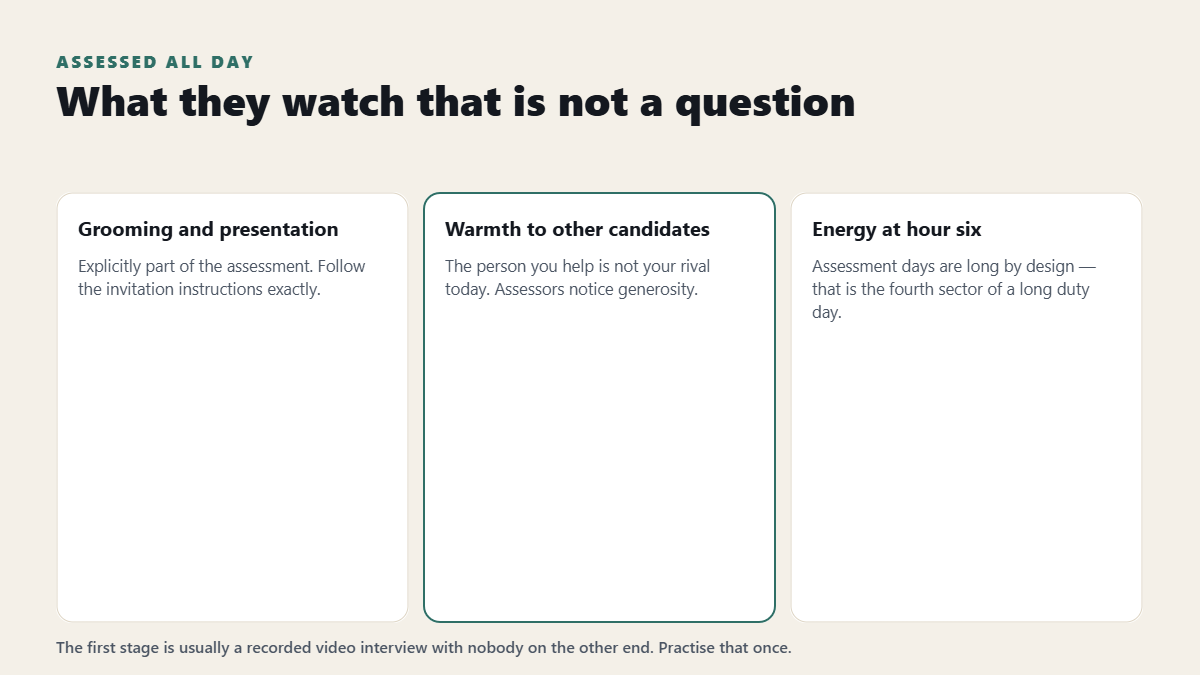
Grooming and presentation. It is part of the assessment and airlines are explicit about it. Follow whatever the invitation says precisely.
Whether you are warm to other candidates. The person you help in the group exercise is not your rival for the day. Assessors notice generosity.
Energy at hour six. Assessment days are long by design. They want to see who is still pleasant at the end, because that is the fourth sector of a long day on the aircraft.
Practice the video interview especially
The first stage is usually recorded with no human present — a prompt, a timer, and your own camera. It is a strange thing to do cold, and it is where a lot of strong candidates fall out.
Record yourself answering "why do you want to be cabin crew" three times and watch one back. The third take is the one they should have got.
If you want real questions and honest feedback on pace and delivery, RehearseAI runs it out loud for the role. Every account gets 10 free practice minutes a month — one 10-minute interview, or shorter sits whenever you like, no credit card required.
Quick answers
How long is the recruitment process? Often several weeks from application to offer, with a training course after that.
Do I need a second language? Not always, but it helps considerably at many airlines and can be the deciding factor.
Is there a height or reach requirement? Most airlines have a reach test rather than a height rule, to confirm you can access overhead equipment.
What if I have no aviation experience? Almost nobody does. Customer-facing work, teamwork and staying calm are what transfer.
<!-- related-guides -->Related guides
If this was useful, these are the next ones to read:
- Common Interview Questions and How to Answer Them: The 15 most common interview questions, what each one is really checking, and the answer shape that works for it, with links to the full answer for the hard ones.
- Internship Interview Questions and Answers: What internship interviews are really assessing when everyone knows you have no experience, and how to convert that question instead of apologizing for it.
- Grad School Interview Questions, and How to Answer: The five questions almost every graduate program asks, what the panel is really assessing, and the four questions worth asking them back.
- Project Manager Interview Questions and Answers: The project manager interview questions that come up most, what each one is really testing, and how to answer with a real project and not a methodology lecture.
Sources
Organizations and career centers worth reading alongside this post:
- Federal Aviation Administration
- Careers — United Airlines
- Interview Preparation — Career Engagement, University of California, Berkeley
Recorded first rounds work like a HireVue interview. Behavioral answers fit the STAR method. More on why I built this.