RehearseAI
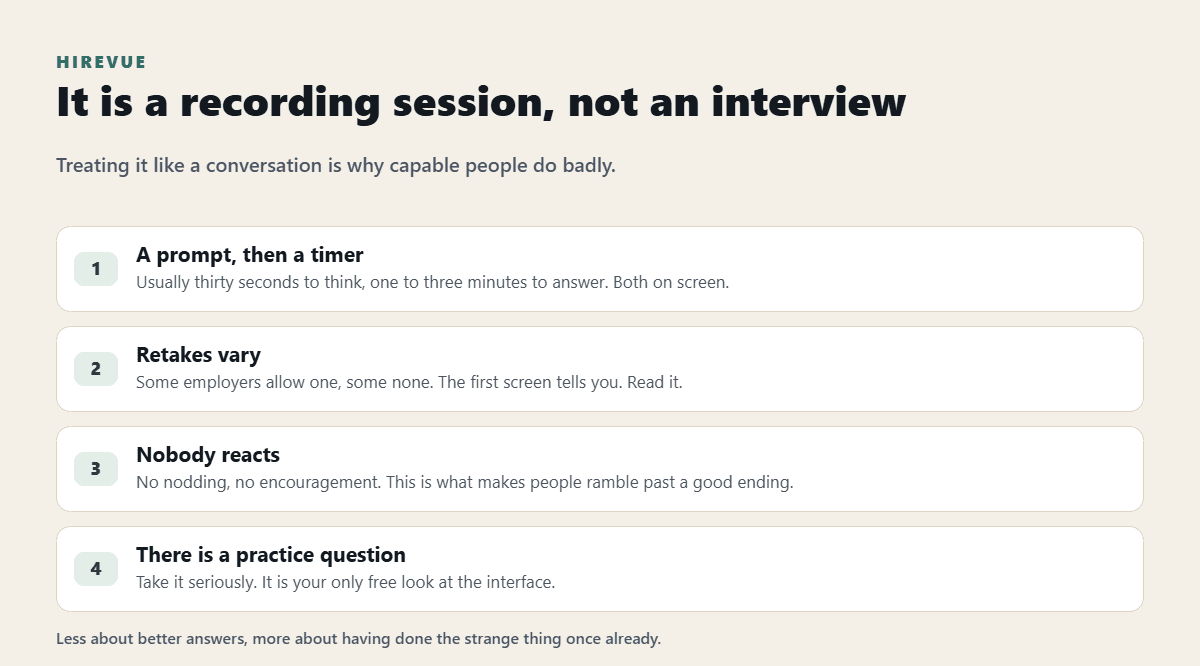
A HireVue interview is not really an interview. It is a recording session that happens to use interview questions, and treating it like a conversation is why capable people do badly at it.
There is usually no human on the other end while you record. A prompt appears, a short thinking timer runs, and then you talk to your own camera for two minutes. Sometimes you get a retake. Often you do not.
Practicing for it is less about knowing better answers and more about getting used to a genuinely strange experience before it counts.
What the format actually is
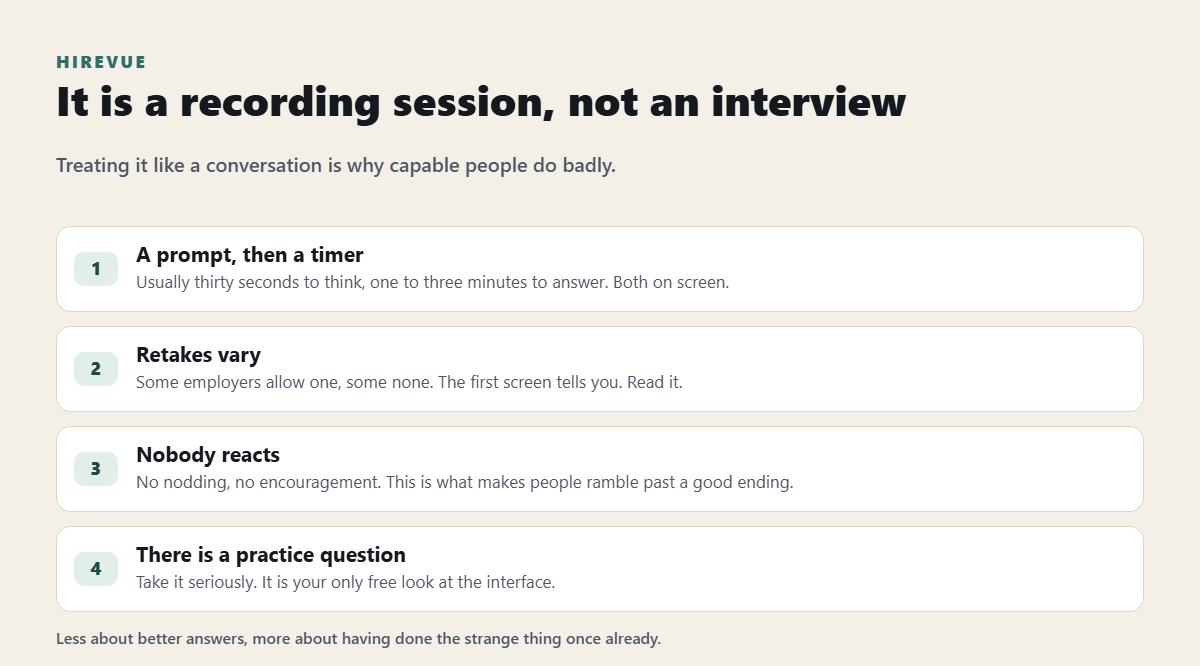
A prompt, then a timer. Usually thirty seconds to think and one to three minutes to answer. Both are shown on screen.
Sometimes a practice question first. Take it seriously — it is your only free look at the interface.
Retakes vary. Some employers allow one, some none. The instructions on the first screen tell you. Read them, because assuming wrongly is a bad way to lose an answer.
No reaction. Nobody nods. This is the thing that makes people ramble, and simply knowing it in advance takes most of the sting out.
How to practice, specifically
Reading answers does not prepare you for this. Recording does.
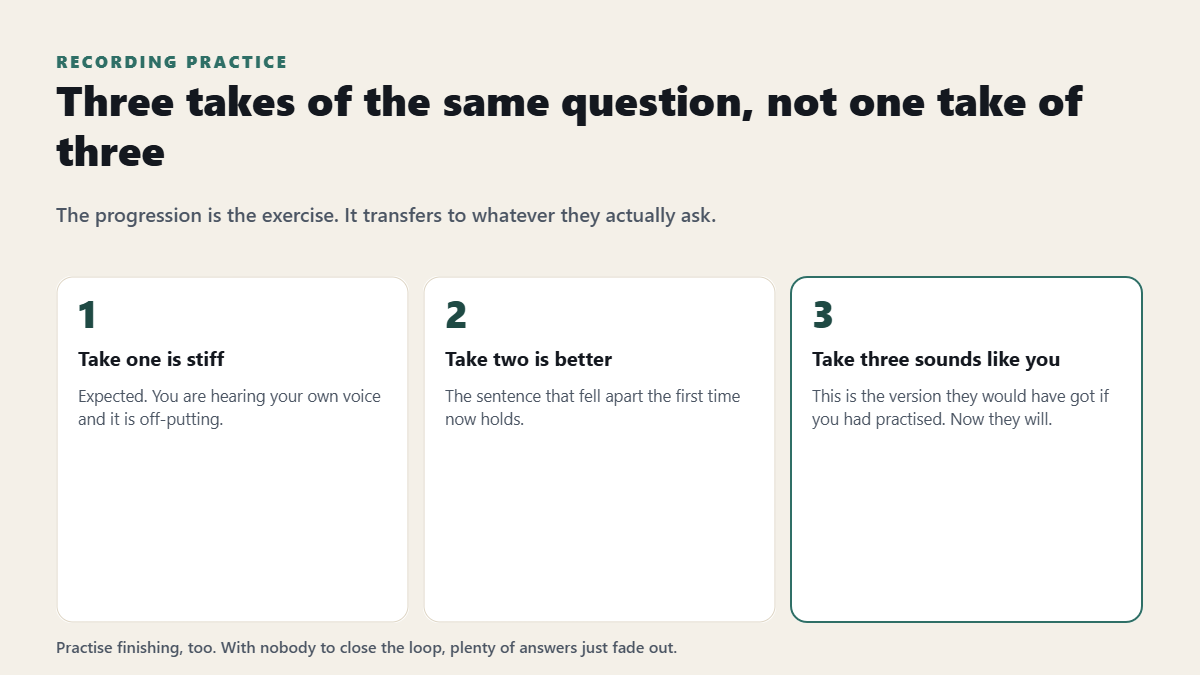
Do at least three recorded takes. Not of different questions — of the same question. The first is stiff, the second is better, the third sounds like a person. That progression is the whole exercise, and it transfers to whatever they actually ask.
Practice against a timer. Set ninety seconds on your phone and answer until it goes. Most people's instinct is badly calibrated: they either finish in twenty-five seconds or get cut off mid-sentence.
Watch one take back. Only one. Note three things: where you looked away, any filler word you used repeatedly, and whether you actually answered the question or circled it.
Practice finishing. With no interviewer to close the loop, plenty of answers just fade out. Have a landing sentence — "so the outcome was…" — and practice saying it. A clean ending is disproportionately memorable on video.
The setup, which is worth fifteen minutes
- Light in front of you. Face a window or a lamp. Light behind you makes a silhouette.
- Camera at eye level. Books under the laptop. Looking down reads as tired.
- Look at the lens, not your own face. Hard, and it is what makes it feel like eye contact.
- Test the microphone. Record ten seconds, play it back. Poor audio ends more of these than poor answers.
- Close everything else. Notifications during a recorded answer are unrecoverable.
- Have water, out of frame. Two minutes of talking is drier than you expect.
What they ask
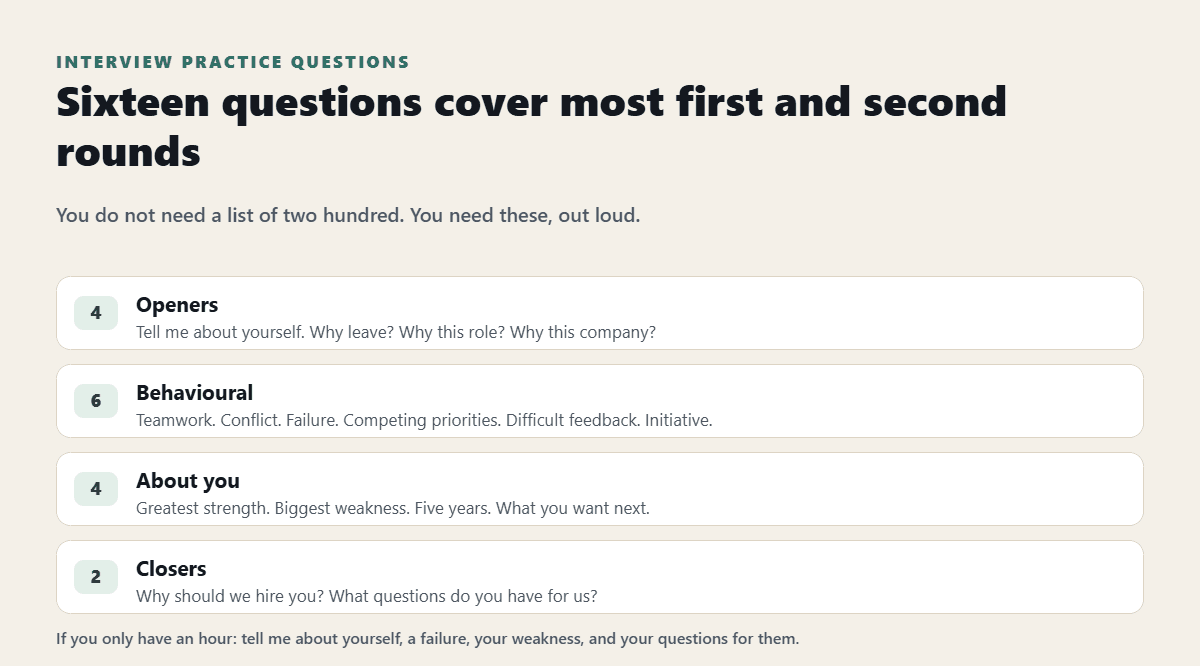
Standard behavioral material — a time you solved a problem, a time you worked in a team, why this company, a time you failed, how you handle competing priorities.
The efficient preparation is not one answer per question. It is three real stories, each known in four lines, which you can point at whichever prompt appears. Under a thirty-second timer, choosing a story is achievable; writing one is not.
Use the STAR shape so each story has an ending. Endings matter more here than in a live interview, because nothing else signals that you are finished.
<!-- expanded-2026-10-24 -->Sample HireVue questions, and how to answer each
Employers write their own prompts, but most draw from the same short list. For each one, the thing to decide in the thirty-second timer is which of your three stories fits.
"Tell me about yourself." Sixty to ninety seconds: what you do now, the two or three things in your background that matter for this role, one result, and why this company. Say the company's name once.
"Why do you want to work here?" One specific reason that is true of them and not of their competitors, connected to one thing about you. "Your stores are open 24 hours and I've worked nights before" beats a paragraph about values.
"Tell me about a time you worked on a team to achieve a goal." Pick the story where your part is clearest. Say what the team was doing, what you specifically did, and what happened. The camera cannot see the team, so name your piece.
"Tell me about a time you failed or made a mistake." Pick a real one, keep the setup to one sentence, spend most of the time on what you did next and what you changed. End on the change, not the failure.
"Describe a time you had to manage competing priorities." Say what the two things were, how you decided which came first, who you told, and what the outcome was. The deciding rule is what they want to hear.
"Where do you see yourself in five years?" Direction, not a job title. Something you want to be good at, and one reason this role moves you toward it.
A ninety-second answer, with the clock
Here is how a timed behavioral answer should spend its seconds. The numbers matter more on video than in a room, because there is nobody to rescue a long one.
- 0 to 10 seconds, the setup. "In my last job I ran the morning shift at a coffee shop, and in March we lost two of five staff in the same week."
- 10 to 55 seconds, what you did. Three or four concrete actions. Rewrote the schedule, moved the slowest task off the rush hour, trained the two newest people on one station each, asked the owner for a temp for Saturdays.
- 55 to 80 seconds, the result. One or two numbers if you have them. "We kept wait times under four minutes through the month and nobody else quit."
- 80 to 90 seconds, the landing. "So the outcome was that the shift held together, and I learned to cut the task list before cutting people's hours."
If you run long, it is almost always the setup. Cut it to one sentence and the rest fits.
Common HireVue mistakes
- Reading. Eyes tracking left to right are obvious on video. Bullet prompts only, placed next to the lens.
- Looking at your own face. The preview window is a trap. Cover it with a sticky note if you have to.
- Finishing in twenty seconds. The timer is a ceiling, not a target, but a thirty-second answer to a two-minute prompt reads as thin. Add the result and the landing sentence.
- Restarting mid-take. Unless the employer allows retakes, a stumble you talk through sounds human. A visible restart sounds worse.
- Flat energy. With no one reacting, people drift quieter. Sit up, speak a notch louder than feels natural, and let your face move.
- Treating the practice question as a throwaway. It is your only free look at the timers and the interface.
The day of: a ten-minute checklist
- Charge the laptop and plug it in anyway.
- Close every other app and silence the phone in another room.
- Light in front, camera at eye level, plain background.
- Record ten seconds and play it back for audio.
- Three bullet prompts for your three stories, taped beside the lens.
- Water out of frame.
- Say one full answer out loud before you start, so the first recorded sentence is not your first spoken sentence of the day.
Then do a real run
Everything above is easy to agree with and only works if you actually record yourself once. Almost nobody does, which is exactly why one run puts you ahead.
If you would rather have real questions and honest feedback than sit judging your own footage, RehearseAI runs the interview out loud for the role and stage, then tells you about pace, filler and whether the answer landed. Every account gets 10 free practice minutes a month — one 10-minute interview, or shorter sits whenever you like, no credit card required, enough for a couple of full takes.
Quick answers
How long is a HireVue interview? Usually fifteen to thirty minutes, with four to eight questions.
Can I use notes? A few bullet points off-camera are fine. Reading is very visible on video, so keep it to prompts.
Does HireVue score my face or voice? Practices vary by employer and have changed over time. Assume a human reviews the recording and focus on being clear rather than on gaming anything.
What if I fumble the first sentence? Keep going. A recovered answer sounds human. Restarting mid-take usually sounds worse than the fumble did.
What should I wear? What you would wear to the interview in person, minus busy patterns — they shimmer on camera.
Can you retake a HireVue? It depends on the employer's settings, not on HireVue. Some employers allow one re-record per question, some allow none, and the instructions on screen tell you which before you start. Treat every take as the only one, and use the practice questions HireVue offers beforehand to get the nerves out.
<!-- related-guides -->Related guides
If this was useful, these are the next ones to read:
- Mock Interview Practice: How to Improve Your Answers and Timing: Most interviews are lost on pacing, not knowledge. How to get your answers into the sixty to ninety second window, and handle the follow-up without unraveling.
- Target Video Interview Questions and Setup: The questions in Target's video interview, why the format is harder than the questions, and the fifteen minutes of setup that changes your result.
- Phone Interview Tips and Questions: Why phone interviews are harder than they feel, what recruiters are screening for, and the five minutes of setup that changes how you sound.
- What Is a Mock Interview? Meaning and What to Expect: What a mock interview is, in plain words: who runs one, what happens in the room, how long it takes, and how to prepare so the practice is worth your time.
Sources
Organizations and career centers worth reading alongside this post:
- HireVue
- Types of Interviews — UConn Center for Career Readiness
- Interview Preparation — Career Engagement, University of California, Berkeley
More on why I built this, or read the rest of the blog.