RehearseAI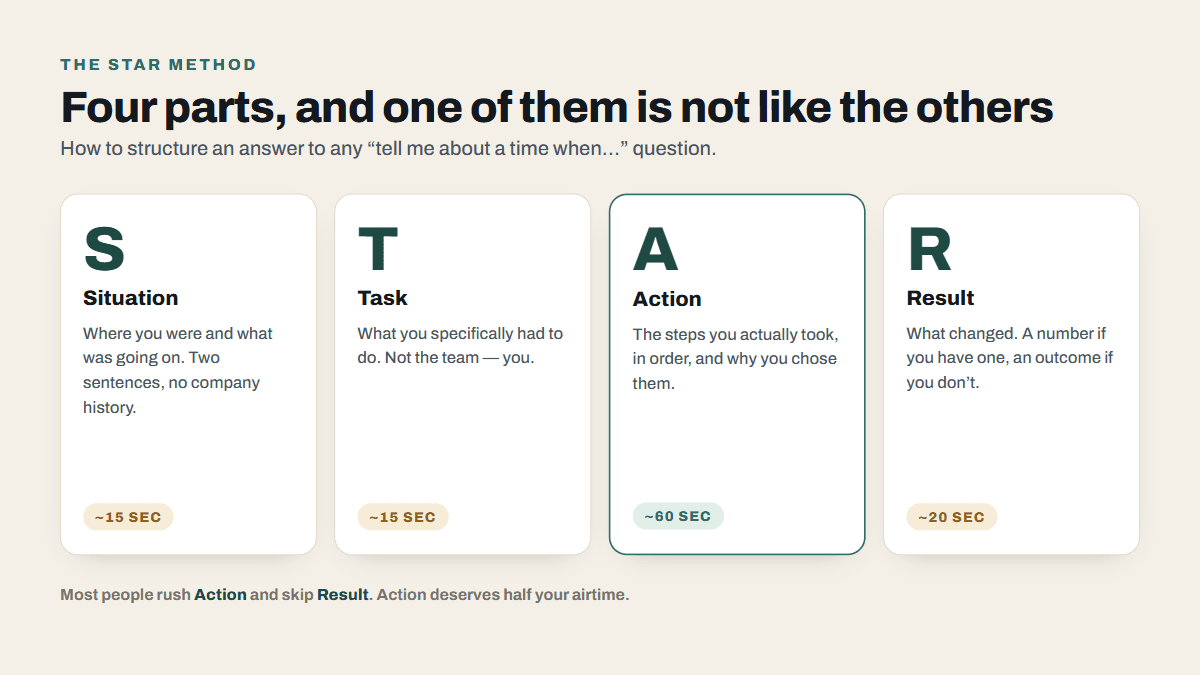
There is a moment in most interviews where the whole thing quietly turns. The interviewer leans back and says: "Tell me about a time when…"
And you start talking. And somewhere around the fourth sentence you realize you have no idea where this story is going, and neither does the person listening.
I know that moment well. I spent years on both sides of it — twenty of them in corporate leadership, plenty of them getting the rejection email that always seems to arrive at 4:45 on a Friday. What surprised me most as a hiring manager wasn't how many candidates couldn't do the job. It's how many obviously could, and still lost it in the first eight minutes, because they'd never said any of it out loud before.
The STAR method interview answer is the fix. Not a trick, not a script — just a shape that keeps a good story from falling apart on the way out of your mouth.
What is the STAR interview method?
STAR is an acronym for the four parts of a complete answer to a behavioral question:
- Situation — where you were, what was going on
- Task — what you were responsible for
- Action — what you actually did
- Result — what changed because you did it
That's it. The STAR method of interviewing isn't a personality test or a corporate ritual. It exists because interviewers are trying to predict what you'll do in a job they can't show you, and the only honest evidence available is what you've already done somewhere else. A story with all four parts gives them that evidence. A story missing two of them gives them a nice feeling and nothing to write down.
The four parts, and how long each should take
The proportions matter more than the letters. Here's the split that works:
| Part | What goes in it | Roughly how long |
|---|---|---|
| Situation | Where you were and what was going on | 15 seconds |
| Task | What you specifically were responsible for | 15 seconds |
| Action | The steps you took, in order, and why | 60 seconds |
| Result | What changed because you did it | 20 seconds |
Notice how lopsided that is. Action gets more airtime than the other three combined, and that's deliberate. Situation and Task are scene-setting — they exist so the Action makes sense. If you spend ninety seconds explaining your company's org chart, you've spent your whole answer on the part nobody is evaluating.
Result is the part people skip most, usually out of modesty. Don't. An answer without a Result is a story about effort. An answer with one is a story about impact.
Same story, two answers
Here is the difference, using the same candidate and the same underlying experience:
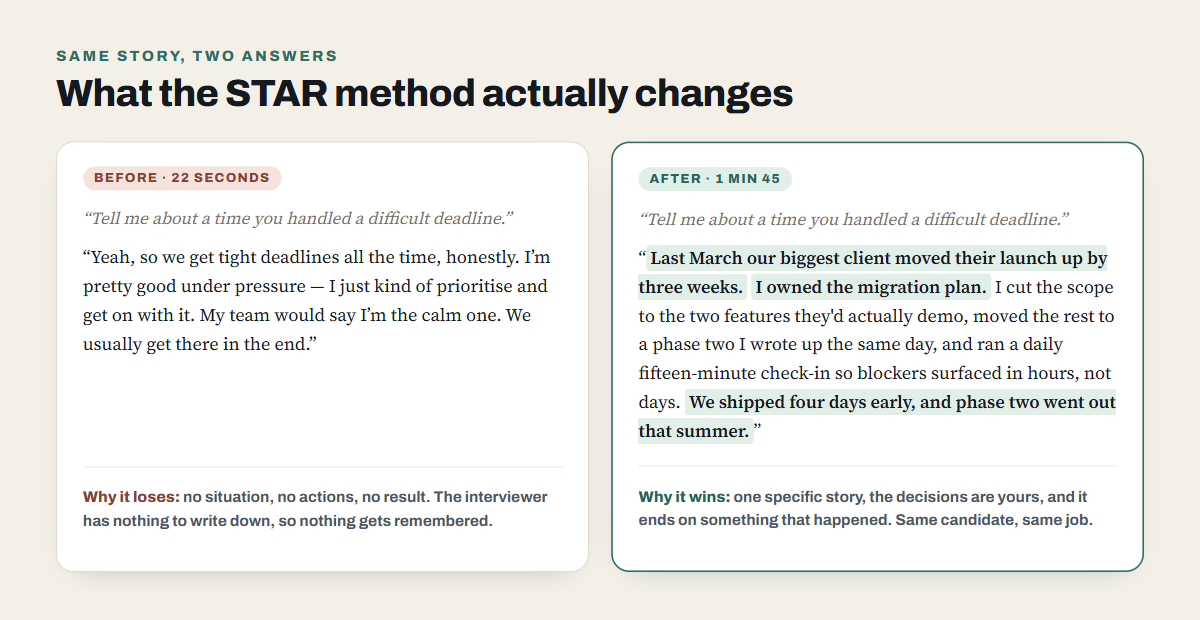
The left-hand answer isn't dishonest. It's not even badly delivered. It's just unusable — there's nothing in it a hiring manager could repeat to a colleague an hour later. The right-hand one is memorable because it's specific, and it's specific because it has a shape.
Three STAR method examples you can borrow the shape of
Don't borrow the content. Borrow the skeleton.
"Tell me about a time you disagreed with your manager."
Situation: Our team was about to commit to a vendor I thought was wrong for us. Task: I had two days to either get on board or make the case against it. Action: I put together a one-page comparison — cost over three years, the two integrations we'd lose, and what switching later would cost. I asked for fifteen minutes rather than raising it in the group meeting, so it wasn't a public fight. Result: We went with the other vendor. My manager started asking me to pressure-test the next two decisions.
"Tell me about a time you failed."
Situation: I owned a launch that slipped by six weeks. Task: I'd committed to a date without checking whether the design team had capacity. Action: I told the stakeholders in week two rather than week five, rebuilt the plan around what design could actually take on, and started running a capacity check before any date got promised. Result: We shipped six weeks late, which was my fault. But no date I gave after that one slipped, and the capacity check became how the team planned.
"Tell me about a time you led without authority."
Situation: Two teams were duplicating the same reporting work and neither would drop it. Task: Nobody had asked me to fix this. I just kept getting both versions. Action: I mapped where the numbers diverged, took it to both leads separately with the differences rather than an opinion, and offered to own the merged version myself for one quarter. Result: One report instead of two, and I handed it off cleanly at the end of the quarter.
Notice the failure example. It ends on a Result, and the Result is honest. STAR doesn't require the story to have gone well — it requires it to have gone somewhere.
Where the STAR method goes wrong
Five mistakes, in the order I saw them most often:
- The Situation swallows the answer. Two sentences. If the interviewer needs more, they'll ask.
- "We" instead of "I". Team players say "we". Hiring managers are trying to work out what you did. Use "we" for context and "I" for your actions.
- No Result at all. The story just stops. Always land the plane, even if the landing is "it worked, and here's how we knew."
- A made-up number. If you don't have a metric, don't invent one — a real outcome beats a fake percentage, and a good interviewer can smell the difference.
- Rehearsing it as a script. Memorized answers sound memorized. The point of STAR methods is to remember the shape, so you can build the story live and still sound like a person.
The part nobody tells you: you have to say it out loud
You can read this whole page, nod along, and still fall apart in the room. I did, repeatedly.
Reading a framework and performing it under pressure are different skills. The words come out in a different order when someone is looking at you. You hear yourself say "I'm a people person" and think who is talking right now?
So the actual work is rehearsal, and rehearsal has a supply problem. The mirror doesn't ask follow-ups. Your friends are too kind to tell you your answer went nowhere. And nobody volunteers for round four of behavioral questions at nine o'clock on a Tuesday.
That's the gap RehearseAI was built to close: real questions for the actual role and stage, asked out loud, with honest feedback afterwards on what you said and how you said it. Every account gets one free 5-minute interview a month, no card, enough to take one or two STAR answers for a run before the interview that matters.
Whether you practice with us, a patient friend, or a voice recorder on your kitchen table — practice out loud. That's the whole difference.
Quick answers
How long should a STAR answer be? Between ninety seconds and two minutes. Under sixty and it's thin; over three and you've lost the room.
Do I need a STAR answer for every question? No. Use it for anything that starts "tell me about a time", "give me an example", or "describe a situation where". Straight factual questions don't need it.
How many stories should I prepare? Five or six flexible ones beat twenty rigid ones. A single good story usually answers three or four different questions depending on which part you emphasize.
What if I don't have a great example? Use a small one told well. A modest story with a clear Result outranks an impressive story with no shape.
What does STAR stand for? Situation, Task, Action, Result. Two sentences of Situation to set the scene, one sentence of Task so the interviewer knows what you were responsible for, then most of your time on the Action you personally took, and a Result you can measure or at least describe. If you remember one thing, remember that the Action is the answer and the rest is the frame.
Which interview questions expect a STAR answer? Anything that opens with "tell me about a time", "give me an example of", "describe a situation where", or "walk me through how you handled". The twelve that come up most:
- Tell me about a time you disagreed with your manager.
- Tell me about a time you missed a deadline.
- Give me an example of a goal you reached, and how.
- Describe a situation where you had to persuade someone.
- Tell me about a mistake you made and what you did next.
- Tell me about a time you had to learn something quickly.
- Describe a conflict on your team and your part in resolving it.
- Give me an example of going beyond what was asked.
- Tell me about a time you had too much to do and not enough time.
- Describe a decision you made with incomplete information.
- Tell me about a time you received hard feedback.
- Tell me about a time you led without being the manager.
Five or six stories, told well, cover all twelve. Practice them out loud; the free question generator will pull the ones your specific posting is likely to ask.
STAR vs CAR vs SOAR: is one better? They are the same idea with the letters moved. CAR (Challenge, Action, Result) folds Situation and Task into one, which suits short answers. SOAR (Situation, Obstacle, Action, Result) makes you name what was in the way, which suits questions about setbacks. STARR adds a second R for Reflection, what you would do differently, and interviewers at large companies increasingly listen for it. Pick one and stop worrying about the acronym; the interviewer is scoring the Action and the Result, not the framework.
Sources
The advice above lines up with what university career centers publish; these are the ones I checked it against:
- The STAR Method for Behavioral Interviews — MIT Career Advising & Professional Development
- STAR Method of Interviewing — University of Washington Career & Internship Center
- STAR Method Behavioral Interviews — University of Cincinnati Career Education
Interviewing is a separate skill from the job itself — and, unlike most things, it's one you can rehearse. More on why I built this, or read the rest of the blog.
To find the behavioral questions your specific role is likely to ask, run the posting through the free question generator.
Heading into a technical screen? The same four steps carry the story questions in .NET Core interview questions and data engineer interview questions.