RehearseAI
"What is your biggest weakness?" is the most-dreaded question in interviewing, and the reason is that everyone can feel the trap without being able to name it.
Say something real and you seem to be arguing against your own case. Say something fake and you sound like every other candidate. So people reach for the disguised strength — I work too hard, I care too much, I am a perfectionist — and the interviewer writes something down that is not in your favor.
Here is what the question is actually for, and how to answer it without either lying or damaging yourself.
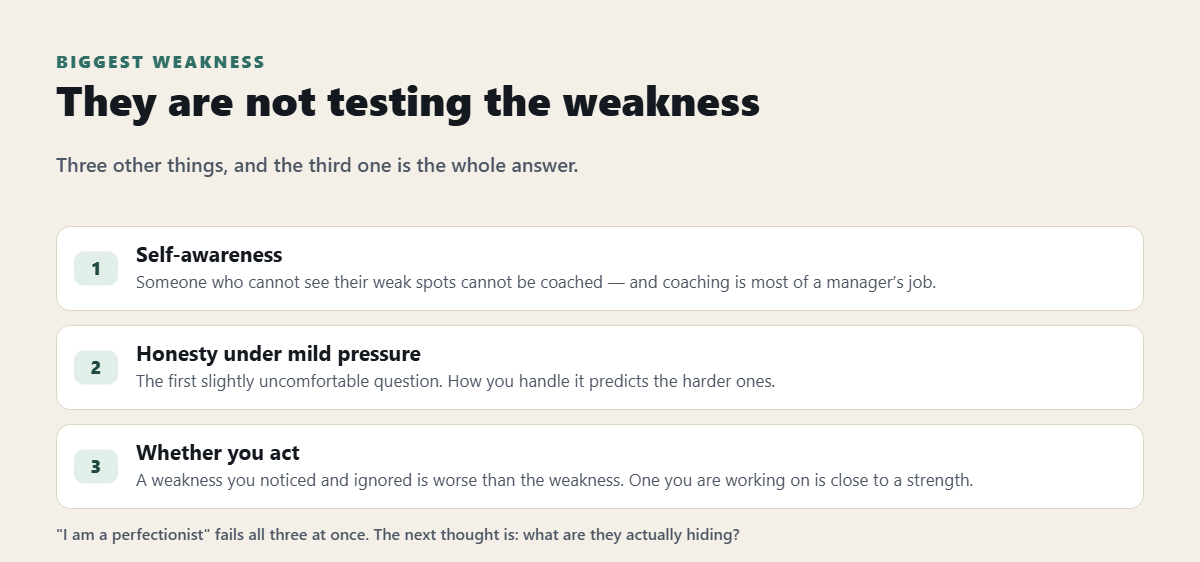
What they are really testing
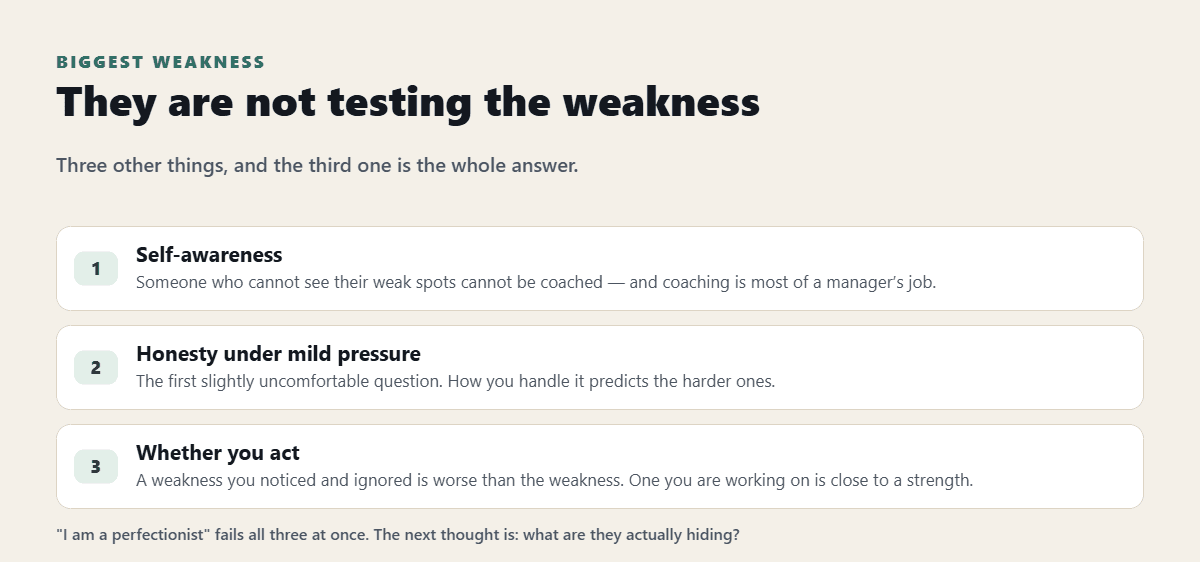
Not the weakness. Three other things:
Self-awareness. Can you look at your own work honestly? Someone who cannot see their weak spots cannot be coached, and coaching people is most of a manager's job.
Honesty under mild pressure. This is the first slightly uncomfortable question in most interviews. How you handle it predicts how you will handle a harder one.
Whether you act. A weakness you have noticed and done nothing about is worse than the weakness. A weakness you are actively working on is close to a strength.
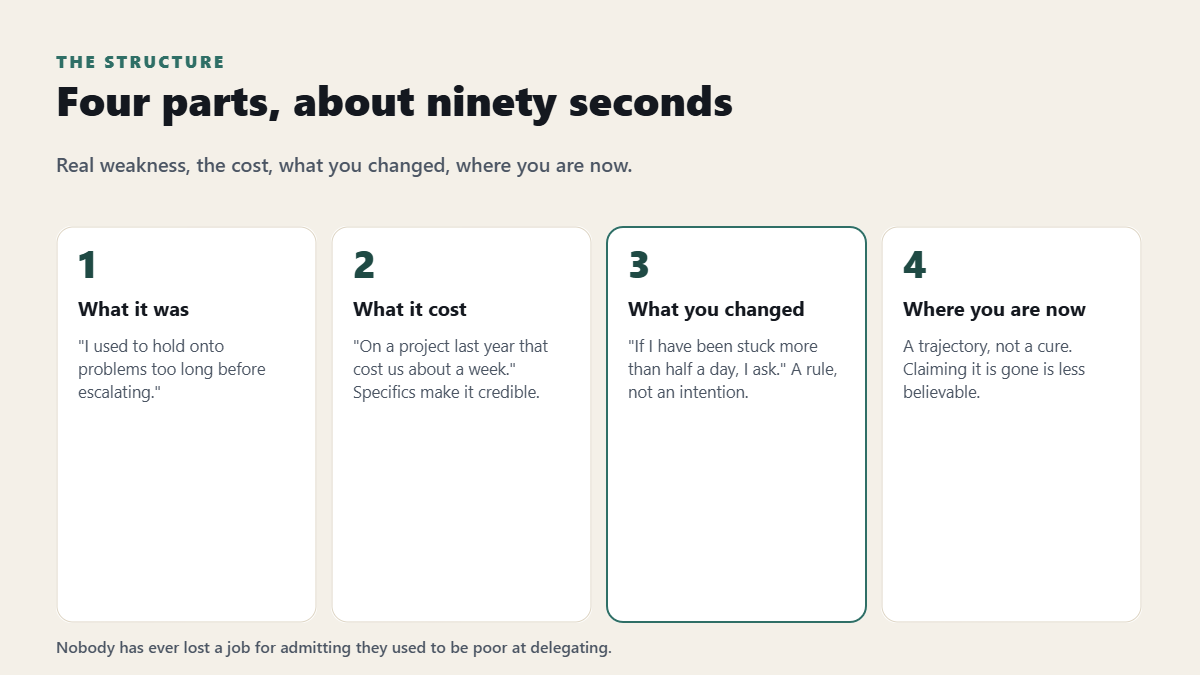
That third point is the whole answer. The structure that works is: a real weakness, the impact you noticed, what you changed, where you are now.
Why "I'm a perfectionist" fails
Interviewers have heard it thousands of times, and it fails on all three tests at once. It is not self-aware, it is not honest, and it demonstrates no action.
The same applies to "I work too hard", "I care too much", and "I take on too much because I want to help". They register as evasion, and the interviewer's next thought is: what are they actually hiding?
Answering honestly is genuinely lower risk. Nobody has ever lost a job for admitting they used to be poor at delegating.
What a good answer sounds like
"I used to hold onto problems too long before escalating. I thought asking early looked like I could not handle it. On a project last year that cost us about a week, because I spent days on something a colleague had already solved. So I gave myself a rule: if I have been stuck for more than half a day, I ask. It felt uncomfortable for about a month and now it is just how I work — and I have started asking my own reports the same question."
Four parts, roughly thirty seconds each: what it was, what it cost, what you changed, where you are now.
Notice the ending. It does not claim the weakness is gone. It shows a trajectory, which is more believable and more useful.
Choosing which weakness to name
Two rules.
It must be real. You will be asked a follow-up, and invented weaknesses have no detail behind them.
It must not be the core of the job. Do not tell a data analyst interview that you are careless with numbers, or a customer service panel that you find people draining. Choose something genuine that sits beside the role rather than through the middle of it.
Safe, honest territory for most roles: delegating, saying no to too much work, escalating late, public speaking, being too blunt in writing, impatience with slow processes, over-preparing.
Two variations you should expect
"What would your last manager say you need to work on?" Same question, harder to dodge. Use an actual piece of feedback you were given — that is what makes it credible.
"Tell me about a time you received difficult feedback." Also the same question. The structure is identical: what was said, how you reacted, what changed.
Prepare one honest weakness and it covers all three.
Say it out loud, exactly once
This is the answer people most often deliver badly despite knowing what they want to say, because there is a flinch in the middle of it. You get to "I used to…" and your instinct is to soften, qualify, or joke.
Say the whole thing aloud once. The flinch mostly disappears on the second attempt, and what is left sounds like someone comfortable with themselves — which is exactly the impression the question is designed to test for.
If you want the follow-up asked properly, RehearseAI will push on it the way a real interviewer does and tell you afterward how it landed. Every account gets 10 free practice minutes a month — one 10-minute interview, or shorter sits whenever you like, no credit card required.
Quick answers
How long should the answer be? About sixty to ninety seconds. Long enough for all four parts, short enough not to dwell.
Can I say I have no weaknesses? No. It is the single worst answer available.
Should the weakness be work-related? Yes. Keep it professional and current — something from the last couple of years.
What if my real weakness is central to the job? Then name a genuine one that sits beside it, and be ready to talk honestly if they press. Do not build the interview on a claim you cannot defend.
<!-- related-guides -->Related guides
If this was useful, these are the next ones to read:
- What Are Your Strengths? How to Answer in an Interview: How to answer "what are your strengths?" in a job interview: how to pick the right one, the three-part answer that works, and examples you can adapt.
- Reasons for Leaving a Job: How to Answer in an Interview: Good reasons for leaving a job, the honest one-sentence answer that works in an interview, and how to handle the hard cases: fired, laid off, a bad boss, or burnout.
- Salary Expectations: How to Answer in an Interview: How to answer "what are your salary expectations?" without underselling yourself: three honest ways to respond, how to find your range, and what to put in the desired salary box.
Sources
The advice above lines up with what university career centers and professional bodies publish; these are the pages I checked it against:
- How to answer the "tell me about yourself" and "greatest strength/weakness" questions — Penn Career Services
- Your Greatest Weakness: the dreaded question and how to answer — Bucknell University Center for Career Advancement
Related: behavioral questions and what they test and the STAR method. More on why I built this.