RehearseAI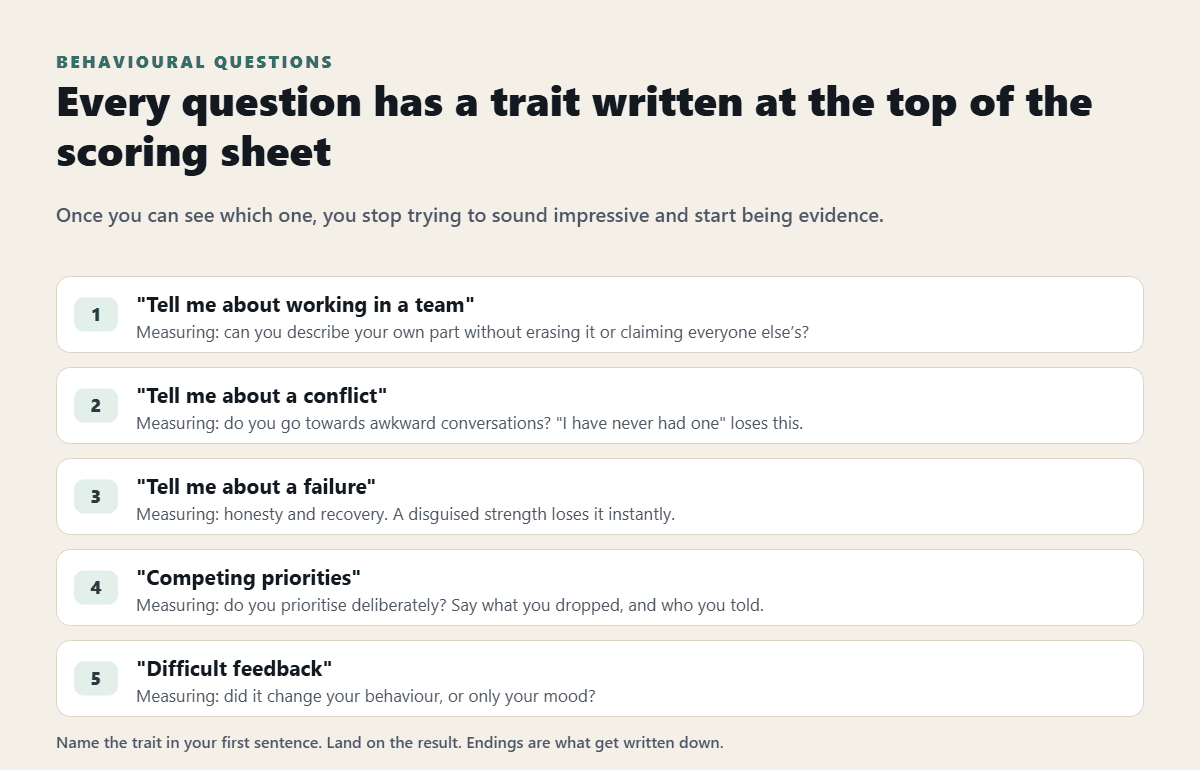
Behavioral questions all sound like invitations to tell a nice story about yourself. They are not. Each one is a specific test, and the person asking usually has a scoring sheet with a trait written at the top.
Once you can see which trait is being scored, the answer becomes much easier to aim. You stop trying to sound impressive and start trying to be evidence.
Here are the behavioral questions that come up most, what each is really measuring, and how to practice them so they survive contact with a real room.
The six you will almost certainly get
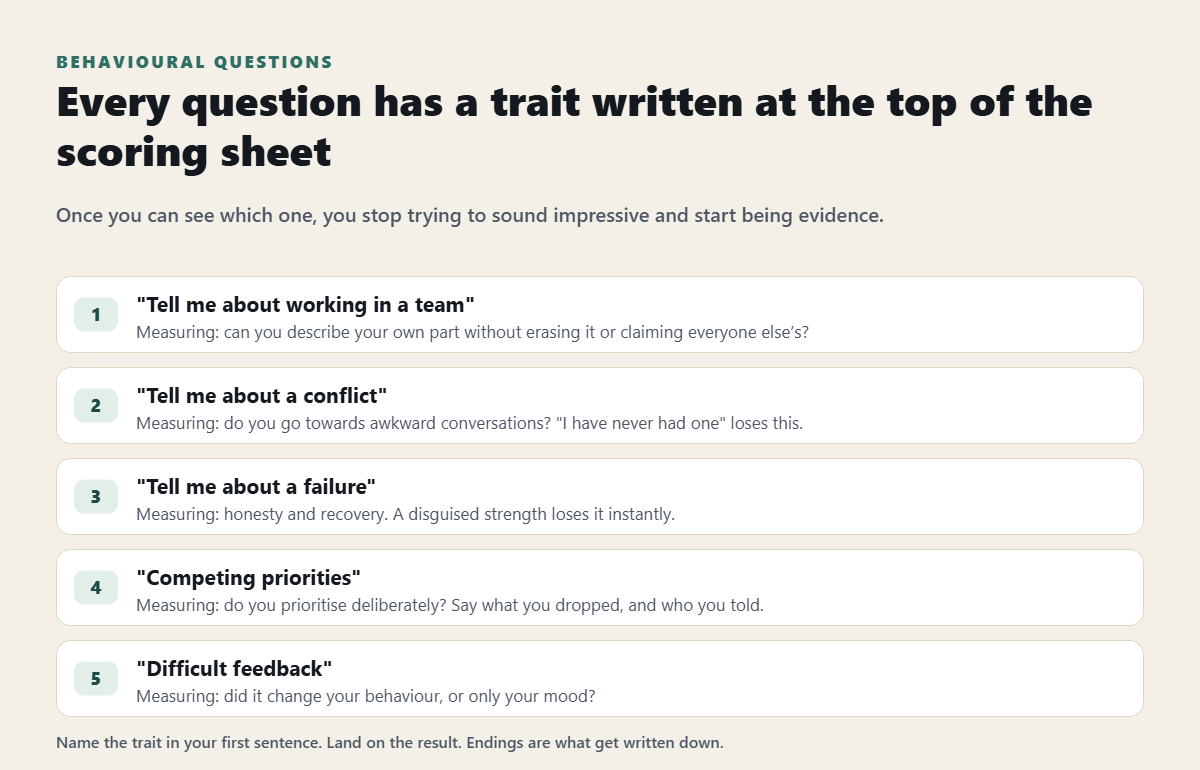
"Tell me about a time you worked in a team." Measuring: whether you can describe your own contribution without either erasing it or claiming everyone else's. Say "we" for context and "I" for your actions.
"Tell me about a conflict with a colleague." Measuring: whether you go towards awkward conversations. The worst answer is "I have never had one" — it means either you avoid them or you are not telling the truth.
"Tell me about a time you failed." Measuring: honesty and recovery. A disguised strength ("I care too much") loses this question instantly. A real failure with a real correction wins it.
"Tell me about a time you handled competing priorities." Measuring: whether you prioritize deliberately or just work faster. Say what you dropped or delayed, and who you told.
"Tell me about difficult feedback you received." Measuring: whether feedback changes your behavior or only your mood. End on what you now do differently.
"Tell me about a time you took initiative." Measuring: whether you act without being asked, and whether you finish. Initiative that fizzles is not initiative.
Answer the question that was asked
The most common way strong candidates lose marks is drift. You are asked about conflict, you tell a story that begins with conflict, and by the end you are describing a product launch.
Two habits fix it:
Name the trait in your first sentence. "The clearest example of handling conflict was…" It anchors you and it tells the interviewer their box is about to be ticked.
Land on the result. Endings are what get written down. An answer that fades out leaves the interviewer with a blank line in their notes.
The STAR structure exists for exactly this — situation, task, action, result, with most of your time in the action.
How to practice behavioral questions properly
Reading your answers is not practice. Three things that are:
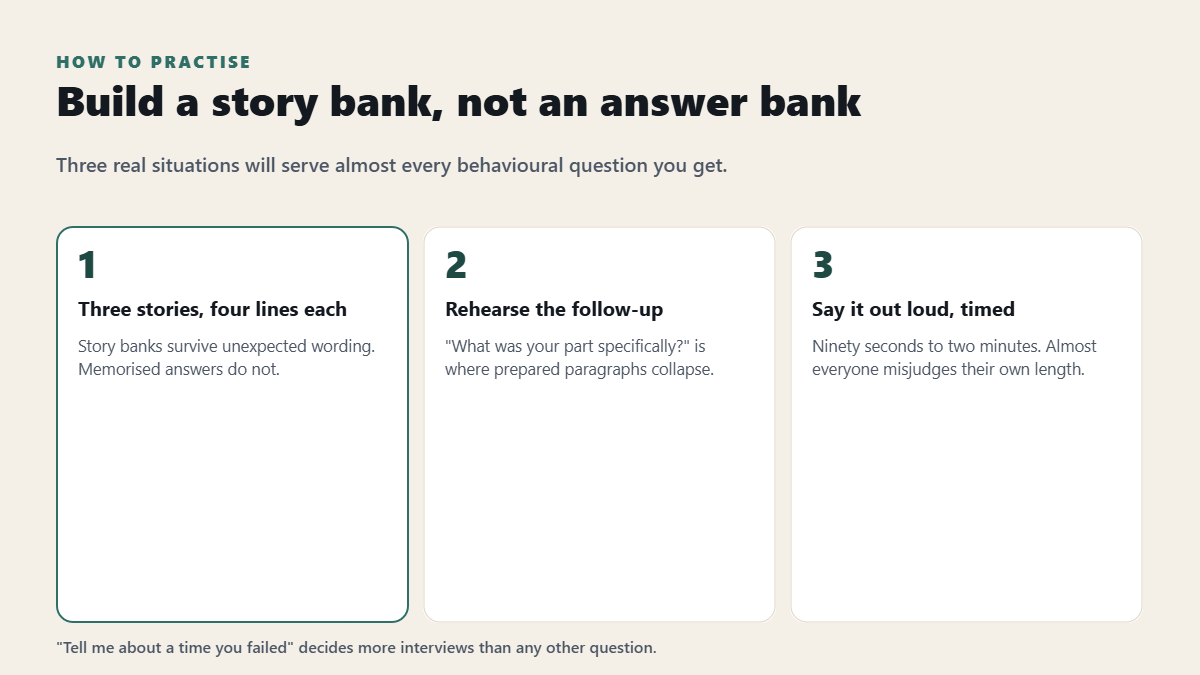
Build a story bank, not an answer bank. Three or four real situations, each written in four lines. Most of the six questions above can be served by one of them, depending on which part you emphasize. Story banks survive unexpected wording; memorized answers do not.
Rehearse the follow-up, not the answer. Real interviewers do not stop at your story. "What would you do differently?" "What did your manager think?" "What was your part specifically?" Those are where prepared answers collapse, because you rehearsed the paragraph rather than the situation.
Say it out loud, timed. Ninety seconds to two minutes. Almost everyone is wrong about their own length until they hear it, and answers that run over three minutes lose the room regardless of quality.
The one that catches everyone
"Tell me about a time you failed" is where most interviews are actually decided, because it is the only question where the temptation to perform is stronger than the temptation to answer.
Pick something real, that was genuinely your fault, that you fixed. Not catastrophic — nobody expects a disaster — just true. Say what happened, say what you did about it, say what you changed. Then stop talking.
Candidates who do this well are memorable precisely because so few people do.
Then rehearse against something that pushes back
The gap in most preparation is that nobody asks the follow-up. A friend will let a vague answer pass out of politeness. A recording cannot ask anything at all.
That is what RehearseAI is for — behavioral questions for the actual role and stage, asked out loud, with follow-ups when you dodge, and feedback afterwards on length, filler and whether the answer landed. Every account gets one free 5-minute interview a month, no credit card required, enough to run your best two stories.
Quick answers
How many stories should I prepare? Three or four flexible ones. Twenty rigid ones is worse, not better.
Can I use the same story for two questions? Once, framed differently, is fine. Twice starts to sound thin.
What if I have no work experience? Use study, volunteering, sport or family responsibility. The structure is identical and interviewers know what a first job looks like.
Should I say "situation" and "task" out loud? No. If they can hear the acronym, it sounds rehearsed. The structure should be invisible.
More on why I built this, or read the rest of the blog.