RehearseAI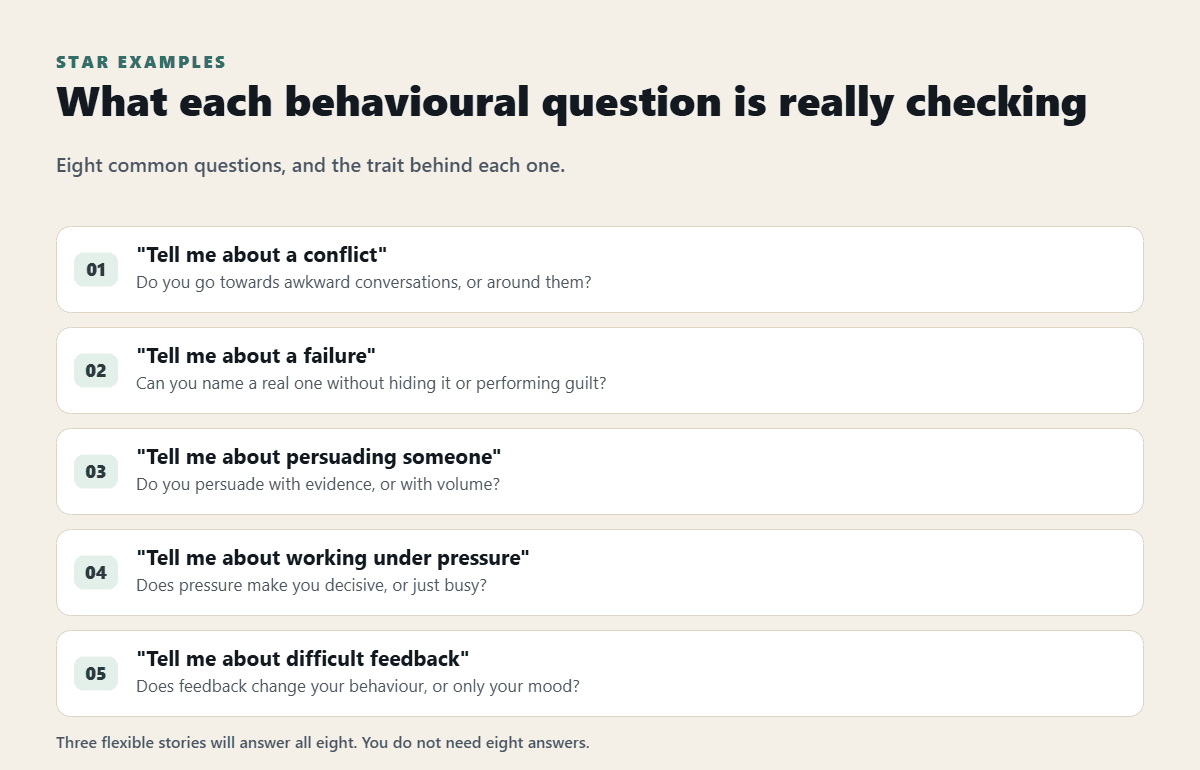
Frameworks are easy to agree with and hard to use. You read what STAR stands for, it makes perfect sense, and then someone asks you about a time you handled conflict and your brain offers you nothing but static.
What actually helps is seeing the shape filled in. So here are STAR method examples for the questions that come up most, with a note on what the interviewer is really checking each time.
Steal the structure. Do not steal the stories — yours will always land better, because you can answer the follow-up.
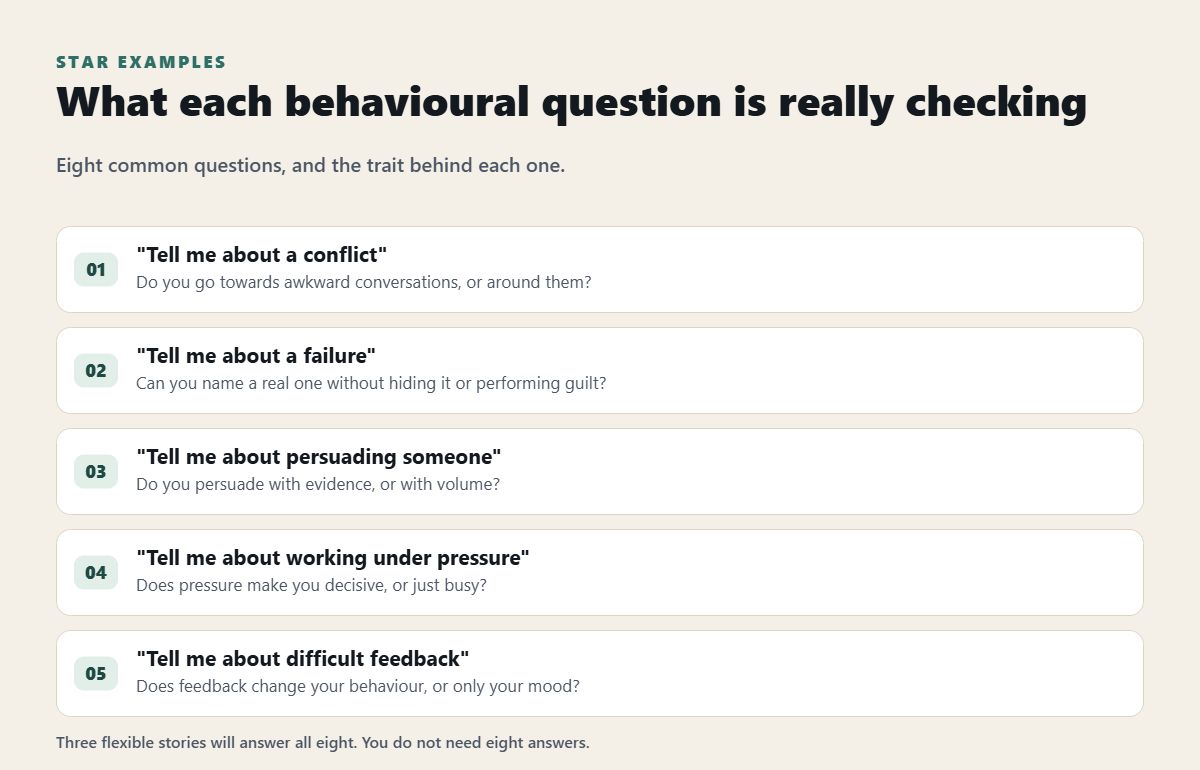
1. "Tell me about a time you handled conflict at work"
Situation: Two people on my team had stopped speaking after a disagreement about who owned a piece of the roadmap. Task: I was the project lead. It was slowing delivery and everyone could feel it. Action: I spoke to each of them separately first, so nobody had to perform in front of the other. Both were right about something and neither had said it plainly. I put the ownership question in writing, proposed a split, and had them both agree to it in one short meeting rather than leaving it verbal. Result: The line held for the rest of the project. They are not friends, but the work moved.
What they are checking: whether you go towards awkward conversations or around them.
2. "Tell me about a time you failed"
Situation: I committed our team to a launch date in a room full of stakeholders. Task: I had not checked whether design had the capacity to hit it. Action: By week two it was obvious we would miss. I said so then, rather than hoping. I rebuilt the plan around what design could genuinely take, cut two features to a phase two, and started checking capacity before promising any date. Result: We shipped six weeks late, which was my fault. No date I gave after that one slipped.
What they are checking: whether you can name a real failure without either hiding it or performing guilt.
3. "Tell me about a time you had to persuade someone"
Situation: We were about to renew a tool nobody on the team actually used. Task: Nobody had asked me to look at it. I just kept seeing the invoice. Action: I pulled the usage numbers, worked out the annual cost per active user, and found two people who did rely on one specific feature. I took the finance lead the numbers plus a migration plan for those two, so it was a decision rather than a complaint. Result: We dropped the tool and moved those two onto something we already paid for.
What they are checking: whether you persuade with evidence or with volume.
4. "Tell me about a time you worked under pressure"
Situation: Our biggest client moved their launch forward by three weeks. Task: I owned the migration plan and had to decide what was still possible. Action: I cut scope to the two features they would actually demo, wrote up the rest as a phase two the same day so it did not feel like a loss, and ran a fifteen-minute daily check-in so blockers surfaced in hours rather than days. Result: We shipped four days early. Phase two went out that summer.
What they are checking: whether pressure makes you decisive or just busy.
5. "Tell me about a time you led without authority"
Situation: Two teams were producing the same report with different numbers. Task: Not my job. But I was the one receiving both versions every Monday. Action: I mapped exactly where the figures diverged and took that to each lead separately — the differences, not an opinion about who was wrong. Then I offered to own one merged version for a quarter. Result: One report instead of two. I handed it off cleanly at the end of the quarter.
What they are checking: whether you can move things without a title to lean on.
6. "Tell me about a time you received difficult feedback"
Situation: My manager told me my written updates were so long nobody read them. Task: I disagreed at first. I thought I was being thorough. Action: Rather than argue, I asked two colleagues what they actually read. Both said the first two lines. So I moved the decision and the ask to the top and pushed detail into an appendix nobody had to open. Result: Replies got faster. I now write everything that way.
What they are checking: whether feedback changes your behavior or just your mood.
7. "Tell me about a time you missed something important"
Situation: A pricing change went out with the old figure still on one page. Task: I had approved the change and had not checked every surface. Action: I found it within a day, fixed it, contacted the eleven customers who had seen the wrong number and honoured the lower price for them. Then I wrote a short checklist of every place a price appears. Result: Eleven refunds, no complaints, and the checklist caught a second one two months later.
What they are checking: whether your instinct is to cover or to correct.
8. "Tell me about a time you had to learn something quickly"
Situation: The person who ran our reporting left with two weeks' notice. Task: I had to keep the weekly numbers going without them. Action: I sat with them for three sessions and recorded each one. I rebuilt the two reports myself while they were still there to correct me, and wrote the steps down as I went rather than afterwards. Result: No week was missed. The notes meant the next person needed one session, not three.
What they are checking: whether you learn systematically or just cope.
More "tell me about a time" interview questions
The eight above are the ones you will hear most. Interviewers have plenty of others, and every one of them wants the same four-part answer. Here are twelve more "tell me about a time" interview questions worth a glance:
- Tell me about a time you disagreed with your manager.
- Tell me about a time you missed a deadline.
- Tell me about a time you went beyond what was asked.
- Tell me about a time you had too much to do and not enough time.
- Tell me about a time you made a decision without all the information.
- Tell me about a time you had to deliver bad news.
- Tell me about a time you dealt with a difficult customer.
- Tell me about a time you changed your mind.
- Tell me about a time you worked with someone you found difficult.
- Tell me about a time you set a goal and reached it.
- Tell me about a time you improved a process.
- Tell me about a time you had to adapt to a big change.
You do not need twelve new stories. Read down the list and, for each question, decide which story you already have that you would reach for.
The same questions also arrive in different clothes: "give me an example of," "describe a situation where," "walk me through how you handled." Treat every one of them as "tell me about a time."
Turning these into your own
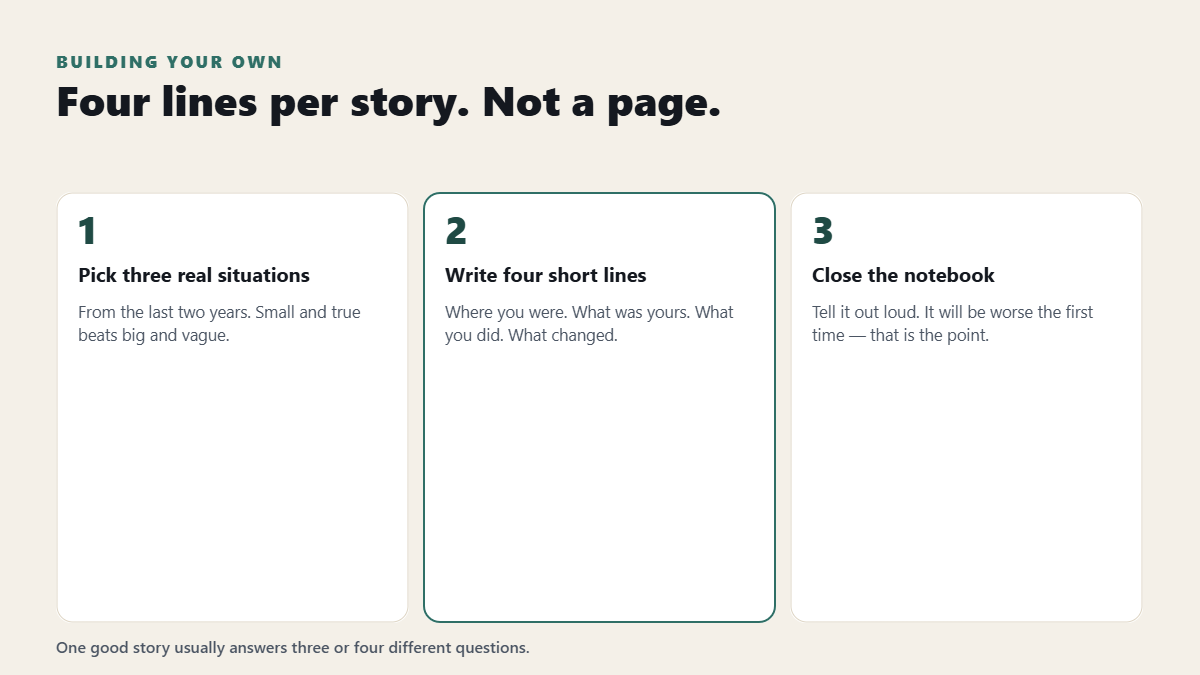
Take three real situations from the last two years. For each one, write four short lines — where you were, what was yours to do, what you did, what changed. Four lines, not a page.
Then notice something useful: one good story usually answers three or four of the questions above, depending on which part you lean on. The conflict story is also a persuasion story. The failure story is also a feedback story. You do not need eight answers. You need three flexible ones.
Then say them out loud
This is where most preparation stops, and it is the part that actually decides the interview. A story that reads well on paper can still come out sideways when a stranger is looking at you and you are trying to sound relaxed.
So read your four lines once, then close the notebook and tell the story to the room. It will be worse the first time. That is the point — better it happens in your kitchen than in the interview.
If you want the follow-up questions too, RehearseAI will ask them out loud, in the voice of the role you are applying for, and tell you afterwards what landed. Start your free 5-minute interview — no card, and it is enough to run one of your three stories out loud.
Quick answers
Do I need a different story for every question? No. Three or four flexible stories cover most behavioral interviews. Emphasize a different part depending on what is asked.
Can I use the same story twice in one interview? Once is safe if you frame it differently. Twice starts to sound like you have only had one job.
What if the interviewer interrupts my STAR answer? Let them. Answer what they asked, then offer the Result — "and the outcome was…" — so the story still lands.
Should I say the words "situation" and "task" out loud? No. The structure should be invisible. If they can hear the acronym, it sounds rehearsed.
Sources
The advice above lines up with what university career centers publish; these are the ones I checked it against:
- The STAR Method for Behavioral Interviews — MIT Career Advising & Professional Development
- STAR Method — Tippie College of Business Career Guide, University of Iowa
- STAR Method of Interviewing — University of Washington Career & Internship Center
If you want the framework itself rather than the examples, start with the STAR method, step by step. Or read more about why I built this.
Want examples closer to your own role? Try networking interview questions and Splunk interview questions.