RehearseAI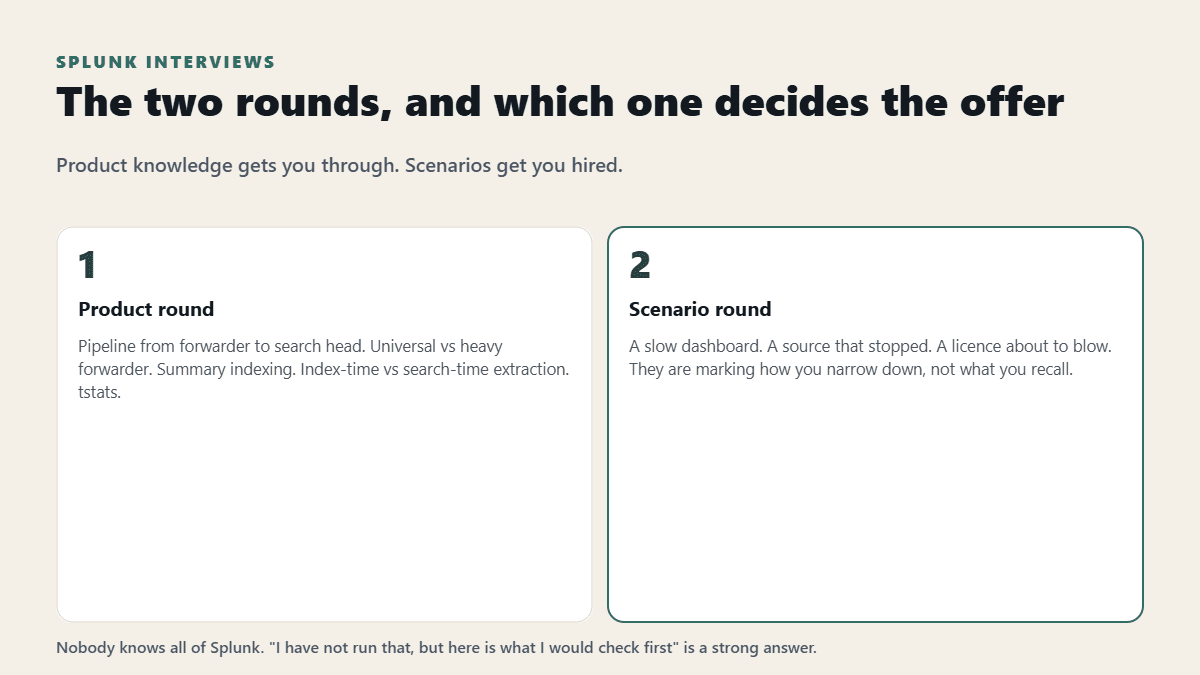
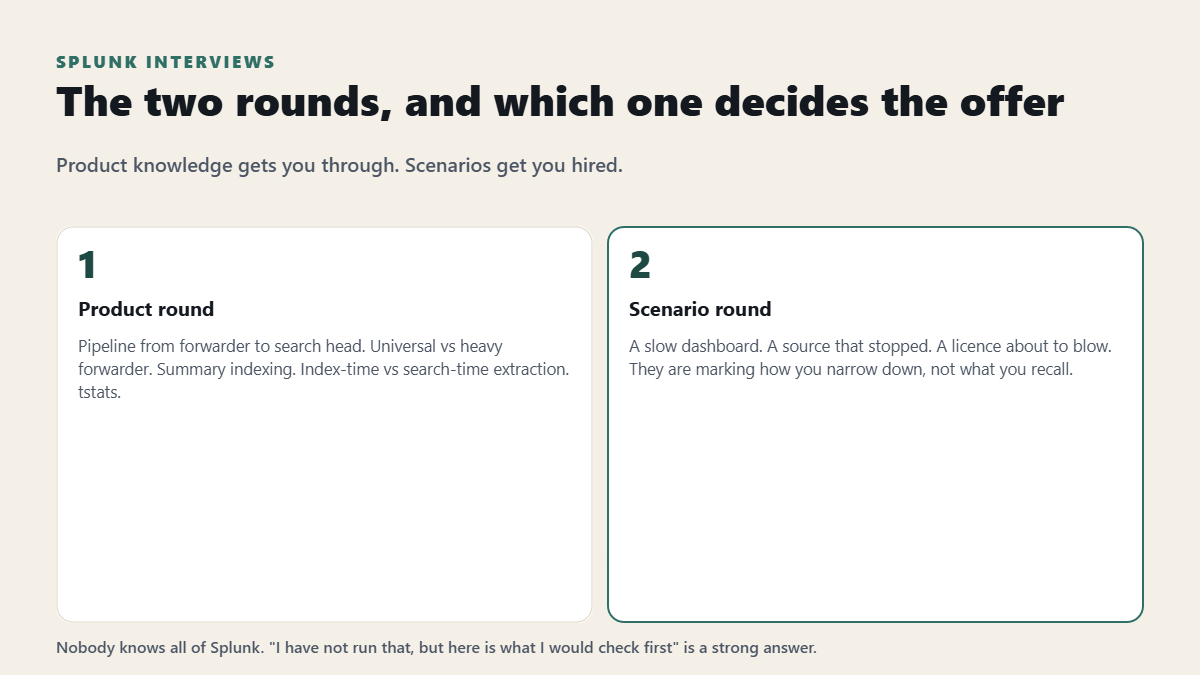
Splunk interviews have a particular shape. There is usually a round of "do you know the product" questions, then a much more revealing round where someone describes a messy situation — data not showing up, a search taking four minutes, a dashboard nobody trusts — and watches how you think.
The first round you can revise for. The second is where offers are decided.
Here are the questions that actually come up, what each one is really testing, and how to answer without either bluffing or drowning the room in detail.
The product questions
"Walk me through what happens to an event between the forwarder and the search head."
The single most common opener, because it separates people who have run Splunk from people who have read about it. Cover input, parsing, indexing and search — and name where things usually go wrong (parsing, almost always: timestamps and line breaking).
"What is the difference between a universal forwarder and a heavy forwarder?"
Short answer: the universal forwarder just ships raw data and is light; the heavy forwarder parses first, which costs CPU but lets you filter or route before anything is indexed. Then add the judgment bit — you reach for a heavy forwarder when you need to drop noise or mask sensitive fields before it hits the index.
"What is a summary index and when would you use one?"
They want to hear that you understand cost. Summary indexing pre-computes expensive aggregations so a dashboard is not re-scanning months of raw events every time somebody opens it.
"How do index-time and search-time field extraction differ, and which do you prefer?"
The correct answer includes a preference and a reason. Search-time is the default for a reason — it is flexible and does not bloat the index — but index-time earns its place for fields you filter on constantly.
"What does the tstats command do, and why does it matter?"
Because it queries indexed metadata rather than raw events, it is dramatically faster on large ranges. Mentioning it unprompted signals that you have had to make slow searches fast for real.
The scenario questions
This is the part worth preparing properly, because the answer is a process, not a fact.
"A dashboard used to load in seconds and now takes four minutes. Go."
Do not start guessing. Narrate a search:
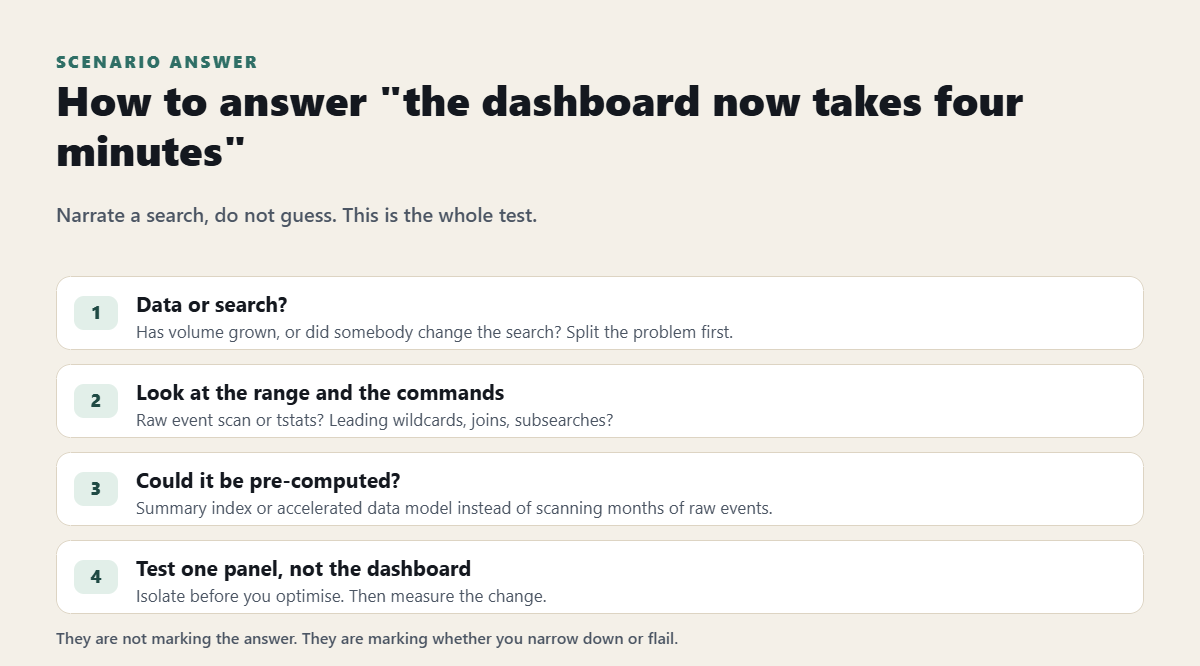
"First I would check whether it is the data or the search — has volume grown, or did the search change? Then I would look at the time range and whether it is using
tstatsor scanning raw events. I would check for wildcards at the start of terms, joins and subsearches, and whether the panels could be served from a summary index or an accelerated data model instead. Then I would test one panel at a time rather than the whole dashboard."
They are not marking your answer. They are marking whether you narrow things down or flail.
"A source has stopped sending data. How do you find out why?"
Work from both ends: is the forwarder running and connected, is the input still defined, has the file rotated or changed permissions, is the index full or the license exceeded, is a props change silently dropping the events. Saying "I would check the internal logs" specifically — rather than "I would investigate" — reads as experience.
"We are about to exceed our license. What do you do this week?"
The good answer is not "buy more". It is: find the top talkers, work out what is noise, filter or route it at the forwarder, and only then talk about licensing.
What separates the strong candidates
Three things, consistently.
They say what they do not know. Splunk is large. Nobody knows all of it. "I have not run that in production, but here is what I would check first" is a genuinely strong answer. Bluffing to an interviewer who runs the platform daily never survives one follow-up.
They talk about cost and volume. Anyone can write a search that works. The value is in the person who notices it will scan four hundred million events every fifteen minutes.
They have one story ready. A real incident where a search or an ingestion problem mattered, told in a couple of minutes. That story does more for you than five perfect definitions.
Do a dry run, out loud
Splunk answers are unusually hard to say well. You know the material, and it still comes out as a heap of half-sentences, because explaining a pipeline aloud is a different skill from operating one.
Pick the four scenario questions above and answer each one out loud, to a wall if necessary, in under two minutes. The first attempt will ramble. The second will not.
If you want the follow-ups too, RehearseAI runs the interview for the actual role and asks the "and why did you check that first?" questions a real interviewer would. Every account gets one free 5-minute interview a month, no credit card required.
Quick answers
How technical do Splunk interviews get? Usually one round of product knowledge and one scenario round. Some places add a live search exercise — ask the recruiter, they will normally tell you.
Should I get certified before applying? A certification gets you past a screen. It does not survive the scenario round on its own. Practical stories matter more.
What if I have only used Splunk Cloud, not on-prem? Say so plainly. Most of the day-to-day is the same, and pretending otherwise falls apart the moment they ask about indexer clustering.
Do they ask about SPL syntax from memory? Rarely word for word. They care that you know which command solves which shape of problem.
Sources
The technical ground here is Splunk's own documentation; these are the pages I checked it against:
- About the search language — Splunk Enterprise documentation
- About indexer clusters and index replication — Splunk Enterprise documentation
- Training & Certification — Splunk
If they open with "tell me about a time…", the STAR method is the shape to use. More about why I built this.