RehearseAI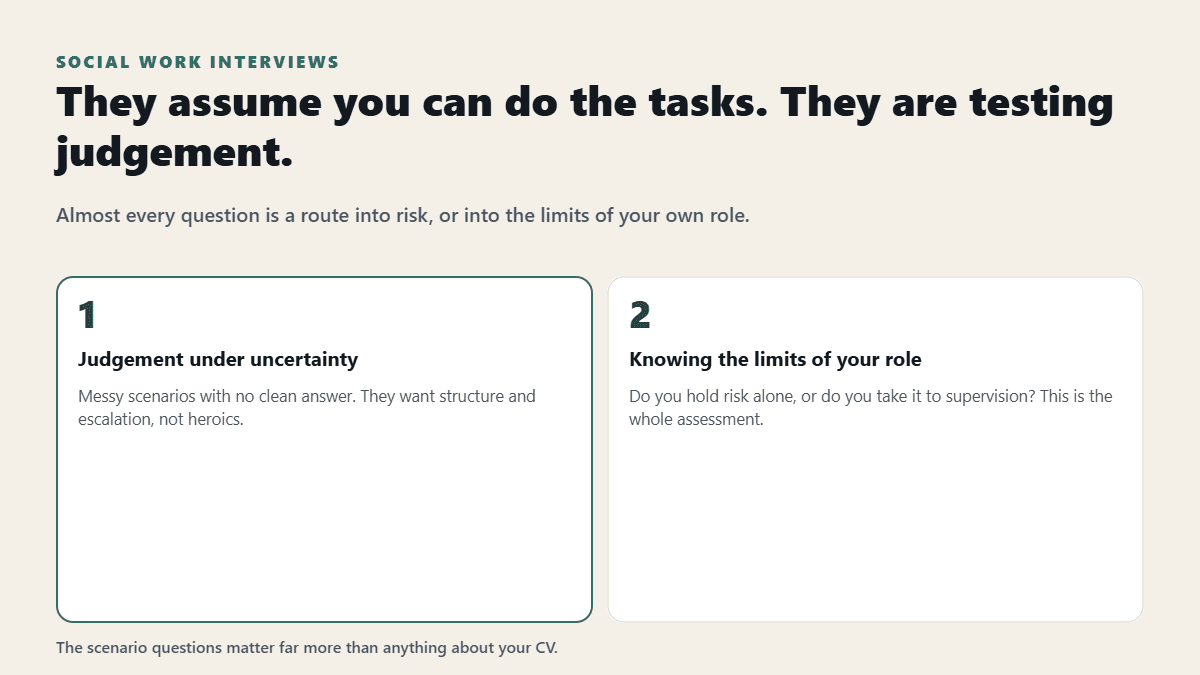
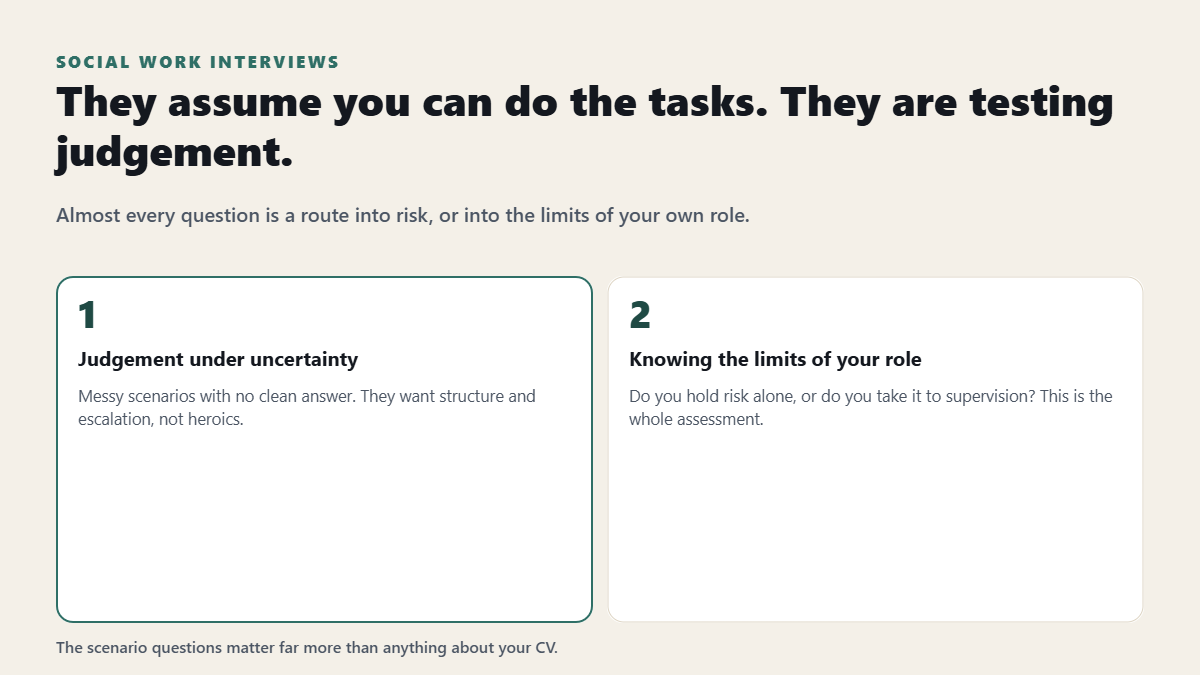
Social work interviews are unusual among professional interviews: the panel is not primarily assessing whether you can do the tasks. They assume the qualification covers that.
What they are testing is your judgment under uncertainty, and whether you know the limits of your own role. Almost every question is a route into one of those two.
That is why the scenario questions matter so much more than the ones about your CV.
"Why social work?"
Answer honestly and specifically, and avoid the two failure modes.
The first is a rescue narrative — wanting to save people. Panels hear it as a warning sign, because it predicts burnout and boundary problems.
The second is vagueness. "I want to make a difference" could be any job.
What works is a concrete route: something you saw, a placement that changed your mind about something, work you did before qualifying. Then a sentence about what keeps you in it, which is a different question from what got you into it.
The scenario questions
This is the real interview. You will be given a messy situation and watched.
"You visit a family and have concerns, but the parent refuses you entry. What do you do?"
They want structure, not heroics:
"I would not force the situation at the door. I would stay calm, explain plainly why I am there and what my duty is, and try to agree a time to return. Then I would record the refusal and what I observed factually, discuss it with my supervisor the same day, and check the case history for a pattern. If the threshold for immediate risk was met, I would escalate through the proper channel rather than acting alone."
"A service user discloses something that puts a child at risk, and asks you to keep it confidential."
The answer must be unambiguous. You cannot promise that confidentiality. You explain the limits — ideally you explained them before the disclosure — you say what you have to do next, you do it, and you record it. Panels are checking that you will not be talked out of a safeguarding duty by someone you like.
"You disagree with your manager's decision on a case."
Testing whether you can challenge appropriately. Raise it directly with reasoning, put it in writing if it is serious, use the escalation route your organization has, and keep working the case in the meantime. Neither silent compliance nor going around them.
The three words that make scenario answers work
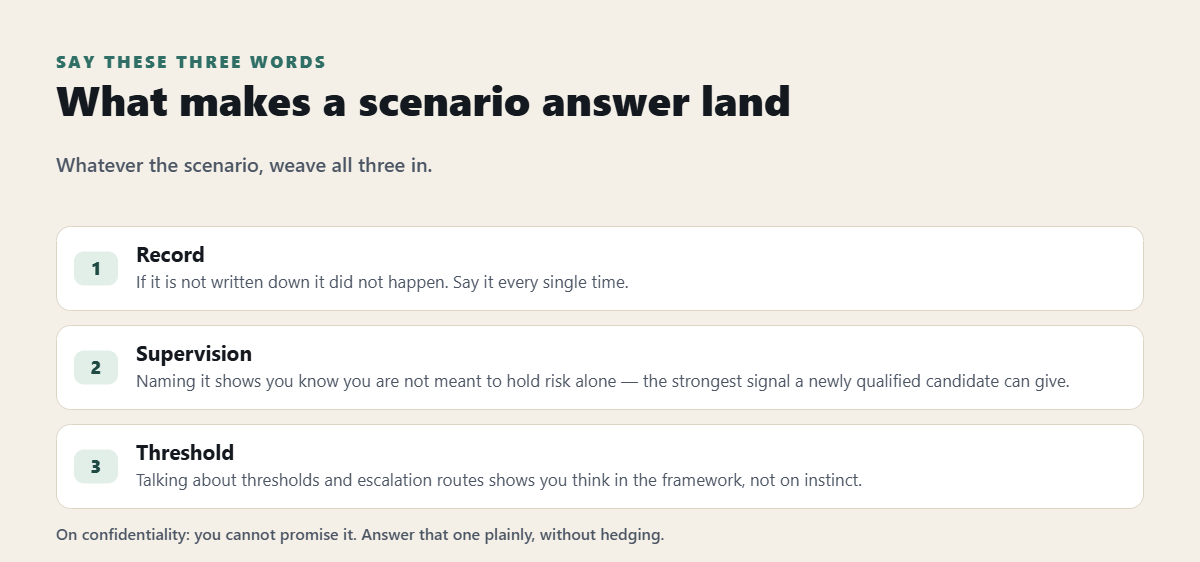
Whatever the scenario, weave in these:
Record. If it is not written down it did not happen. Say it every time.
Supervision. Naming supervision shows you know you are not meant to hold risk alone. It is the single strongest signal a newly qualified candidate can give.
Threshold. Talking about thresholds and escalation routes shows you think in terms of the framework rather than instinct.
"Tell me about a difficult case"
Anonymise it properly — no identifying details — and the panel will notice that you did.
Then give it a shape: the situation, what your role specifically was, what you did, what happened, and what you took from it. Difficult does not have to mean dramatic. A case where you got something wrong and corrected it lands better than one where everything worked.
"How do you look after yourself in this job?"
Not a soft question. Emotional resilience is a genuine assessment criterion, because turnover is expensive and burnout is common.
Be specific and practical: supervision used properly, keeping to boundaries about hours, peer support, something outside work you actually do. Vague answers about being resilient are read as not having thought about it.
Rehearse the scenarios out loud
Scenario answers are long, and they fall apart in speech far more easily than on paper. You know the framework perfectly and still spend three minutes circling because you have never had to say it in order with someone watching.
Take the three scenarios above and answer each aloud in two minutes. Say the words record, supervision and threshold out loud until they arrive naturally rather than as an afterthought.
If you want the follow-ups — "and what if the manager disagreed?" — RehearseAI asks them out loud for the role and stage and tells you afterwards where the answer sagged. Every account gets one free 5-minute interview a month, no credit card required.
Quick answers
How long is a social work interview? Often forty-five minutes to an hour, sometimes with a written exercise or presentation beforehand.
Will there be a written task? Frequently — a case recording or a short analysis under time pressure. Ask what to expect when they invite you.
How much law do I need to quote? Know the relevant framework and thresholds for your jurisdiction. Reciting section numbers is less impressive than applying the principle correctly.
What if I am newly qualified? Say so and lean on supervision and process. Panels expect new practitioners to escalate — not to have all the answers.
The "tell me about a difficult case" question fits the STAR method. More on why I built this.