RehearseAI
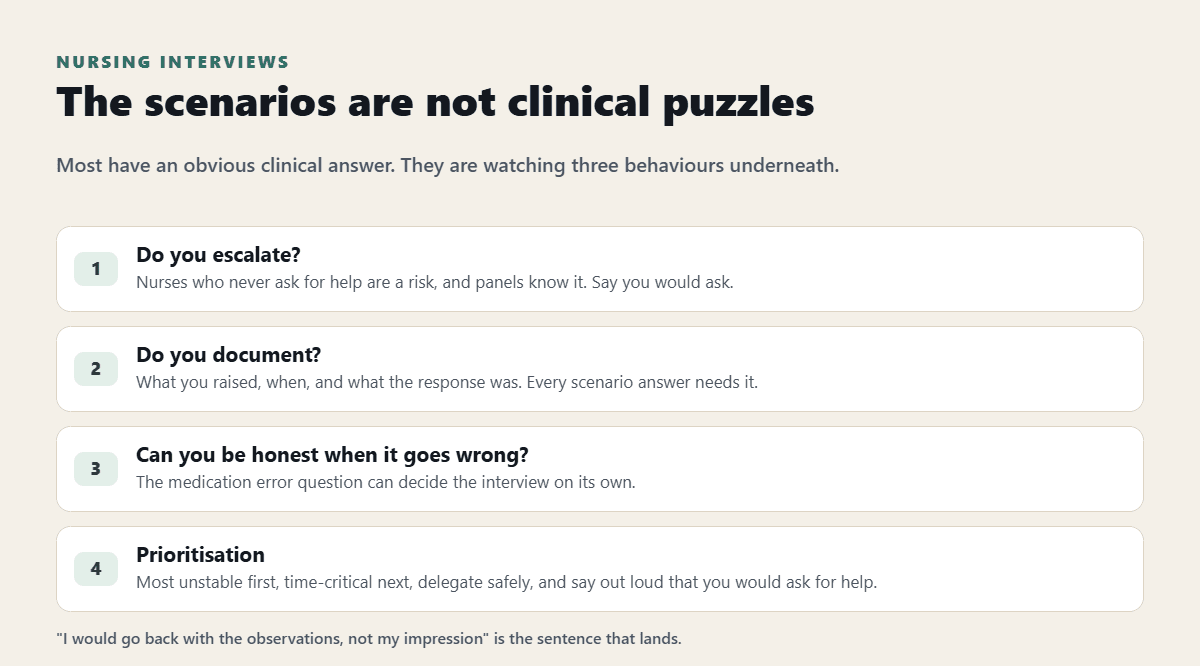
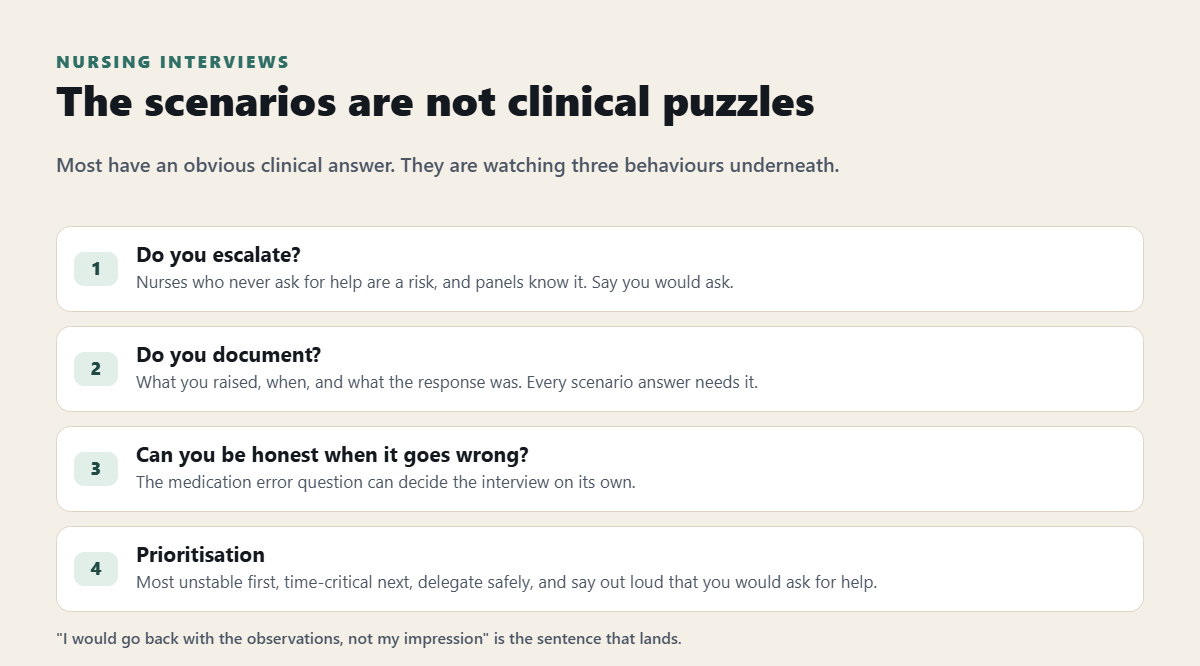
Nursing interviews are heavily weighted toward scenarios, and the scenarios are not really clinical puzzles. Most of them have an obvious clinical answer. What the panel is watching is whether you escalate, whether you document, and whether you can be honest about something going wrong.
Those three behaviors run underneath almost every question below.
"Why nursing?" and "why this unit?"
Answer the second one specifically, because everyone answers the first one similarly.
Name what draws you to this specialty and this setting — the patient population, the acuity, the team structure, a placement that pointed you here. If you are moving from another area, say why plainly. Panels are more comfortable with an honest reason than a polished one.
"How do you prioritize when everything needs doing?"
The most common opening scenario, and a genuine one.
They want a framework rather than heroics. Assess who is most unstable, deal with the time-critical thing first, delegate what can safely be delegated, and say out loud that you would ask for help rather than silently absorb an unsafe workload.
That last clause matters. Nurses who never ask for help are a risk, and panels know it.
"You are worried about a patient but the doctor disagrees"
This question separates candidates.
You do not drop it, and you do not go around them rudely. You state the specific observations rather than the feeling — the numbers, the trend, the change — request a review, document what you raised and their response, and escalate through the chain if the concern stands. Naming your escalation route is the strongest thing you can say here.
"I would go back with the observations rather than my impression: the trend over the last three sets, and what has changed. If the answer was still no and I remained concerned, I would escalate to the charge nurse and record what I had raised and when."
"You make a medication error. What do you do?"
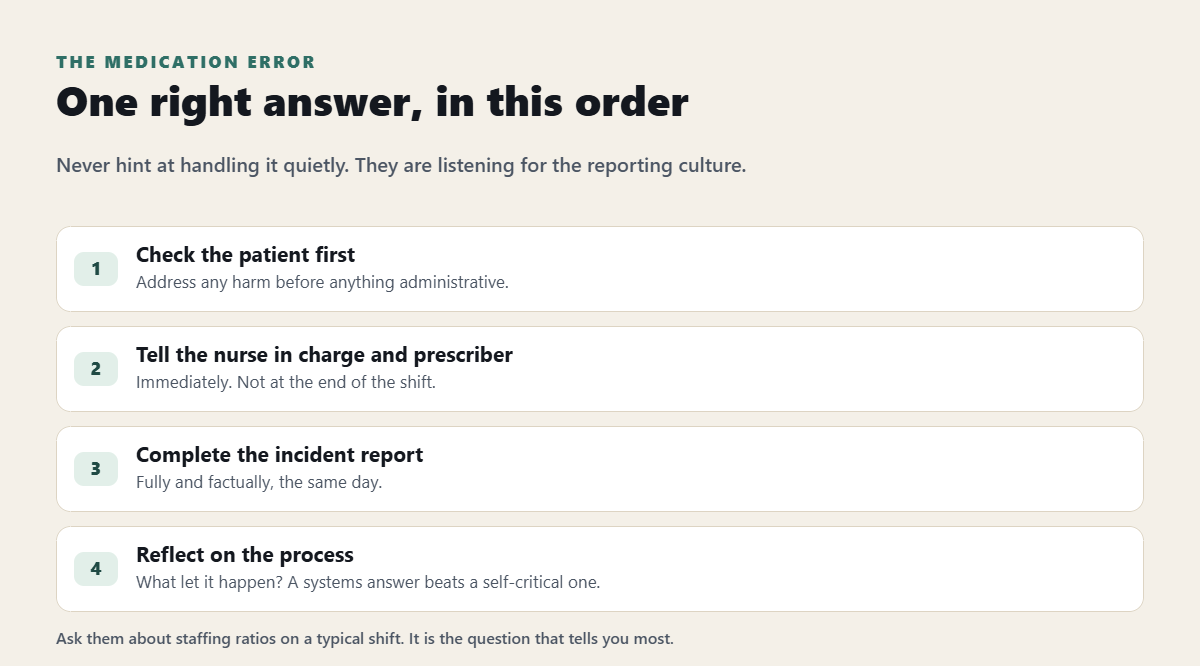
There is one right answer and it is fast, in order:
- Check the patient and address any harm first.
- Tell the charge nurse and the prescriber immediately.
- Complete the incident report.
- Reflect honestly on what in the process let it happen.
Never hint at hesitation or at handling it quietly. Panels are listening for the reporting culture, and this single question can decide the interview.
"How do you handle a distressed or aggressive patient or relative?"
Stay calm, do not match the tone, find out what is actually driving it — usually fear or feeling uninformed. Offer information and a next step. Know when to withdraw and get support, and say so, because personal safety is part of the answer they want.
"Tell me about a time you worked in a difficult team"
Do not badmouth former colleagues. Describe the friction factually, say what you did to work through it, and end on what happened. Panels are imagining how you will one day describe them.
"How do you look after your own wellbeing?"
Not a filler question. Retention is expensive and burnout is real. Give something practical and true — supervision or debriefs after a hard shift, boundaries around extra hours, peer support, something outside work.
What to ask them
- What does the staffing ratio look like on a typical shift?
- How does preceptorship or orientation work for a new hire?
- What is the biggest challenge on this unit right now?
- How is the team supported after a difficult event?
The staffing question is the one that tells you most, and it is entirely reasonable to ask.
Say the two hard ones out loud
The medication error, and the doctor who disagrees.
You already know both answers. The reason to rehearse is that under pressure people soften them — they hedge on the error, or they describe the disagreement without ever saying they would escalate. Saying it aloud once fixes that.
If you want the follow-up questions as well, RehearseAI asks them out loud for the role and specialty and tells you afterward how the answer landed. Every account gets 10 free practice minutes a month — one 10-minute interview, or shorter sits whenever you like, no credit card required.
Quick answers
How long is a nursing interview? Usually thirty to sixty minutes, sometimes with a dosage calculation test.
Will there be a written test? Often a dosage calculation. Ask when they invite you and practice it beforehand.
Should I use a framework for scenario answers? Yes — situation, action, escalation, documentation. It keeps long answers from wandering.
What if I am a new graduate? Lean on placements and on escalation. Panels expect new graduates to ask, not to know everything.
<!-- related-guides -->Related guides
If this was useful, these are the next ones to read:
- Common Interview Questions and How to Answer Them: The 15 most common interview questions, what each one is really checking, and the answer shape that works for it, with links to the full answer for the hard ones.
- Medical Assistant Interview Questions and Answers: Clinical, administrative and scenario questions for medical assistant interviews, including the privacy call and the mistake question that decides it.
- Dental Assistant Interview Questions: The questions a dental assistant interview actually asks, from chairside skills to the anxious patient, and what practices are really assessing.
- CNA Interview Questions and Answers: The CNA interview questions that come up most, what each one is checking, and how to answer the hard ones about difficult residents, mistakes and safety.
Sources
The advice above lines up with what university career centers and professional bodies publish; these are the pages I checked it against:
- Nurse Interview Tips — American Nurses Association
- 50 Nursing Interview Questions (With Sample Answers) — University of Florida Career Connections Center
- ECRI and ISMP Error Reporting System (medication error reporting)
Behavioral questions here fit the STAR method. More on why I built this.