RehearseAI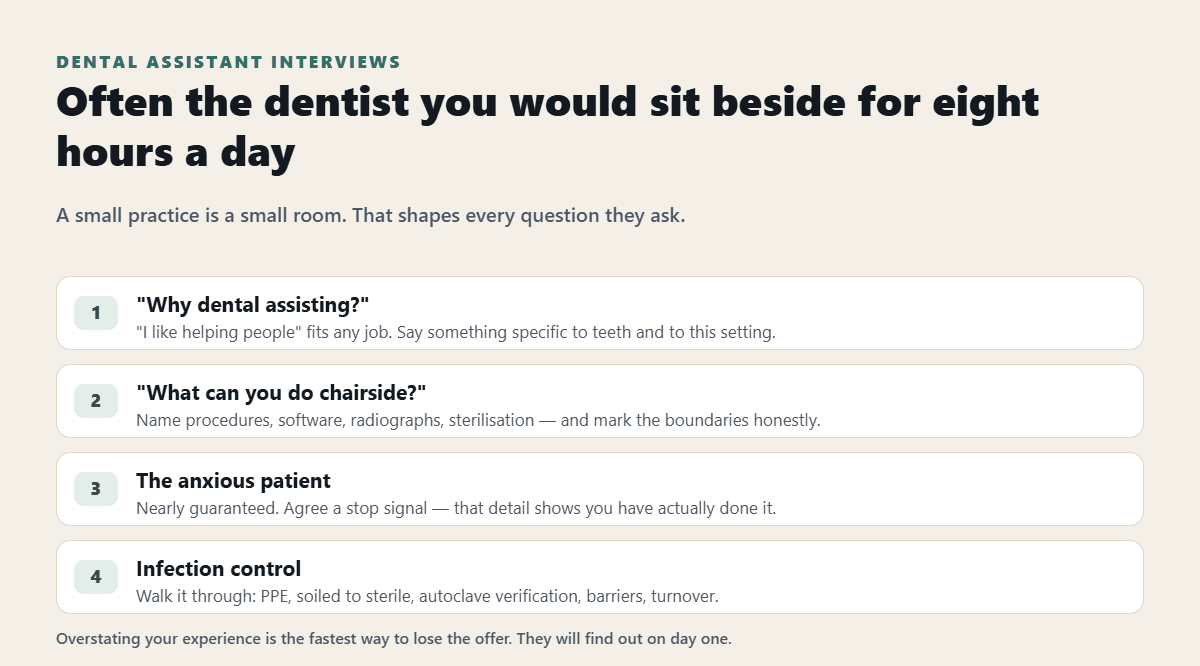
Dental assistant interviews are short, practical, and often conducted by the dentist you would actually be working next to. That last part matters more than anything else, because a small practice is a small room. They are not only asking whether you can do the job. They are asking whether they want you three feet away from them for eight hours a day.
Everything below follows from that.
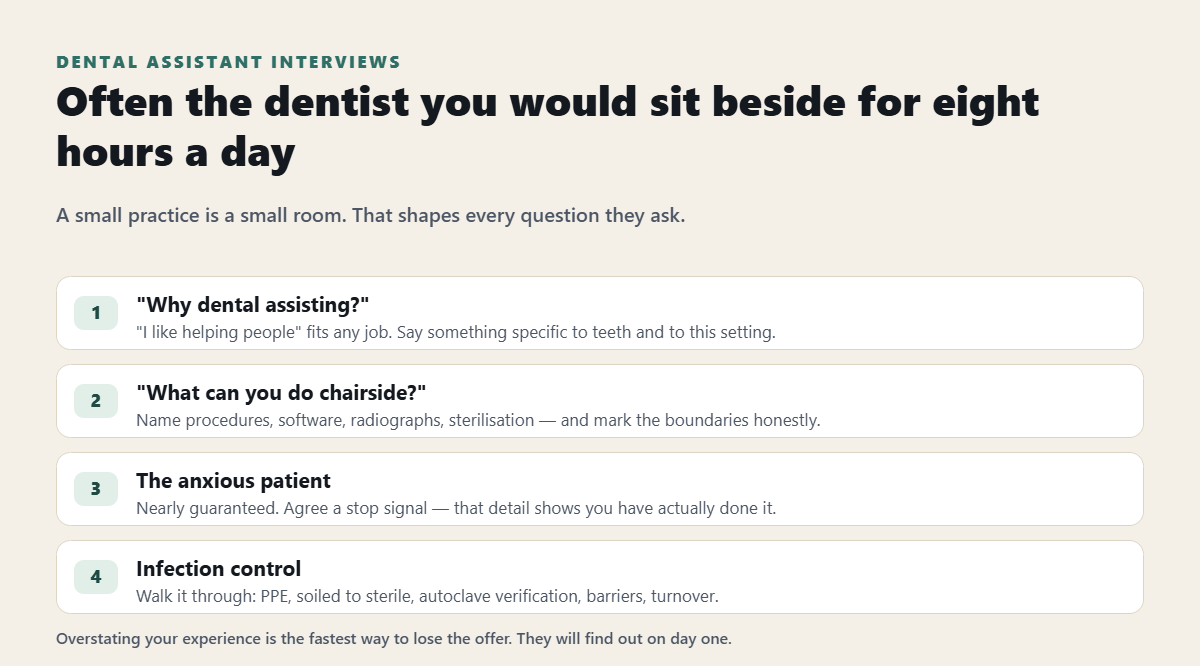
"Why dental assisting?"
The opener, and the one where generic answers cost you.
"I like helping people" is true of almost every job. What lands is something specific to teeth and to this setting — the mix of hands-on work and patient contact, the fact that you see the result the same day, a personal experience that pointed you here.
Say the real reason, even if it is unglamorous. "I wanted healthcare work I could train into quickly and stay in" is an honest answer that practices respect.
"What experience do you have with chairside assisting?"
Be precise, and be honest about the boundaries of what you have done.
Name the procedures you have assisted with, the software you have used for charting and scheduling, whether you have taken radiographs and what your state or country requires for that, and your sterilisation experience. If you trained but have not worked yet, say exactly that and describe what your program covered.
Overstating here is the fastest way to lose an offer. A practice will find out on day one, and they know newly qualified assistants need training.
"A patient is anxious and refusing to sit down. What do you do?"
Dental anxiety is common, so this question is nearly guaranteed.
They want to hear calm and specific, not a slogan:
"I would stop and give them a moment rather than pressing on. I would ask what they are most worried about, because it is often one specific thing rather than the whole appointment. I would explain what is going to happen in order, agree a signal they can raise if they need me to stop, and let the dentist know before we start."
Naming the stop signal is the detail that shows you have done this.
"How do you handle infection control?"
Do not summarize. Walk through it: PPE, instrument processing from soiled to sterile, autoclave use and how you verify a cycle, surface barriers, turnover between patients.
This is a compliance answer as much as a clinical one, and confidence here reassures a practice enormously.
"Tell me about a time you worked under pressure"
Every practice runs late. They want to know what you are like at four o'clock when the schedule has collapsed.
Use a real example with a shape: what the situation was, what was yours to handle, what you actually did, how it ended. Keeping the room turned over, communicating with the waiting patient, staying pleasant when you are behind — those are the details that register.
What to ask them
Two or three questions, about the work:
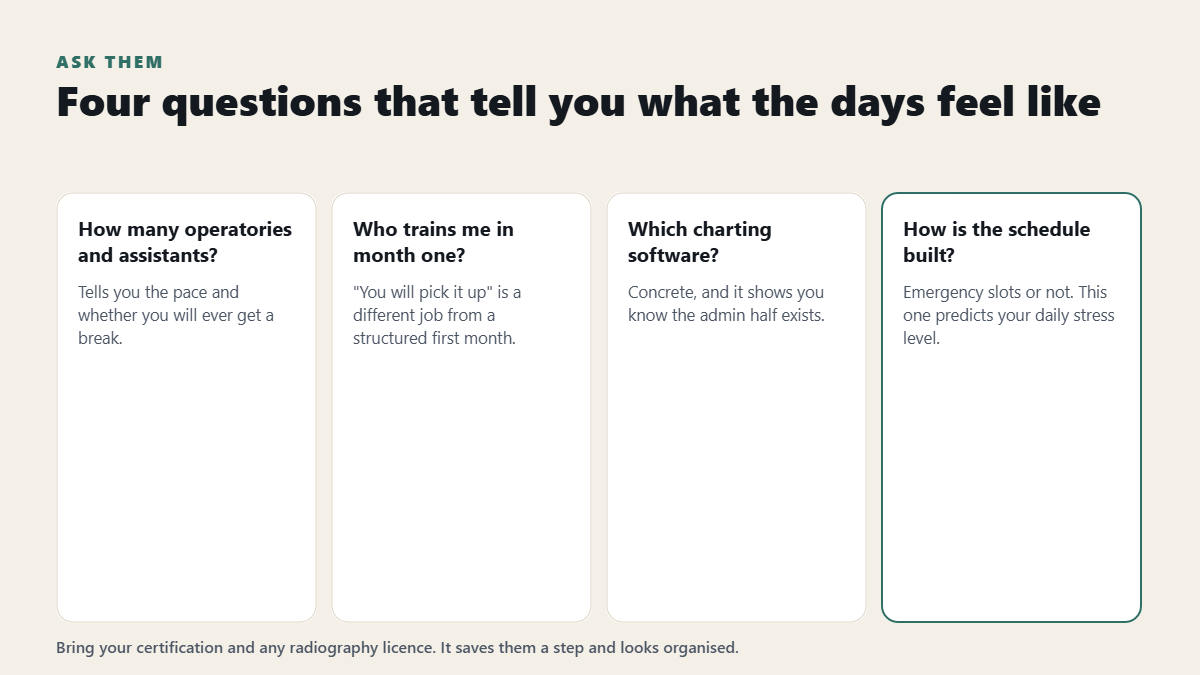
- How many operatories, and how many assistants on a typical day?
- What does the first month look like — who trains me?
- What software do you use for charting?
- How is the schedule built? Are there usually emergency slots?
That last one tells you a great deal about what your days will feel like.
The small things that decide it
Arrive early and look clinical. Tidy, minimal jewelry, hair back, short nails. In a healthcare setting this is not vanity — it is a signal that you understand the environment.
Watch how you talk about your last practice. Even if it was chaotic. Interviewers listen carefully to how you describe colleagues, because they are imagining how you will one day describe them.
Bring your certification and any radiography license. Having it in hand saves them a step and looks organized.
Then say the answers out loud
The questions above are not difficult. They still come out badly if the first time you say them is in the chair.
Pick three — why dental assisting, the anxious patient, and infection control — and answer each aloud in under ninety seconds. Once. You will hear immediately where the sentence runs out of road, and that is the whole benefit.
If you would rather have real questions and honest feedback, RehearseAI will run the interview out loud for the role and tell you afterwards about pace, filler and whether the answer landed. Every account gets one free 5-minute interview a month, no credit card required.
Quick answers
How long is a dental assistant interview? Usually twenty to forty minutes, sometimes with a short working interview afterwards.
What is a working interview? A paid or unpaid trial shift where you assist for a few hours. Ask in advance whether it is paid and what to bring.
What should I wear? Scrubs are acceptable at most practices and safest if a working interview is possible. Otherwise smart and plain.
What if I am newly qualified? Say so directly. Practices hire new assistants constantly. What they need to hear is that you are honest about what you have not done yet.
If they open with "tell me about a time…", use the STAR method. More on why I built this.