RehearseAI
"What are your strengths?" sounds like the easy question. It is the one people answer worst, because the natural reply is a list of adjectives: hard-working, organized, a team player. Every candidate says those words, so they tell the interviewer nothing.
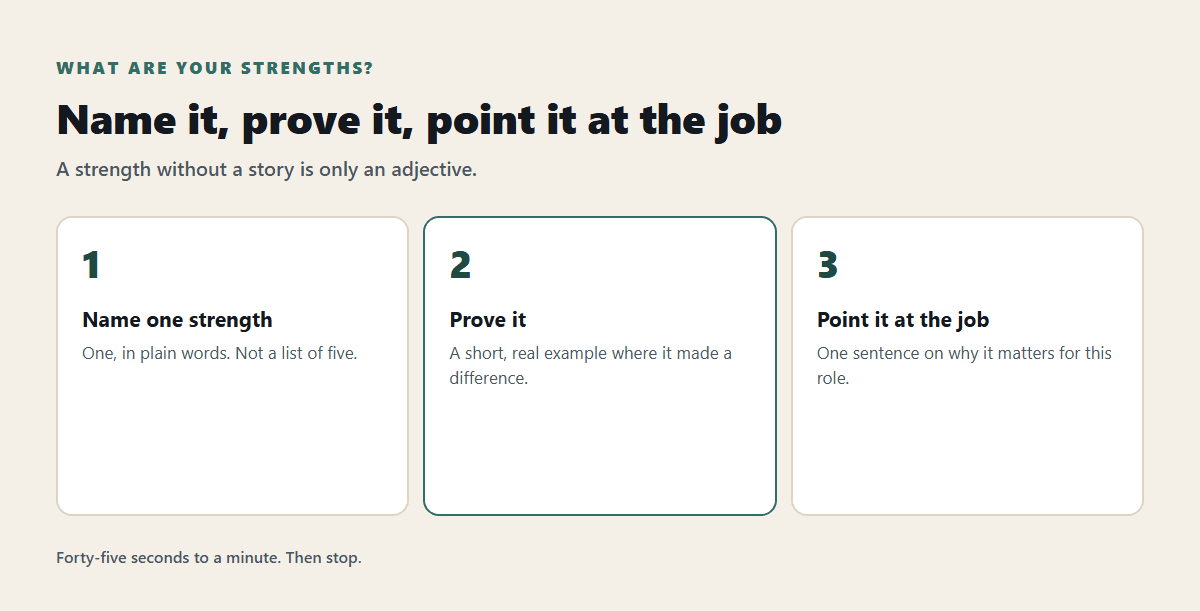
After twenty years of asking this question from the hiring side of the table, I can tell you what a good answer sounds like. It names one strength, proves it with a short story, and connects it to the job.
What they are really asking
The interviewer wants two things: to know what you are good at, and to see whether you know yourself. A candidate who can name a real strength and back it up comes across as someone who will be easy to manage. A candidate who recites five adjectives comes across as someone who has not thought about it.
Choosing the right strength
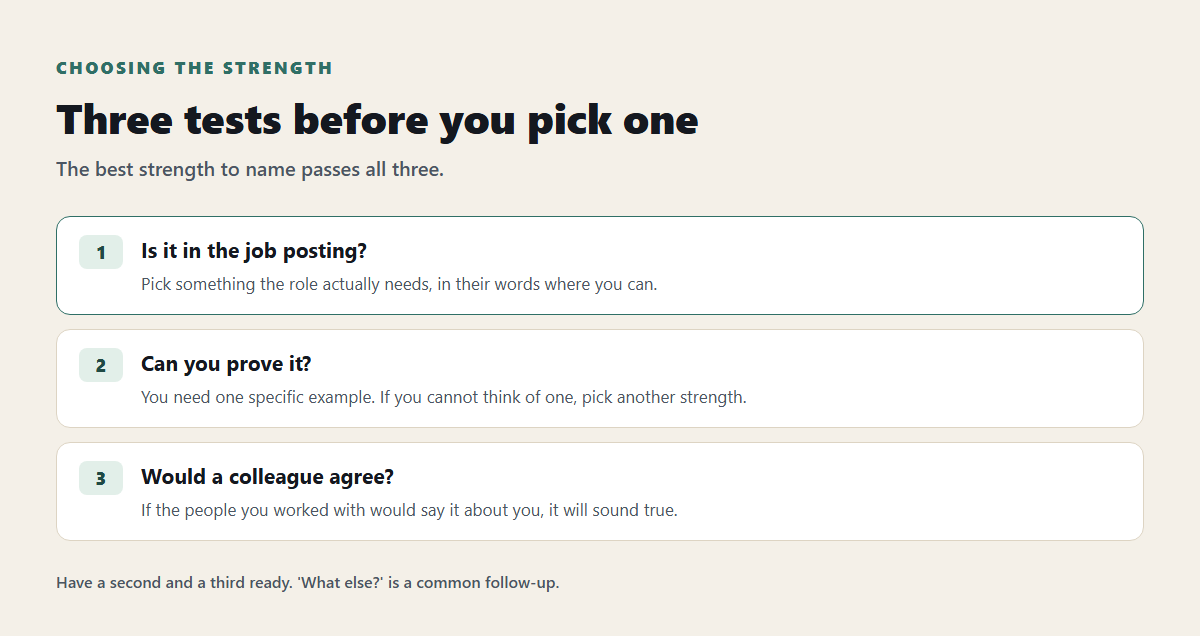
Read the job posting again and underline what it asks for. Your best strength for this interview is the one that sits where the posting and your real record overlap.
Good strengths to name are specific and observable: explaining complicated things simply, staying calm when a customer is upset, catching errors before they ship, getting a new team organized quickly. "I'm a people person" is hard to prove. "I am good at calming down a frustrated customer" is easy to prove.
The three-part answer
1. Name it. One strength, one sentence. "One of my strengths is staying organized when there is a lot going on."
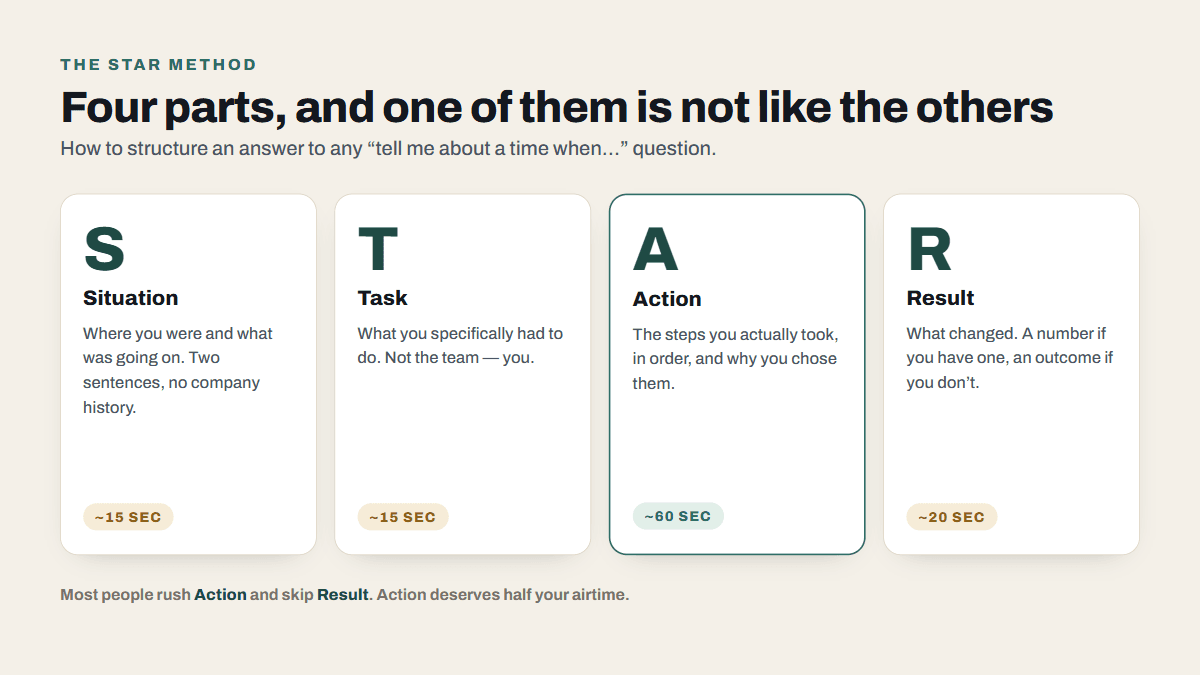
2. Prove it. A short example, thirty seconds at most. Where you were, what you did, what happened. This is a small version of the STAR method.
3. Point it at the job. "From the posting, it sounds like this role juggles several deadlines at once, so I think that would be useful here."
Three examples of strengths for a job interview
For an office or administrative role:
"I am good at keeping track of details. In my last job I handled scheduling for a team of eight, and I built a simple shared calendar that cut our double-bookings to almost none. This role supports several managers, so I would expect that to matter."
For a customer-facing role:
"I stay calm with upset customers. Last year a customer came in angry about a late order. I listened, apologized, and had a replacement to her within the hour. She came back the following week. I know this role is the first point of contact, so that seems like the right strength to bring."
For a first job:
"I am reliable. I did not miss a single practice in three years on my school team, and I was the one the coach asked to open the gym. I know showing up on time matters most in this job."
Notice that none of these uses a big word. Plain strengths with real proof beat impressive ones without it.
If they ask for three strengths
Some interviewers ask for your "top three strengths." Give three names, then prove only the first one in detail: "Organization, staying calm under pressure, and learning new systems quickly. The one I would highlight is organization..." That keeps the answer under a minute.
Mistakes to avoid
- A list with no example. The most common miss.
- A strength the job does not need. Creativity is a fine strength and the wrong one for a compliance role.
- False modesty. "I guess I'm okay at..." This is the one moment you are invited to speak well of yourself.
- Going long. Past ninety seconds, a strength starts to sound like a speech.
The partner to this question is the weakness one, covered in the biggest weakness interview question. They are often asked back to back, so prepare both.
Say it out loud
This answer feels awkward the first time, because most of us are not used to praising ourselves. That awkwardness is exactly why you say it out loud beforehand. Twice is usually enough for it to sound natural.
If you want to hear how it lands, RehearseAI will ask the question, follow up, and tell you afterward how the answer came across. Every account gets 10 free practice minutes a month — one 10-minute interview, or shorter sits whenever you like, no credit card required.
Quick answers
What are good strengths to say in an interview? Ones the job needs and you can prove: reliability, clear communication, calm under pressure, attention to detail, learning quickly.
How many strengths should I give? One, unless they ask for more. Then name three and prove one.
Can I use the same strength for every interview? Only if every job needs it. Check the posting each time.
Is it bragging? No. They asked. A short, factual example is not a boast.
<!-- related-guides -->Related guides
If this was useful, these are the next ones to read:
- Reasons for Leaving a Job: How to Answer in an Interview: Good reasons for leaving a job, the honest one-sentence answer that works in an interview, and how to handle the hard cases: fired, laid off, a bad boss, or burnout.
- Salary Expectations: How to Answer in an Interview: How to answer "what are your salary expectations?" without underselling yourself: three honest ways to respond, how to find your range, and what to put in the desired salary box.
- Common Interview Questions and How to Answer Them: The 15 most common interview questions, what each one is really checking, and the answer shape that works for it, with links to the full answer for the hard ones.
Sources
University career centers that cover this question in their interview guides:
- Interview Preparation — Career Engagement, University of California, Berkeley
- Interviewing — MIT Career Advising & Professional Development
- Interview Preparation Guide — UConn Center for Career Readiness
More on why I built this. The free question generator writes the questions a posting will ask — no account needed.