RehearseAI
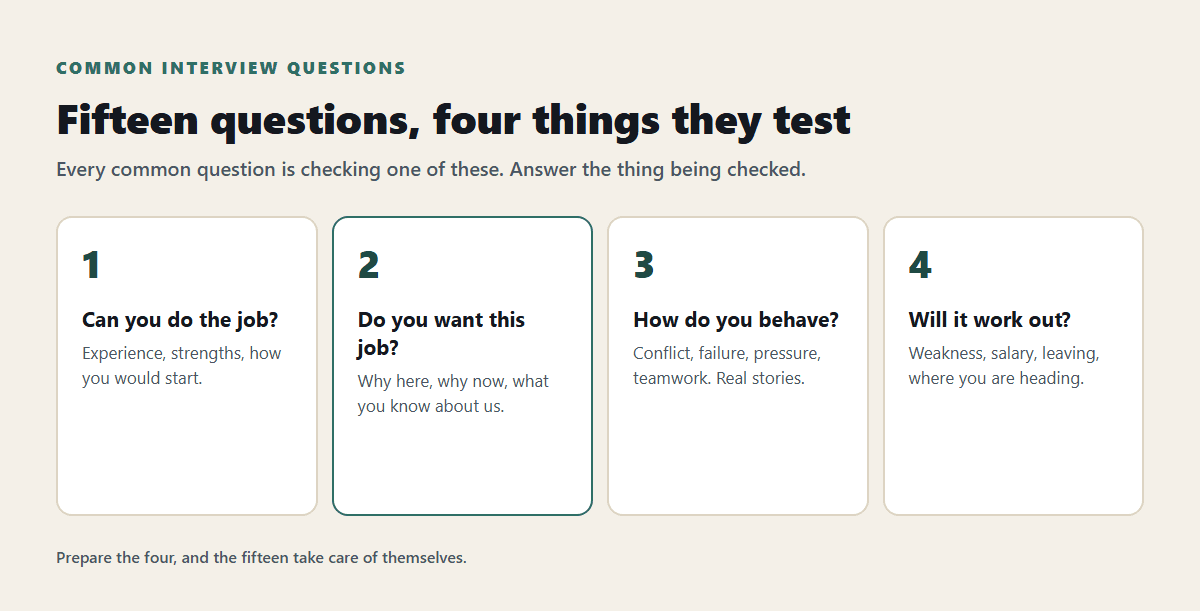
Most job interviews draw from the same short list of questions. The wording changes, the order changes, but underneath, an interviewer is checking four things: can you do the job, do you want it, how do you behave with people, and whether it will work out.
Here are the fifteen common interview questions that cover almost every interview, what each one is really checking, and the shape of a good answer. Where a question deserves a full page, it links to one.
The answer shape that works for all of them
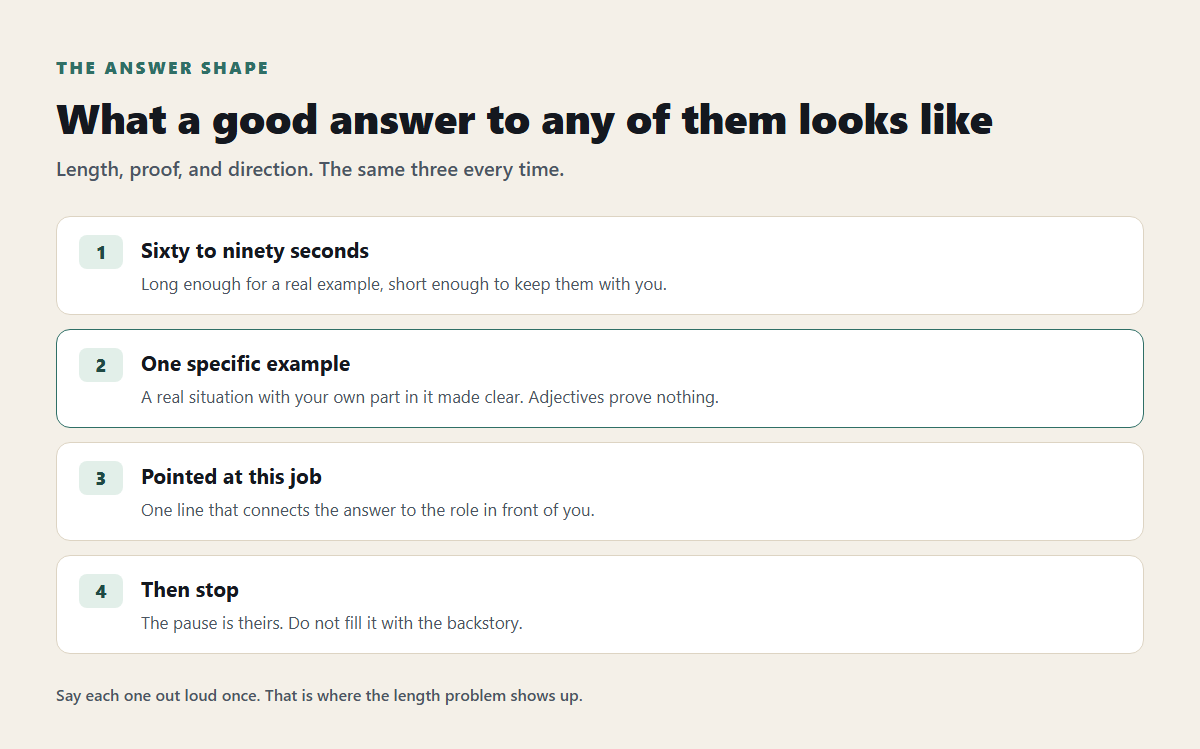
Keep that card in mind and the rest of this page is detail.
Opening questions
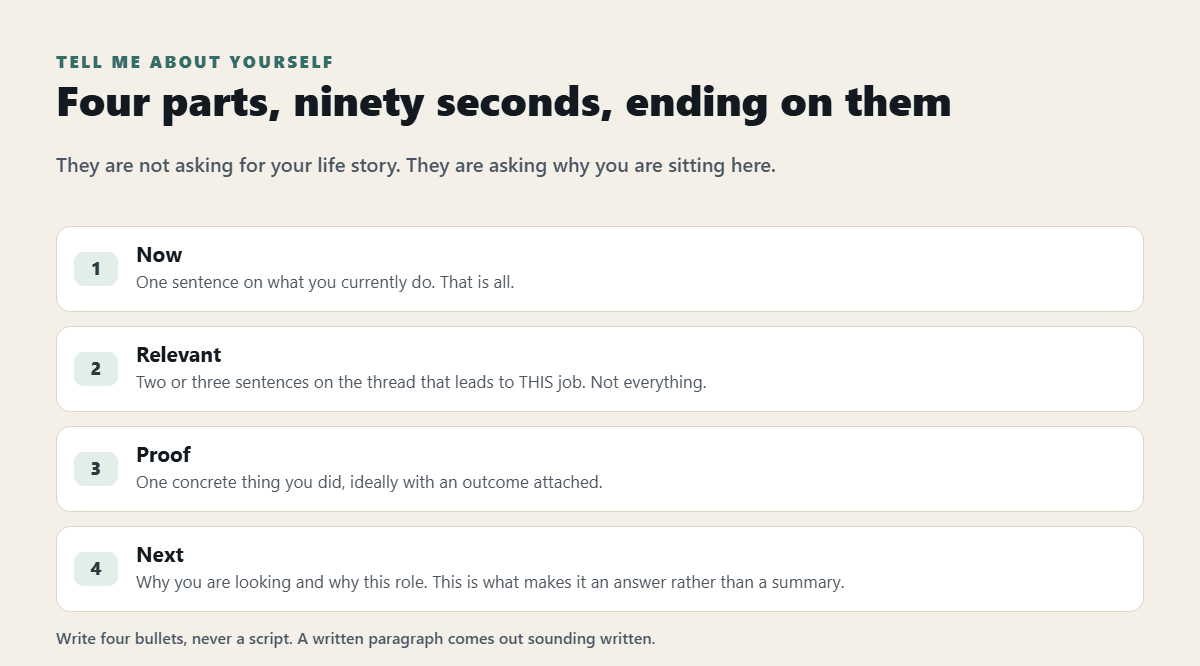
1. "Tell me about yourself." What it checks: can you summarize yourself, and do you know what matters for this job. Shape: where you are now, one or two things you have done that look like this role, and why you are here. About a minute. Full walk-through in tell me about yourself: a sample answer.
2. "Why do you want this job?" What it checks: whether you applied to this job or to fifty. Shape: one specific thing about the role and one about the company, both true, both from your own research.
3. "What do you know about our company?" What it checks: whether you did forty minutes of homework. Shape: what they sell and to whom, one thing that changed recently, and one question it raised for you.
4. "Why should we hire you?" What it checks: whether you can make the case without bragging or apologizing. Shape: the two or three things from your record that match what the posting asks for, in plain words.
Questions about you
5. "What are your strengths?" What it checks: self-knowledge, and whether the strength fits the job. Shape: name one, prove it with a short example, point it at the role. Full answer in what are your strengths?.
6. "What is your biggest weakness?" What it checks: honesty, and whether you work on yourself. Shape: a real weakness that does not sink the job, and what you do about it. Never "I'm a perfectionist." The full answer is in the biggest weakness interview question.
7. "Where do you see yourself in five years?" What it checks: whether this job is a step toward something or a place to hide. Shape: a direction, not a job title, and why this role fits on the way.
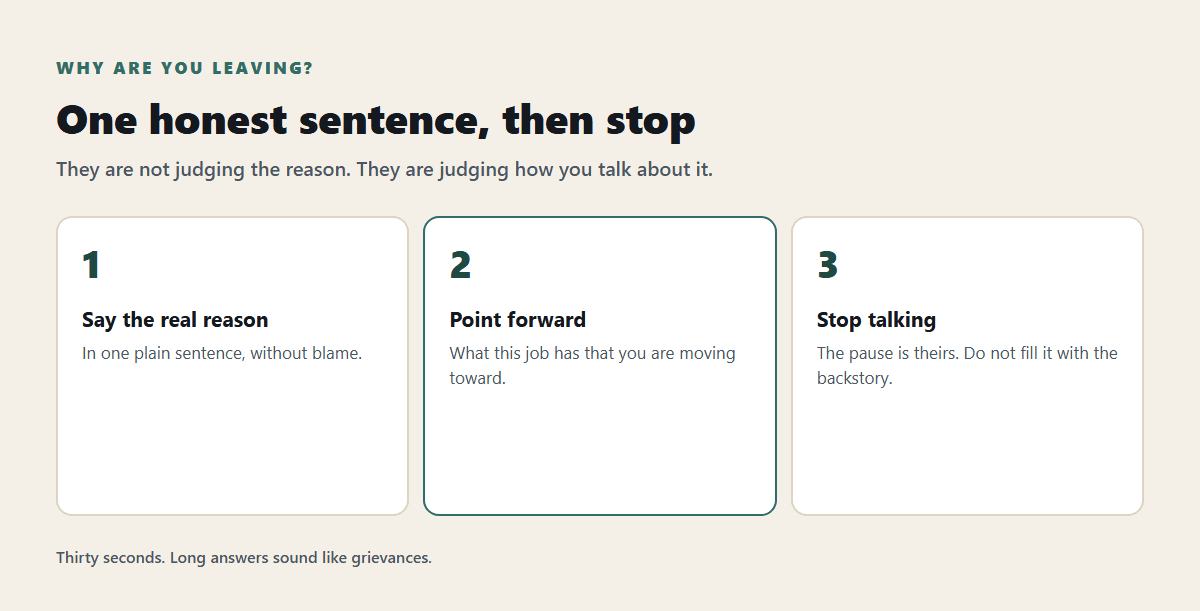
8. "Why are you leaving your current job?" What it checks: whether you blame, and whether you will leave them the same way. Shape: one honest sentence, then what you are moving toward, then stop. Covered in reasons for leaving a job.
Behavioral questions
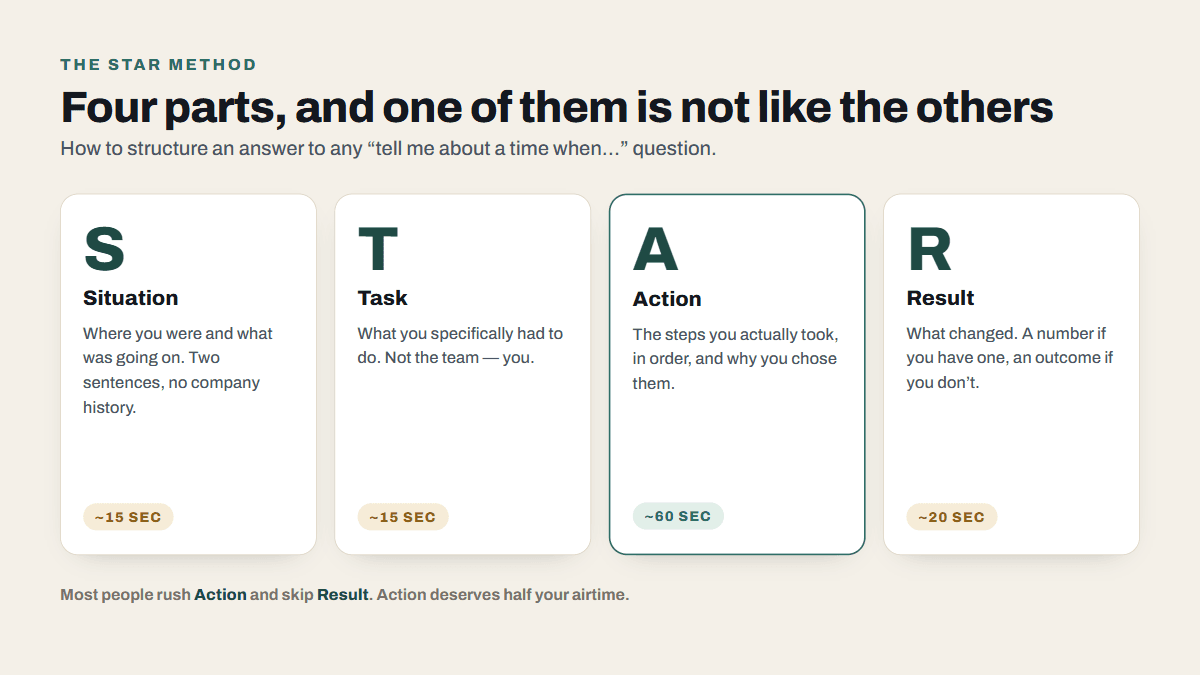
These all start with "tell me about a time." They want a real story, told in four parts: the situation, what was yours to do, what you did, and what changed. That shape is the STAR method, and it is worth learning once.
9. "Tell me about a time you failed." What it checks: whether you can own a mistake and what you did next. Shape: a real failure that was yours, the fix, and the one thing you changed.
10. "Tell me about a conflict with a coworker." What it checks: how you handle people when it is awkward. Shape: the disagreement, how you raised it directly, how it ended. No villains.
11. "Tell me about a time you worked under pressure." What it checks: whether pressure makes you freeze, panic, or prioritize. Shape: what was on fire, what you did first and why, how it came out.
12. "Tell me about a time you worked in a team." What it checks: what your part was, not whether you were present. Shape: the goal, your specific contribution, one thing you did for a teammate.
More of these, with worked answers, in behavioral questions for interview practice.
Practical questions
13. "What are your salary expectations?" What it checks: whether you are in the same range. Shape: ask for theirs first, or give a researched range with the bottom near your real target. Covered in salary expectations: how to answer.
14. "When could you start?" and "What is your availability?" What it checks: logistics, and sometimes how you treat your current employer. Shape: an honest date, with notice period if you have one. For shift work, bring your availability written down.
15. "Do you have any questions for us?" What it checks: whether you are interested, and whether you think. Shape: two or three questions about the work, the team, and the manager. Never "no." The list is in questions to ask in an interview.
Questions by stage
The first call and the second interview use different questions. A phone screen is mostly numbers 1, 2, 8 and 13; see phone interview tips and questions. The second round goes deeper on 4, 9 and 12 and adds a future colleague's questions; see second interview questions.
How to prepare for all fifteen
You do not need fifteen answers. You need about five stories and four facts:
- Five stories from the last few years: a success, a failure, a conflict, a time under pressure, a time you helped someone. Each one answers three or four of the questions above, depending on which part you lean on.
- Four facts about them: what they sell, what changed recently, who you are meeting, and why the role is open.
Then say the answers out loud, with a timer. In twenty years of interviewing people, the difference between a good candidate and a hired one was almost always that the hired one had said the words before. Answers in your head come out twice as long and half as clear the first time they meet air.
If nobody is free to ask you the questions, RehearseAI will: an interviewer asks them out loud, follows up when you dodge, and tells you afterward which answers landed. Every account gets 10 free practice minutes a month, no credit card required. For a quick check of where you stand first, there is a two-minute interview readiness quiz.
Quick answers
What are the most common interview questions? Tell me about yourself, why this job, why should we hire you, your strengths and weaknesses, a failure, a conflict, where you see yourself in five years, why you are leaving, salary expectations, and whether you have questions for them.
How many questions should I prepare for? Prepare the fifteen above. Five flexible stories cover the behavioral ones.
How long should each answer be? Sixty to ninety seconds. "Tell me about yourself" can run to two minutes.
Should I memorize answers? No. Memorized answers fall apart at the first follow-up. Prepare the stories and the facts, then practice saying them in different words.
<!-- related-guides -->Related guides
Every guide in this series, in one place:
- STAR Method Examples for 8 Common Questions: Eight worked STAR method examples for the behavioral questions that come up most, plus what the interviewer is really checking each time.
- STAR vs CAR vs SOAR: Interview Methods Compared: The CAR, SOAR, SMART and STARR interview methods explained next to STAR: what each letter stands for, when each one fits, and why the acronym matters less than you think.
Sources
University career centers whose interview guidance the approach above follows:
- Interview Preparation — Career Engagement, University of California, Berkeley
- Interviewing — MIT Career Advising & Professional Development
- Interview Preparation Guide — UConn Center for Career Readiness
Want to practice these rather than read them? Interview practice questions that are worth it covers how. More on why I built this.
The free question generator writes the questions a specific posting will ask — no account needed.