RehearseAI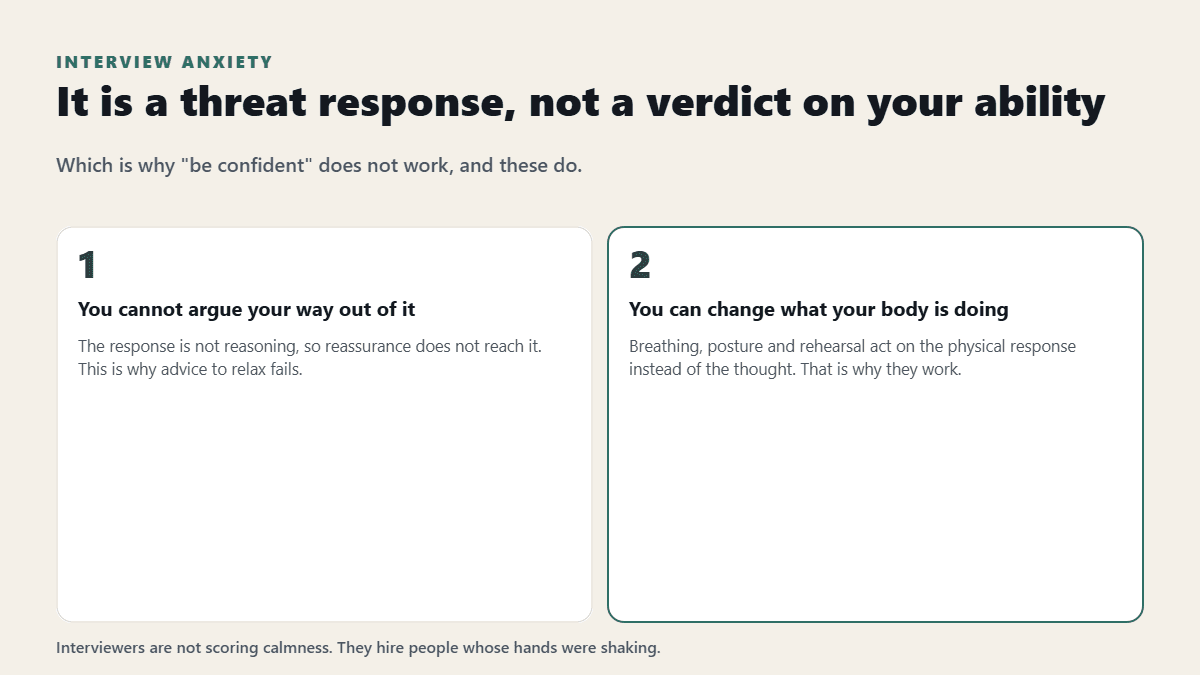
Interview anxiety is not a character flaw, and it is not a sign you are unsuited to the job. It is a nervous system doing exactly what it evolved to do — treating being evaluated by strangers as a threat — in a situation where that response is useless.
I spent years on the wrong end of it. I would get the call, feel fine for a day, and then somewhere in the first five minutes hand the controls to a nervous stranger who had never met me. Afterwards I would remember every good answer I should have given, usually in the shower, usually three days late.
Most advice for this is "be confident", which is like telling someone who cannot sleep to relax. Here is what actually helps, in the order it helps.
What is actually happening
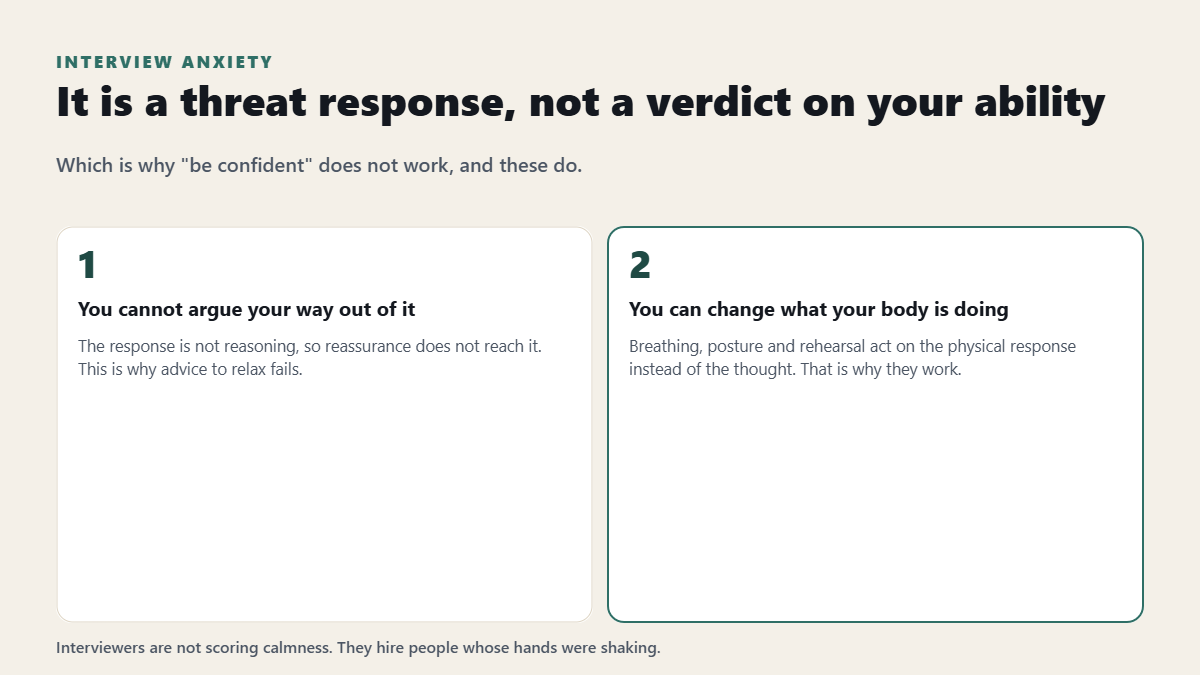
Your body is running a threat response: adrenaline up, heart rate up, blood away from the parts of the brain you need for recalling a story in order. The dry mouth, the shaking hands, the mind going blank — all of it is that, and none of it is a verdict on your ability.
Two things follow from this, and they are the useful part.
You cannot argue yourself out of it. Telling yourself there is nothing to worry about does not work, because the response is not reasoning.
You can change what your body is doing. Breathing, posture and rehearsal all act on the physical response rather than the thought, which is why they work when reassurance does not.
What helps on the day
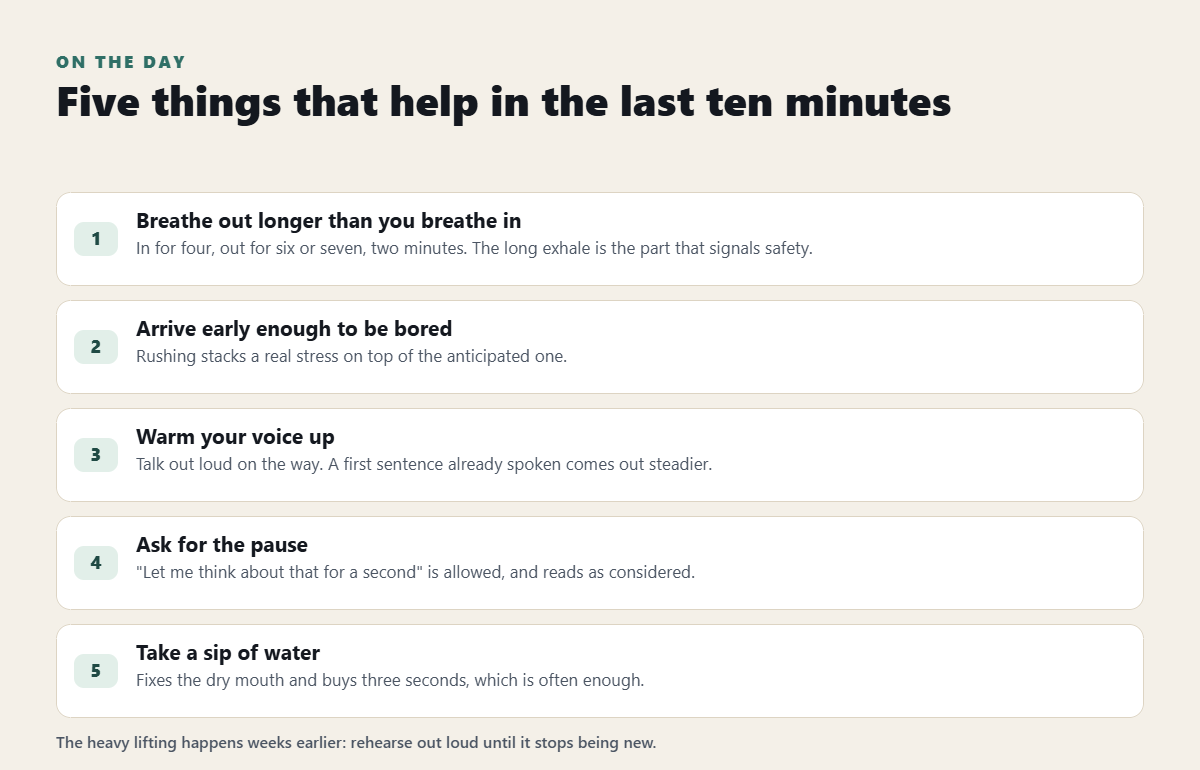
Slow your breathing out, not in. Breathe in for four, out for six or seven, for two minutes. The long exhale is what signals safety. Do it in the car or the corridor, not while walking in.
Arrive early enough to be bored. Rushing stacks a real stress on top of the anticipated one. Fifteen minutes of sitting quietly nearby is worth more than fifteen minutes of last-minute revision.
Warm your voice up. Talk out loud on the way — to a friend on the phone, to yourself, anything. A first sentence that has already been spoken comes out steadier than one that has not.
Ask for the pause. "Let me think about that for a second" is a completely normal thing to say, and it reads as considered rather than stuck. Most people never realize it is allowed.
Have water and take a sip. It fixes the dry mouth and buys three seconds, which is often all you need.
What helps in the weeks before
This is the part that does the heavy lifting, and it is the part most people skip.
Rehearse out loud, repeatedly. Anxiety feeds on novelty. The fourth time you answer "tell me about a time you failed" out loud, your body has stopped treating it as new — and that is a physical change, not a mental trick. It is why performers rehearse rather than just reading the script.
Practice being interrupted. A lot of interview anxiety is fear of being derailed. Have someone break in mid-answer a few times, or use something that asks follow-ups. Once you have recovered from an interruption twice, it stops being frightening.
Prepare three stories, not twenty answers. Trying to hold twenty scripts in your head under adrenaline is what causes the blank. Three flexible stories is a load you can actually carry.
Do not do a last rehearsal the night before. It tends to make people rigid rather than ready. Stop the day before.
The thing nobody says
Some nerves are useful, and completely invisible from the outside. Interviewers are not scoring calmness. They routinely hire people whose hands were shaking, because what they noticed was a clear answer.
The goal is not to feel nothing. It is to be able to speak while feeling something — and that is a trainable skill, not a personality trait.
Rehearsal is the actual treatment
If there is one thing on this page worth acting on, it is that the reliable cure for interview anxiety is repetition, and repetition needs a willing interviewer.
That is precisely what is hard to find. Friends are busy and too kind to push. Nobody volunteers for round four of behavioral questions at nine on a Tuesday.
RehearseAI was built for that gap — real questions, out loud, follow-ups when you dodge, and honest feedback afterwards. Available late at night, and it never gets bored of your fourth attempt. Every account gets one free 5-minute interview a month, no credit card required.
Whether you use it, a patient friend, or a voice recorder on the kitchen table, the mechanism is the same: say it out loud until it stops being new.
Quick answers
Is it normal for my mind to go blank? Yes, and it is the adrenaline, not you. Ask for a second to think — it works and it is normal.
Should I tell the interviewer I am nervous? A brief, light acknowledgment is fine and often relaxes both sides. Do not dwell on it.
Do beta blockers help? Some people use them for performance anxiety. That is a conversation for a doctor, not a blog post.
Does anxiety get better with more interviews? Usually, yes — and faster with deliberate rehearsal than with real interviews alone, because rehearsal lets you repeat the hard part.
More on why I built this — I was very bad at this for a long time. Or read the rest of the blog.