RehearseAI
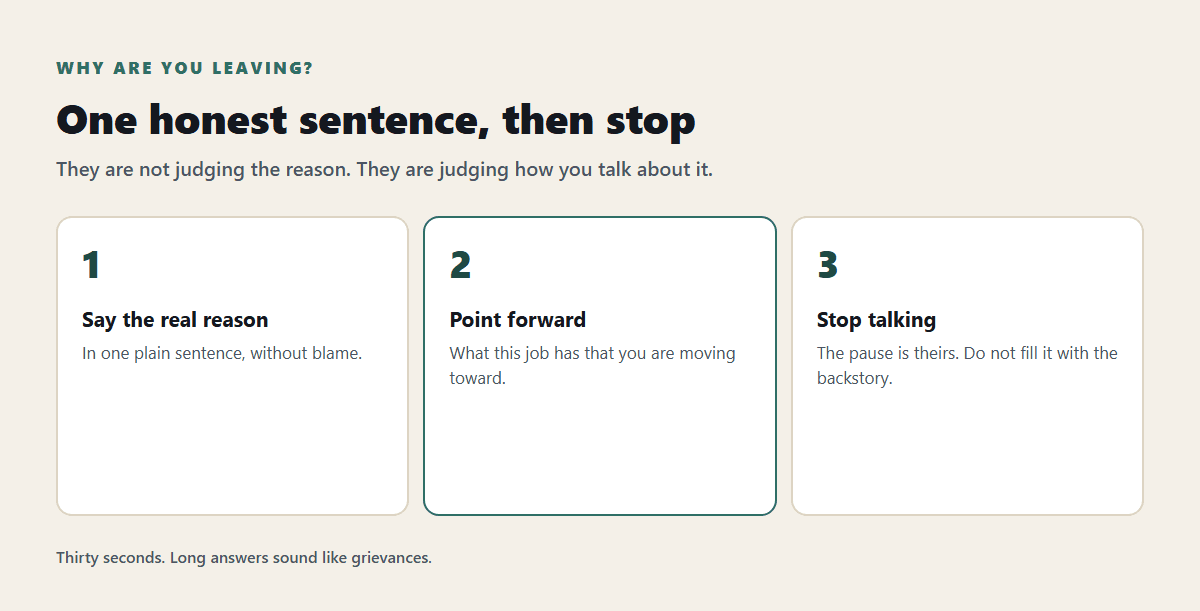
"Why are you leaving your current job?" comes up in almost every interview, and it makes people nervous out of proportion to how much it matters. Interviewers are not judging the reason. They are listening to how you talk about it: whether you blame, whether you ramble, and whether you sound like someone moving toward something.
I asked this question for twenty years from the hiring side of the table. Here is what a good answer sounds like, and what to say in the hard cases.
What they are really asking
Three things:
- Will you leave us the same way? If you left because of a bad manager, they want to know what you did about it before you quit.
- Are you running from something or toward something? "Toward" always sounds better, and it is usually true as well.
- Can you talk about a hard subject calmly? This is the test most people fail. Not with the reason, but with the tone.
Good reasons for leaving a job
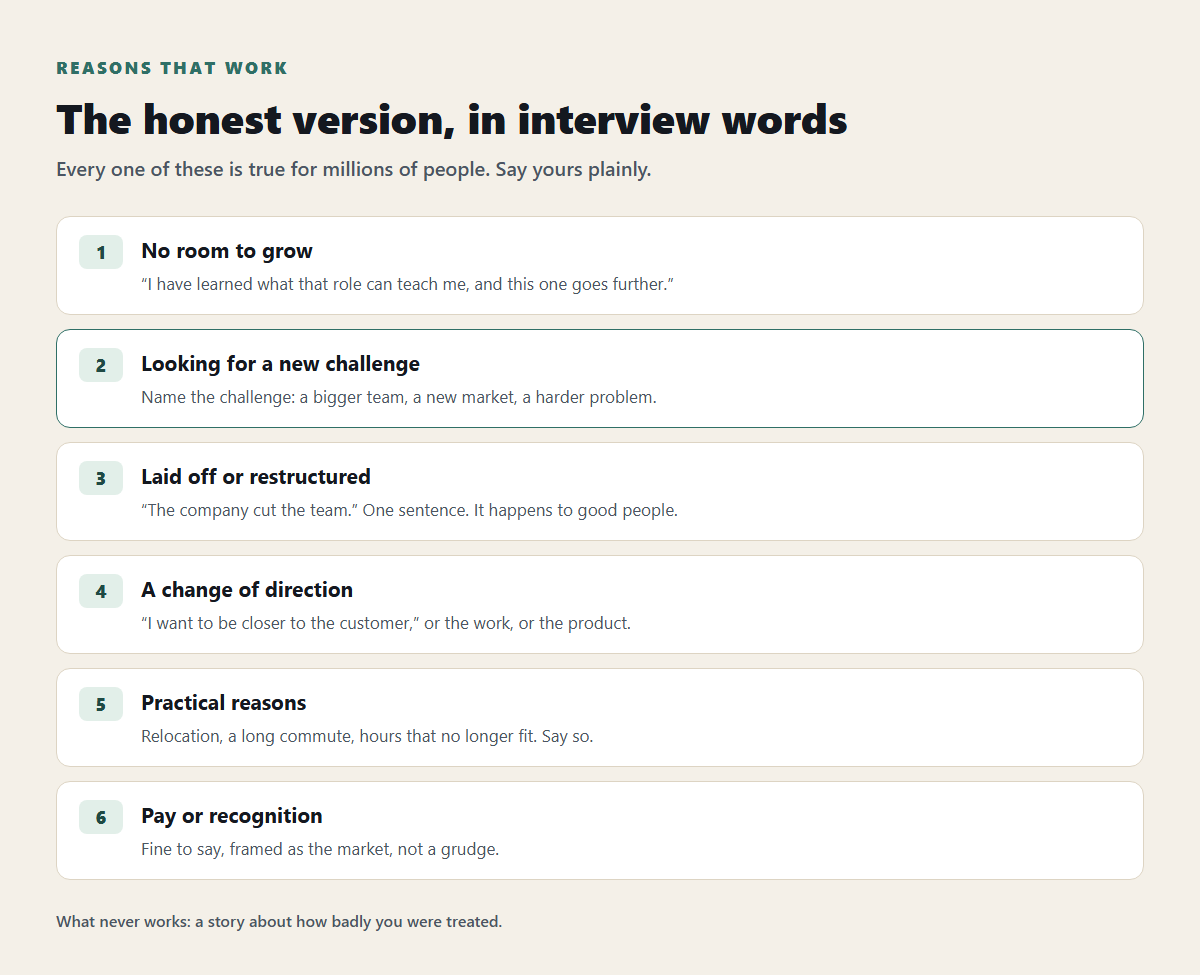
Every reason on that card is normal. Growth, a new challenge, a layoff, a change of direction, a move, better pay. Millions of people leave jobs for exactly these reasons every year, and interviewers know it.
The reason does not need dressing up. It needs to be said plainly, once, and then connected to the job in front of you.
The three-part answer
1. The reason, in one sentence. "I have grown as far as I can in that role."
2. What you are moving toward. "This role has the client-facing work I want more of."
3. Stop. Resist adding the history. If they want more, they will ask.
Put together:
"I have learned a lot in my current role, and I have reached the point where there is not much more it can teach me. This job has the client-facing work I want more of, which is why I applied."
Thirty seconds. That is the whole answer.
The hard cases
You were fired. Do not hide it, and do not tell the story. "That role ended; it was not the right fit, and here is what I took from it." One sentence of reflection, said calmly, closes it. Interviewers hear "fired" far more often than candidates think. What they cannot forgive is a cover story that unravels during a reference check.
You were laid off. This is not a mark against you, and you should not treat it like one. "The company cut the department in March" is a complete answer. If you want, add one line about what you did with the time.
A bad boss. Never say "my manager was terrible," even when it is true. Interviewers cannot check it, and they picture you saying it about them next. Instead, describe the gap: "I want a manager who gives direct feedback, and I did not have that." Then move on.
Burnout. Honest and increasingly common. Keep it practical: "The last two years were a heavy stretch, and I am looking for a role with a sustainable pace where I can do my best work." Do not apologize for it.
It has been a very short stint. Say what you learned and what you want instead. "Six months in, it was clear the role was mostly reporting, and I want to build things. I would rather make that change now than in two years."
You are still employed and interviewing quietly. You can be honest about that too: "I am happy where I am, and this came up because it is the kind of work I have been hoping to move into."
<!-- fanouts-2026-10-25 -->If there is a gap on your résumé
A gap is a reason-for-leaving question in disguise, and it gets the same three-part answer: what happened, what you did with the time, why now.
Say what it was in one plain sentence. "I left to care for a parent." "I was laid off in a round of cuts and the market was slow for my role." "I took a year to finish my degree." Interviewers fill silence with worse guesses than the truth, so do not leave it blank.
Add one thing you did with the time. A course, freelance work, volunteering, a certification, a project. If the honest answer is "I rested and looked for work," say that, and then move straight to why this role.
Do not apologize for it. A gap explained calmly in two sentences is forgotten by the next question. A gap explained with a wince becomes the thing they remember.
Match your dates. Whatever your résumé says, your LinkedIn and your answer should say the same thing. Discrepancies are what turn a gap into a trust problem.
Gaps under three months rarely need explaining at all. If asked, "the search took a few months" is a complete answer.
Mistakes that cost offers
- Blame. Any version of "they did not appreciate me."
- The full history. The answer gets longer and the tone gets worse with every sentence.
- Money as the whole reason. It is fine as part of the answer, framed as the market. Alone, it tells them you will leave for the next raise.
- A reason that contradicts your résumé. If your résumé says you left in June and you say you are still there, the interview is over.
- Saying nothing is wrong. "No reason, just looking" sounds evasive. Everyone has a reason.
Say it out loud, twice
This is the one answer where tone matters more than wording, and tone is impossible to check in your head. Say your three sentences out loud, then once more. If the second version is shorter, you are getting it right.
RehearseAI will ask you this question out loud in a mock interview built from the actual job posting, follow up the way a real interviewer would, and tell you afterward how it came across. Every account gets 10 free practice minutes a month, no credit card required. It usually pairs with the biggest weakness question and tell me about yourself, so prepare those together.
Quick answers
Is "better pay" a good reason for leaving a job? Yes, if it is not the only reason you give. "The market has moved and the role has not" is honest and fine.
Should I say I was fired? If asked directly, yes, briefly and calmly. Never lie; references check out.
What if I just did not like the job? Translate it into what you want instead. "I want more variety" says the same thing without sounding negative.
How long should the answer be? Under thirty seconds. Three sentences.
<!-- related-guides -->Related guides
If this was useful, these are the next ones to read:
- The STAR Method Interview Answer, Step by Step: A clear breakdown of the STAR method interview answer, how long each part should take, three worked examples, and the five mistakes that flatten a good story.
- Salary Expectations: How to Answer in an Interview: How to answer "what are your salary expectations?" without underselling yourself: three honest ways to respond, how to find your range, and what to put in the desired salary box.
- Common Interview Questions and How to Answer Them: The 15 most common interview questions, what each one is really checking, and the answer shape that works for it, with links to the full answer for the hard ones.
- STAR Method Examples for 8 Common Questions: Eight worked STAR method examples for the behavioral questions that come up most, plus what the interviewer is really checking each time.
Sources
University career centers whose interview guidance the approach above follows:
- Interview Preparation — Career Engagement, University of California, Berkeley
- Interviewing — MIT Career Advising & Professional Development
- Interview Preparation Guide — UConn Center for Career Readiness
More on why I built this. The free question generator writes the questions a posting will ask — no account needed.