RehearseAI
"So, tell me about yourself."
It is almost always the first question, and it is the one people most often get wrong — not because it is hard, but because it is vague enough that everybody fills the space differently and most of them fill it badly.
Some recite their resume in chronological order starting with school. Some talk about their family and their dog. Some freeze, because it is a question with no obvious edges.
What the interviewer wants is narrower than it sounds, and once you know the shape it becomes the easiest ninety seconds of the interview.
What they are actually asking
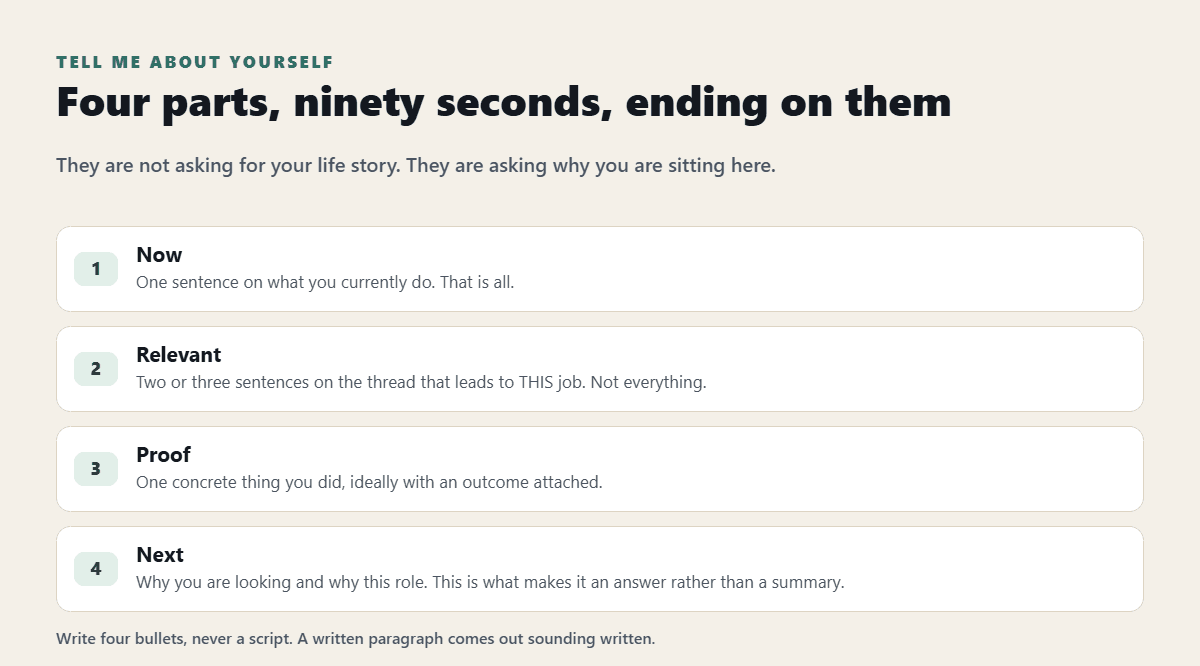
Not your life story. They are asking: why are you sitting here, and should I be interested?
It is a warm-up for them as much as for you. They are settling in, checking you can speak in full sentences, and deciding how the next forty minutes will feel. A clear, confident opening buys you goodwill that lasts the whole conversation.
The shape that works
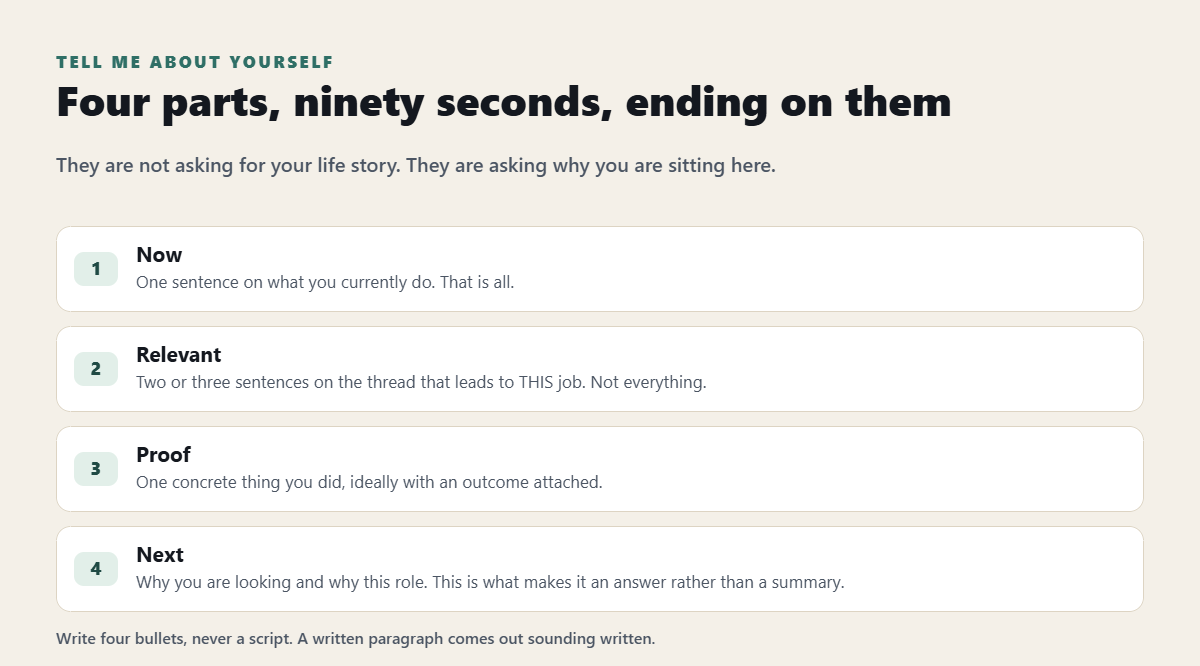
Four parts, ninety seconds total:
Now. One sentence on what you currently do. Relevant. Two or three sentences on the parts of your background that matter for this job — not everything, just the thread that leads here. Proof. One concrete thing you did, ideally with an outcome. Next. Why you are looking, and why this role.
That last part is what makes it an answer rather than a summary. It ends by pointing at them.
A worked example
"I am a support lead at a fintech company, where I look after a team of six handling second-line escalations.
I came into support from a technical background, which turned out to matter — most of what reaches second line is a product problem wearing a support costume. Over the last two years I have spent as much time working with engineering on root causes as I have on tickets.
The thing I am proudest of is a review we ran on our top ten repeat issues. We fixed four of them properly and the escalation volume dropped noticeably for the rest of the year.
I am looking now because I want to do that at a bigger scale, and this role is the first one I have seen where fixing the causes is actually part of the job description rather than something you do on the side."
Ninety seconds. Nothing about school, nothing about hobbies, and it lands on the role.
The four common failures
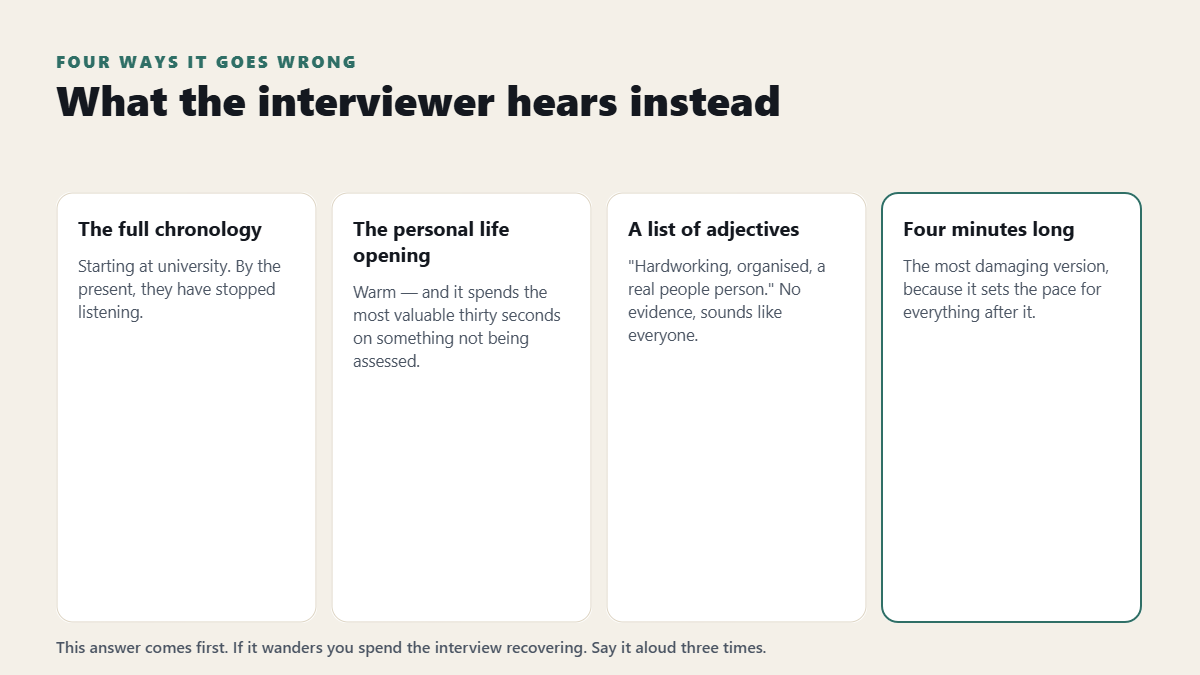
The full chronology. Starting at college and walking forward. By the time you reach the present the interviewer has stopped listening.
The personal life opening. Where you grew up, your partner, your dog. Warm, and it uses the most valuable thirty seconds of the interview on something not being assessed.
The vague list of adjectives. "I'm hardworking, organized and a real people person." No evidence, and it sounds like every other candidate.
Going on too long. Four minutes is common and it is the single most damaging version, because it sets the pace for everything after it.
Adjusting for context
Same shape, different emphasis:
- Screening call with a recruiter? Shorter, sixty seconds, more factual.
- Career changer? Spend a sentence on why the change, then bring the transferable thread forward. Do not apologize for the switch.
- Graduate or first job? Study, one project or job you took seriously, what you want to learn. Nobody expects a decade.
- Very senior role? Slightly longer is acceptable, but lead with scope — team size, remit, the kind of problem you own.
Write four bullets, not a script
The mistake is writing it out in full. A written paragraph comes out of your mouth sounding written — too neat, no breathing, and it collapses the moment they interrupt.
Four bullets: now, relevant, proof, next. That is all you need to rebuild it live, and rebuilding it live is what makes it sound like a person talking.
Then say it out loud, three times
This one answer deserves more rehearsal than any other, for a simple reason: it comes first. If it wanders, you spend the rest of the interview recovering. If it lands, you relax, and so do they.
Say it aloud and time it. The first attempt will run long. The second will be tighter. By the third it usually sounds like you rather than like a recital — and that third version is the one they should get.
If you want it asked properly, with a follow-up afterward, RehearseAI runs it out loud for the role and tells you how long you actually took and where the answer sagged. Every account gets 10 free practice minutes a month — one 10-minute interview, or shorter sits whenever you like, no credit card required.
Quick answers
How long should "tell me about yourself" be? Sixty to ninety seconds. Two minutes at the very outside.
Should I mention hobbies? Only if genuinely relevant, or as a single closing clause. It is not what the question is for.
Should I explain a career gap here? One brief, unembarrassed sentence is fine. Do not make it the center of the answer.
Is it the same as "walk me through your resume"? Close, but that one invites a bit more chronology. Same shape, slightly more structure by role.
<!-- related-guides -->Related guides
If this was useful, these are the next ones to read:
- The Biggest Weakness Interview Question: What the biggest weakness question actually tests, why the perfectionist answer fails, and the four-part structure that works without damaging you.
- What Are Your Strengths? How to Answer in an Interview: How to answer "what are your strengths?" in a job interview: how to pick the right one, the three-part answer that works, and examples you can adapt.
- Reasons for Leaving a Job: How to Answer in an Interview: Good reasons for leaving a job, the honest one-sentence answer that works in an interview, and how to handle the hard cases: fired, laid off, a bad boss, or burnout.
Sources
The advice above lines up with what university career centers and professional bodies publish; these are the pages I checked it against:
- How to perfectly answer the "tell me about yourself" interview question — Wofford College Career Center
- How to answer "tell me about yourself" — UMass Lowell Career Services
- Mock Interview Pre-work: Tell Me About Yourself — Lehigh University Center for Career & Professional Development (PDF)
Related: interview practice questions worth rehearsing and the STAR method. More on why I built this.