RehearseAI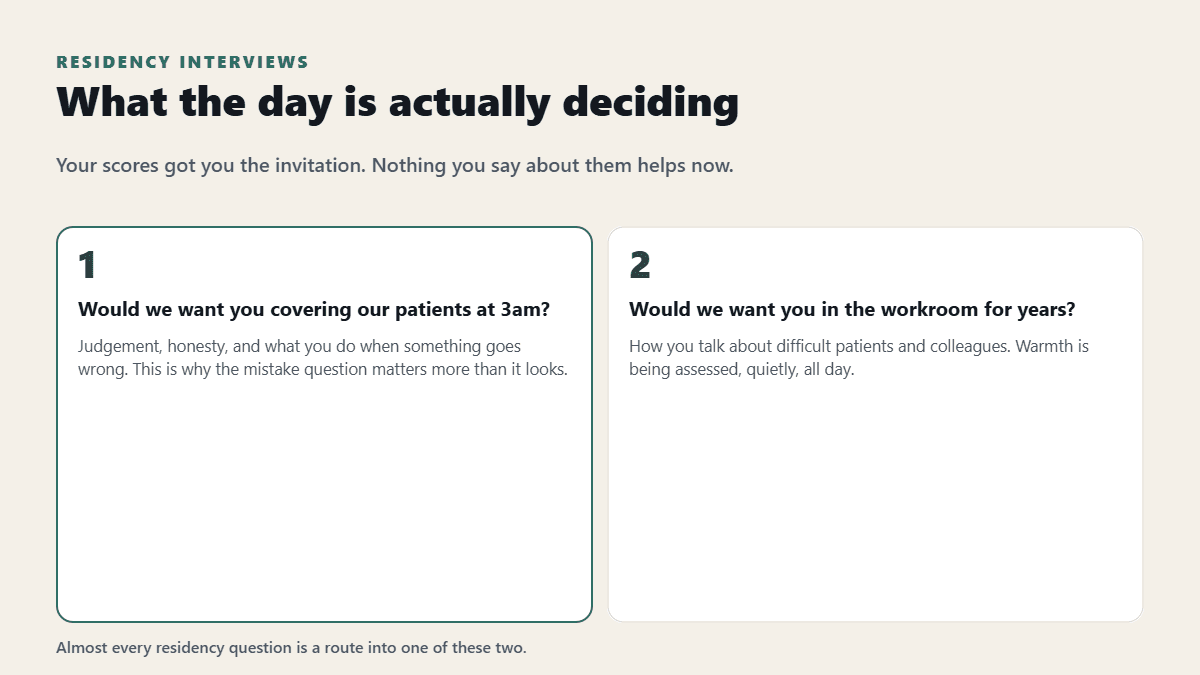
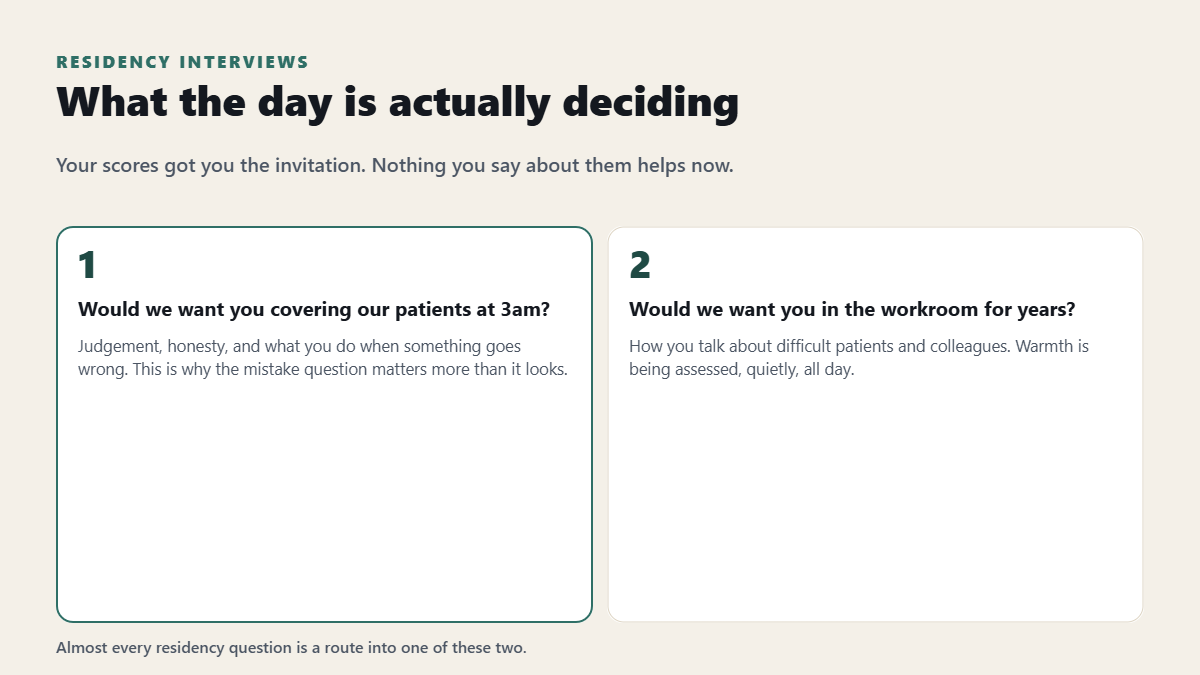
Residency interviews are strange in a specific way: by the time you are in the room, everyone has already decided you are academically capable. Your scores got you the invitation. Nothing you say about them will improve your position.
What the day is actually for is answering two quieter questions. Would we want this person covering our patients at three in the morning? And would we want them in the workroom for the next several years?
Almost every residency interview question is a route into one of those two.
"Tell me about yourself"
Nearly always first, and the one most applicants over-prepare into something stiff.
Ninety seconds. A line about where you started, the turn that pointed you at this specialty, one thing you did about it, and where you want to go. Not a spoken CV — they have the CV.
The most useful test: could a friend hearing it recognize you? If it sounds like any applicant, rewrite it.
"Why this specialty?"
They are checking that the choice is grounded in the actual work rather than an idea of the work.
Anyone can say they love the patient relationships in family medicine or the intensity of emergency care. What lands is a specific moment — a rotation, a patient, a night on call — and what it showed you about the day-to-day. Then, ideally, something you did afterwards to test whether the pull was real.
"Why our program?"
The most-failed question of the day, because a generic answer is instantly recognisable.
Name something only true of them: a rotation structure, a patient population, a track, a person whose work you followed. Then connect it to something concrete about you. Two sentences of specificity beats a paragraph of praise.
"Tell me about a difficult patient encounter"
Not a test of whether you were right. A test of whether you noticed the other person.
Give the situation briefly, say what was actually hard about it — usually communication, not medicine — say what you did, and end on what you now do differently. Blaming the patient is the one way to lose this question outright.
"Tell me about a mistake"
Say a real one. Interviewers have heard "I work too hard" and its variants a thousand times, and the deflection tells them more than the answer would have.
Structure it: what happened, how it was caught, what you did immediately, what you changed. The point is not that you are flawless. It is that you disclose, escalate and correct — which is precisely what they need at three in the morning.
"What are your strengths and weaknesses?"
The weakness must be genuine and must come with the correction. "I used to hold onto tasks too long before escalating; on my last rotation I set myself a rule to flag anything I had been stuck on for more than twenty minutes."
Real, specific, already being worked on.
"Where do you see yourself in ten years?"
Direction, not a fixed plan. Fellowship, academic medicine, rural practice, whatever it is — say what you are leaning towards and what would confirm it. Certainty you do not have is easy to hear.
What to ask them
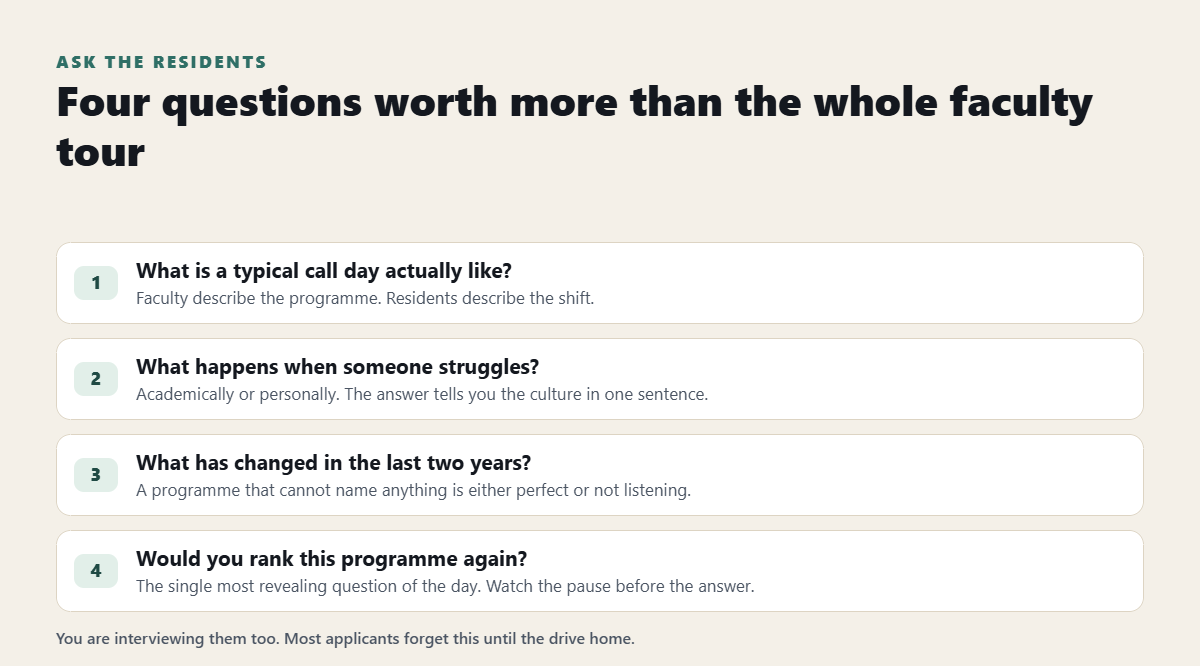
Residents interview you all day; you should be interviewing them too. Ask the residents, not just the faculty:
- What is a typical call day actually like here?
- What happens when someone struggles — academically, or personally?
- What has changed in the program in the last two years?
- Would you rank this program again?
That last question, asked of a resident, is worth the entire day.
The part that only works out loud
You can write perfect answers to all of the above and still deliver them badly, because interview day is not a writing exercise. It is eight to twelve conversations in a row, most of them warm, some of them not, all of them while you are tired and trying to seem fresh.
So rehearse aloud, not on paper. Say your "tell me about yourself" until it stops sounding recited and starts sounding like you. Then do the mistake question, which is the one that catches people.
If nobody is around to run it with you, RehearseAI will — real questions for the specialty and stage, out loud, with honest feedback on pace, filler and what you actually said. Every account gets one free 5-minute interview a month, no credit card required.
Quick answers
How long should residency interview answers be? Ninety seconds to two minutes. Interview days are long and short, clear answers are a mercy.
Is it acceptable to say I am also considering another specialty? Only if the program is dual or you have a genuine reason. Otherwise it reads as uncommitted.
How many program-specific facts should I have ready? Two or three real ones per program is plenty, and far better than ten generic ones.
What if I am asked something illegal, like about children or marriage? You may redirect politely — "I am focused on training right now" — and it is worth noting how it was handled when you rank.
Sources
The advice above lines up with what the Match organizations and the AMA publish for applicants; these are the pages I checked it against:
- Residency Applicants — National Resident Matching Program (NRMP)
- Preparing for Residency — American Medical Association
- Students, Applicants, and Residents — Association of American Medical Colleges (AAMC)
The behavioral questions here fit the STAR method exactly. More on why I built this.