RehearseAI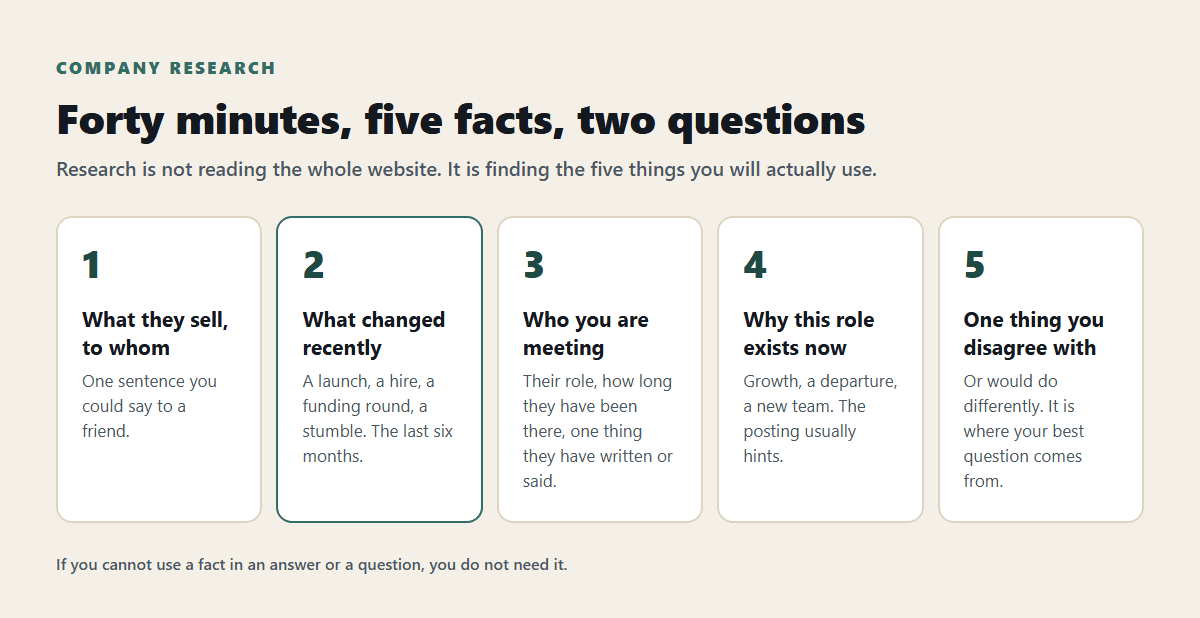
"Research the company" is the most common piece of interview advice and the least specific. Read the website. Know the mission. Understand the values. Candidates dutifully spend an evening on it and arrive able to recite the About page, which the interviewer wrote and does not want to hear back.
Here is how to research a company before a job interview in a way that shows up in your answers: forty minutes, five facts, and two questions.
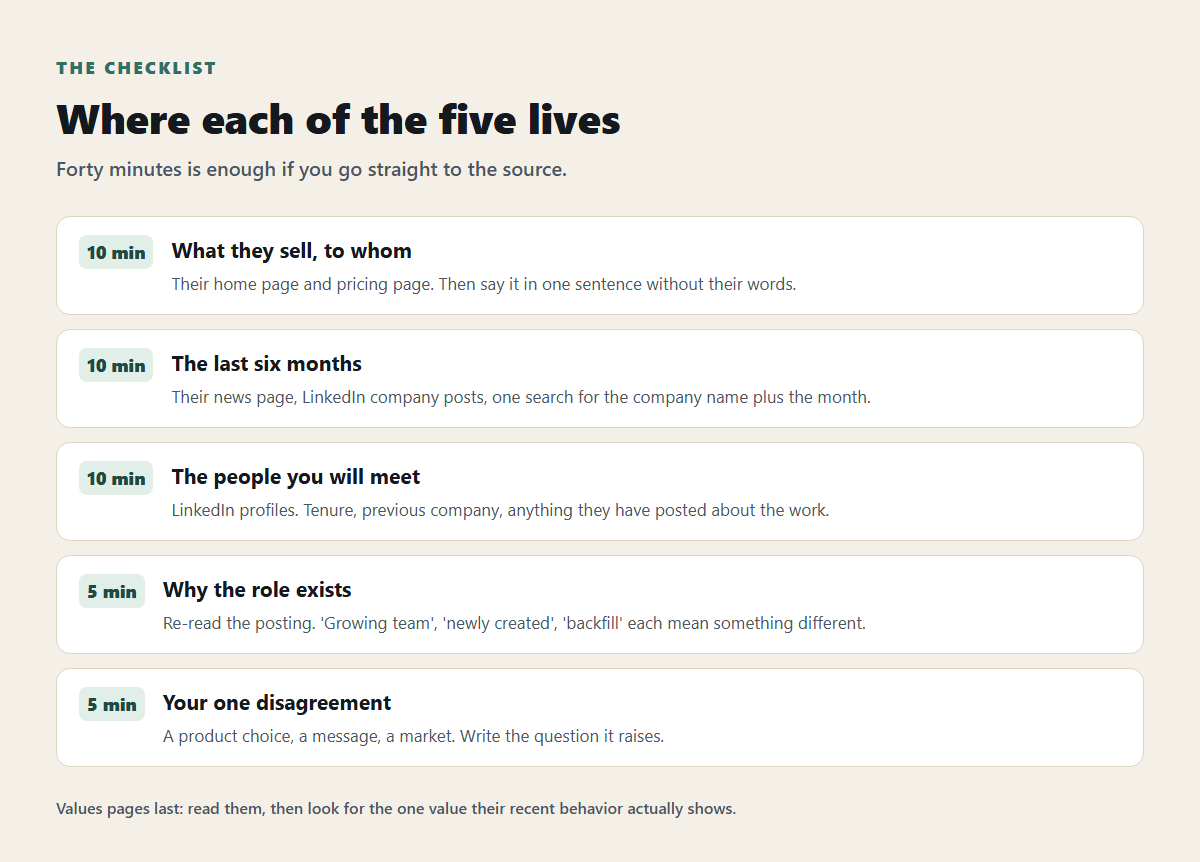
The five things worth knowing
The test for any fact is simple: can you use it in an answer or a question? If not, you do not need it.
1. What they sell, and to whom. One sentence, in your own words, that you could say to a friend. "They make scheduling software for dental practices." If you cannot do this, nothing else in the research matters, and it is the first thing the interviewer will notice.
2. What changed in the last six months. A product launch, a new executive, a funding round, a layoff, an acquisition, a public stumble. Companies in motion have a reason for hiring, and the recent news usually tells you what it is. This is also where "why us" answers stop being generic: "I saw you launched the mid-market tier in June, and this role reads like it exists to support that."
3. Who you are meeting. Their role, how long they have been there, where they were before, and one thing they have written or said about the work. Not to flatter them. To calibrate: a hiring manager who joined three months ago is building; one who has been there eight years is protecting.
4. Why this role exists now. The posting usually hints. "Newly created" means nobody has done it before and the shape is negotiable. "Growing team" means capacity. A backfill means someone left, and it is fair to ask why.
5. One thing you disagree with, or would do differently. A product decision, a piece of marketing, a market they have not entered. You will not say it as a criticism. You will turn it into your best question.
Where the values page fits
Every company has a values page, and every candidate is told to "connect the company values to your answers." Done literally, this produces answers like "I really identify with your value of ownership," which sounds like it was generated.
Do it the other way around. Read the values page, then look at the recent news and the job posting and ask which one value the company's actual behavior shows. A company that just shipped three products in a quarter really does value speed, whatever else the page says. Then pick one of your stories that shows the same thing, and tell it without naming the value. The interviewer will make the connection, and it lands far harder than the label would.
How to use the research in the room
Research shows up in three places, and only three.
"Why us?" One specific thing from item 2 or 4. "The mid-market launch" beats "your reputation for innovation" every time, because only one of those proves you looked.
One answer, quietly. When you tell a story that happens to match the value their behavior shows, you have used the research without announcing it.
Your two questions at the end. This is where item 5 pays off. "I noticed you have not gone after the enterprise segment; is that a choice or a timing thing?" is the kind of question that gets remembered, because it means you thought about their business rather than their brochure. Ask about the work, never about the perks.
What not to do
Do not memorize the founding year, the headcount, or the mission statement. Do not mention the CEO's podcast appearance unless it is relevant to the role. And do not let research eat the evening you should have spent saying your answers out loud. Forty minutes of research and forty minutes of spoken practice beats three hours of reading, every time.
If you want the practice half handled, RehearseAI runs the interview out loud for the actual posting, follows up when you dodge, and tells you afterwards how it sounded. Every account gets one free 5-minute interview a month, no credit card required.
Quick answers
How much company research is enough? Forty minutes, five facts, two questions. If you can say what they sell in one sentence and name one recent change, you are ahead of most candidates.
Should I mention I researched them? Never as a statement. Let the specific detail in your "why us" answer do the telling.
What if I cannot find recent news? Small companies often have none. Use the posting instead: why the role exists now is your "recent change."
What if I disagree with something they do? Turn it into a curious question, not a critique. "Is that a choice or a timing thing?" is how you say it.
Sources
The approach above lines up with what university career centers publish on interview preparation; these are the ones I checked it against:
- Interview Preparation — Career Engagement, University of California, Berkeley
- Preparing for Interviews — Tufts University Career Center
- Interview Preparation Guide — UConn Center for Career Readiness
Research is one part of a personalized interview preparation plan. More on why I built this.
The free question generator turns the posting into the questions they will ask — no account needed.