RehearseAI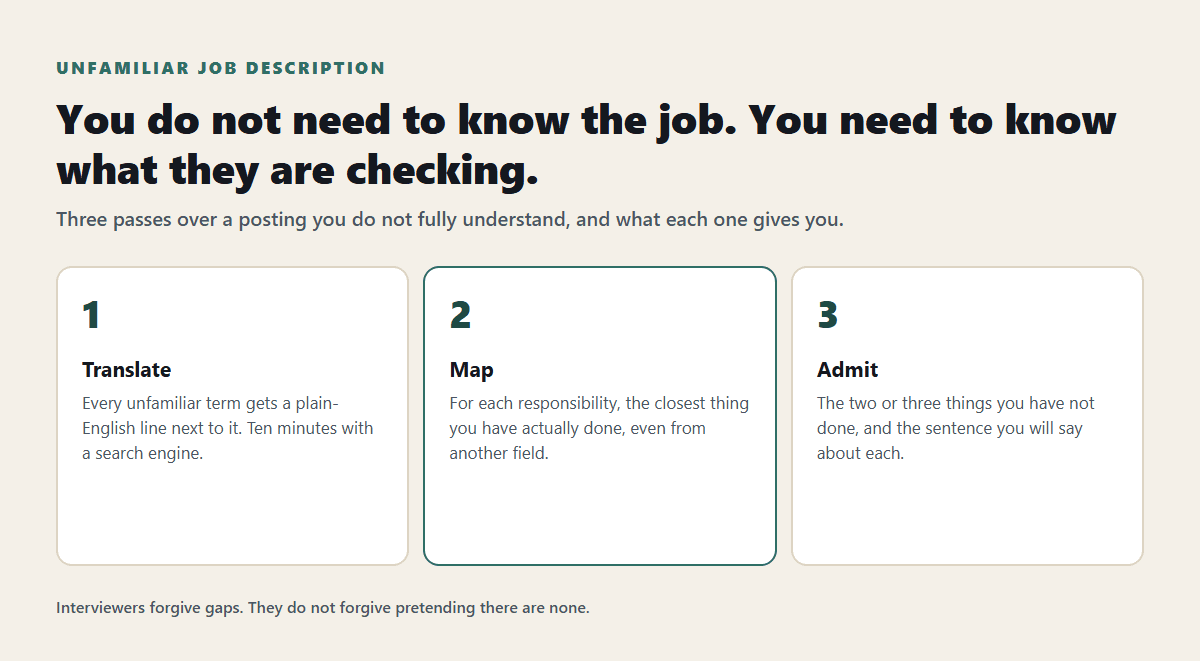
Sometimes you get an interview for a job you do not fully understand. A career change. A title that means something different at this company. A posting full of tools and acronyms you have never used. You know you can do the work, or at least that you could learn it, but the description reads like it was written for someone else.
Here is the thing to hold on to: the interview is not a test of whether you already know the job. It is a test of whether they can picture you doing it. That is a much more manageable problem, and it can be prepared for in a few hours.
First pass: translate everything you do not recognize
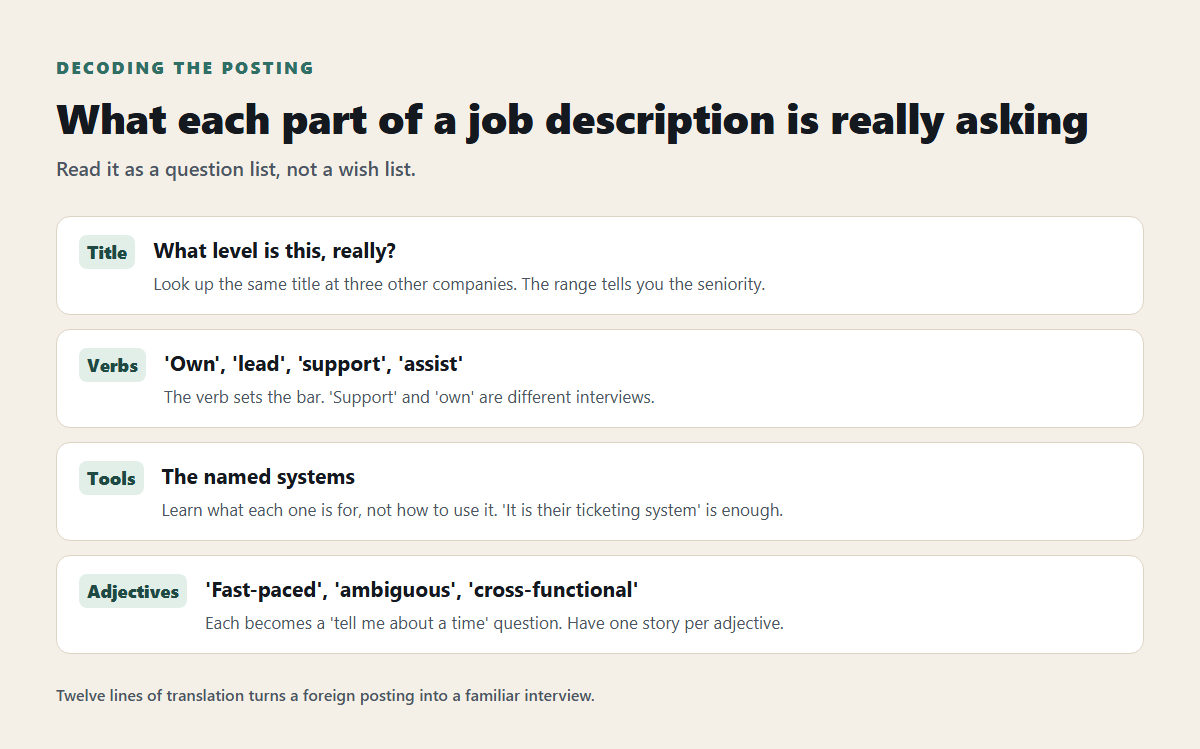
Go through the posting line by line and, next to every unfamiliar term, write a plain-English note. What is that tool for? What does that acronym stand for? What does "stakeholder alignment" mean in practice at a company like this?
This takes ten or fifteen minutes with a search engine, and it removes most of the fear. A job description that seemed foreign usually turns out to be a job you understand, described in a vocabulary you had not met. You do not need to be fluent. You need to not freeze when they use the word.
The one thing worth researching properly is the title. Search the same title at three or four other companies and read their postings. The overlap tells you what the role actually is; the differences tell you what this company has added. If a "coordinator" at this company is a "manager" everywhere else, you now know something about the seniority, and possibly the pay.
Second pass: map your experience onto theirs
Now read the responsibilities as a list of questions. "Manage vendor relationships" is really "tell me about a time you had to get something from a person who did not report to you." "Own the monthly reporting" is "how do you make sure something recurring is right every time?"
For each one, write the closest thing you have actually done, even if it comes from a different field, a different job title, or outside work entirely. You have never managed vendors, but you ran the volunteer roster for three years and got forty people to show up on time. Same skill. Say so.
Four short lines per example: where you were, what was yours to do, what you did, what changed. That shape is the STAR method, and it works across fields precisely because it is about what you did, not what you were called.
Third pass: name the gaps and decide what you will say
There will be two or three responsibilities where you have nothing close. Do not paper over them. Interviewers can hear a bluff from across the table, and a bluff on a small gap costs you more than the gap itself would have.
Instead, write one honest sentence for each. "I have not used that system. I picked up two similar ones in my last role within a month, and I would expect the same here." Or: "That part is new to me, and it is one of the reasons I want the job." Then move on. A named gap with a plan is a normal thing for a candidate to have. An unnamed one is a risk the interviewer has to guess at.
It also helps to have one question ready about the biggest gap. "How much of the week is the reporting side?" tells you how much it matters, and shows you read the posting properly.
Practice the translation out loud
Everything above is easier to write than to say. The moment an interviewer uses one of those terms in a question, you have to translate, find your example, and answer, in real time, while looking at them. That is the part that needs rehearsal.
So take four of the responsibilities, ideally including one gap, and answer them out loud on a timer. Sixty to ninety seconds each. Listen for the place where you reach for their vocabulary and stumble, and say that answer again. Two short sessions on different days is enough.
If you want the questions asked to you rather than read to yourself, paste the posting into the free question generator and you will get the questions that role would actually ask, each with a line on what the interviewer is checking. RehearseAI will then run the interview out loud for that posting, follow up when you dodge, and tell you afterwards how it sounded. Every account gets one free 5-minute interview a month, no credit card required.
Quick answers
Should I tell them the job description was unfamiliar to me? Not in those words. Say what you did about it: "I looked into what the reporting side involves, and here is how it maps to what I have done."
What if I do not know most of the tools listed? Learn what each one is for, not how to use it. Interviewers hire for the skill; the tool is usually a month of learning.
How do I answer "why this role" when it is a change of field? With the thread that connects them. What you were doing before, what you liked most about it, and why this role has more of that.
Is a big gap a reason not to interview? Rarely. Postings describe an ideal candidate who mostly does not exist. Interview, name the gap, and let them decide.
Sources
The approach above lines up with what university career centers publish on preparing for interviews; these are the ones I checked it against:
- Interview Preparation Guide — UConn Center for Career Readiness
- Preparing for Interviews — Tufts University Career Center
- Interview Prep — Florida State University Career Center
The examples you map onto the posting should follow the STAR method. More on why I built this.
Not sure what they will ask? The free question generator writes the questions from the posting — no account needed.