RehearseAI
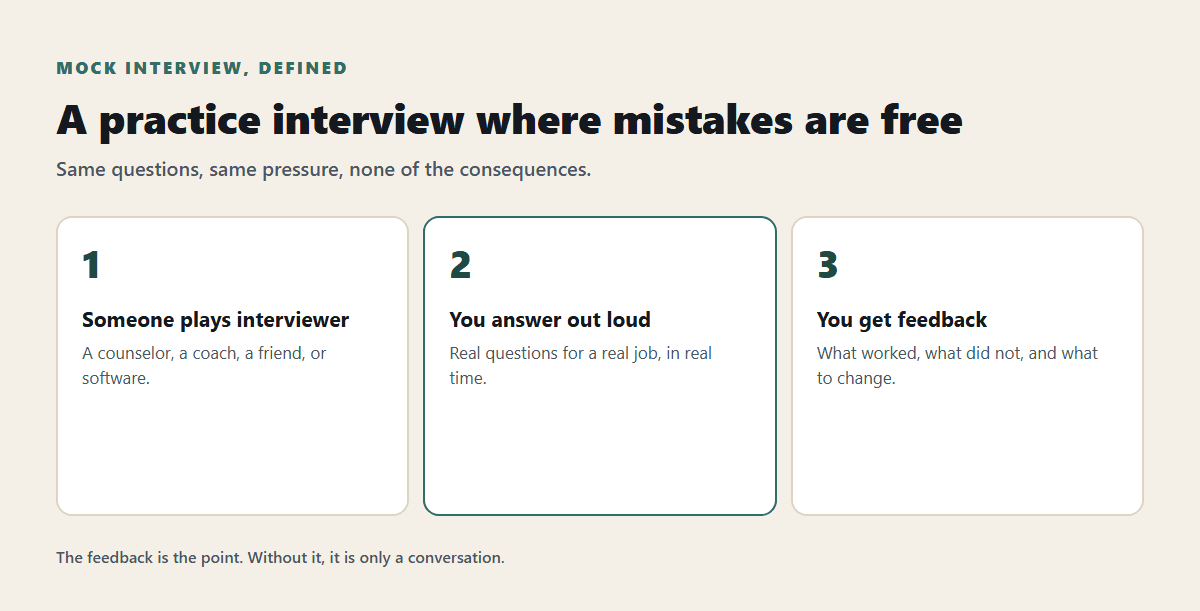
A mock interview is a practice interview. Someone plays the interviewer, asks you the kind of questions the real one will ask, and then tells you how you did. Nothing is at stake, which is exactly why it is useful: you get to make your mistakes somewhere they cost nothing.
That is the whole definition. The rest of this page covers what actually happens in one, who can run it, and how to prepare so you get something out of it.
Mock interview meaning, in one line
"Mock" here means imitation, not mockery. A mock interview imitates a real job interview as closely as possible: the same questions, the same format, the same slightly uncomfortable silence while you think. The only thing missing is the consequence.
Schools, career centers and coaches all use the term the same way. You may also hear "practice interview" or "interview simulation." They mean the same thing.
What happens in a mock interview
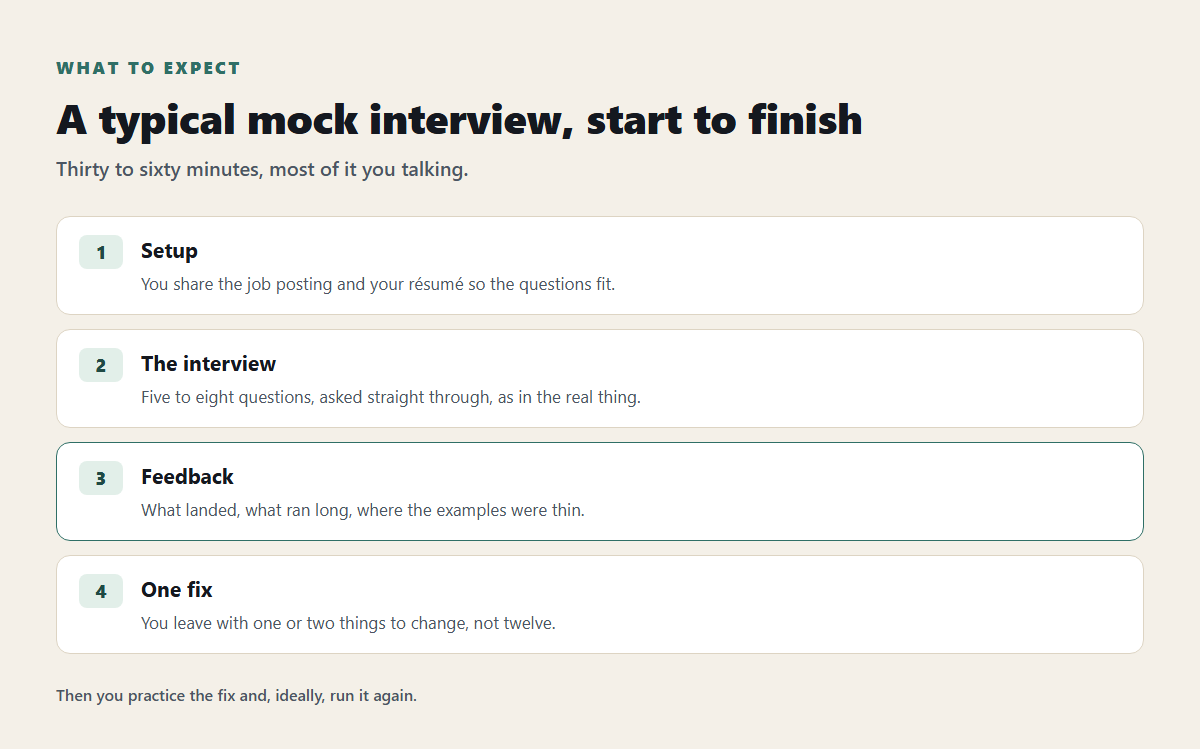
Before. You give the interviewer the job posting and, usually, your résumé. A good mock interview is built around the job you are going for, not a generic list.
During. The interviewer asks five to eight questions and you answer them out loud, in full, as if it were real. They may ask follow-ups. They should not stop to coach you mid-answer; that comes later.
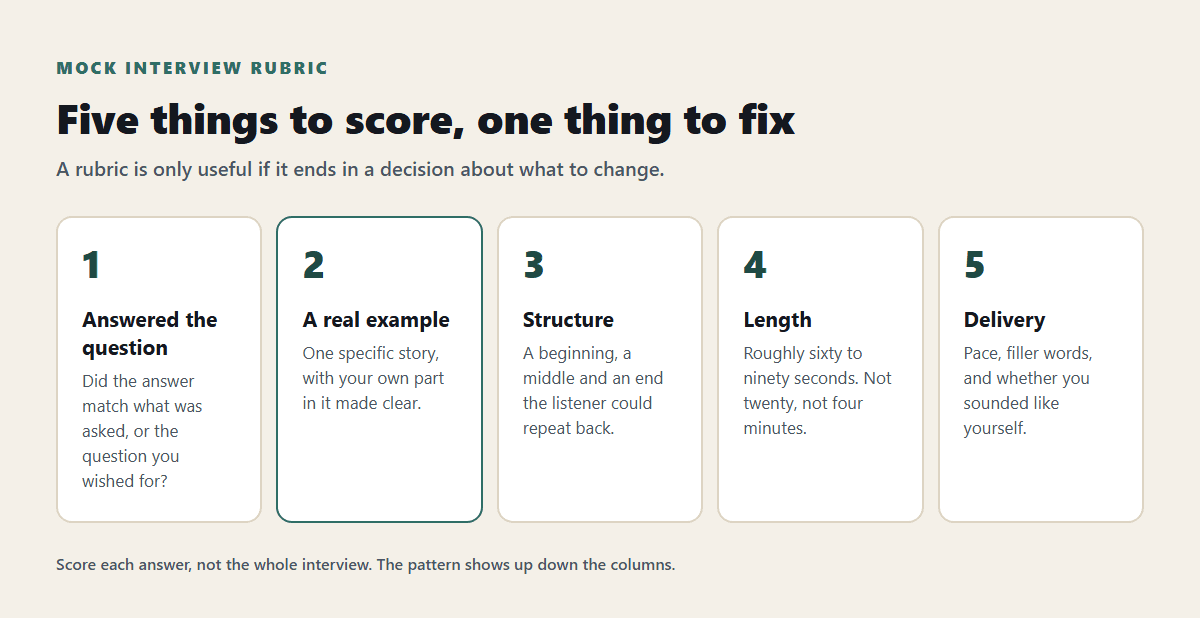
After. You get feedback. This is the part that makes it a mock interview and not a chat. Expect comments on whether you answered the question, whether your examples were specific, how long you spoke, and how you came across.
Most run thirty to sixty minutes including feedback.
Who runs a mock interview
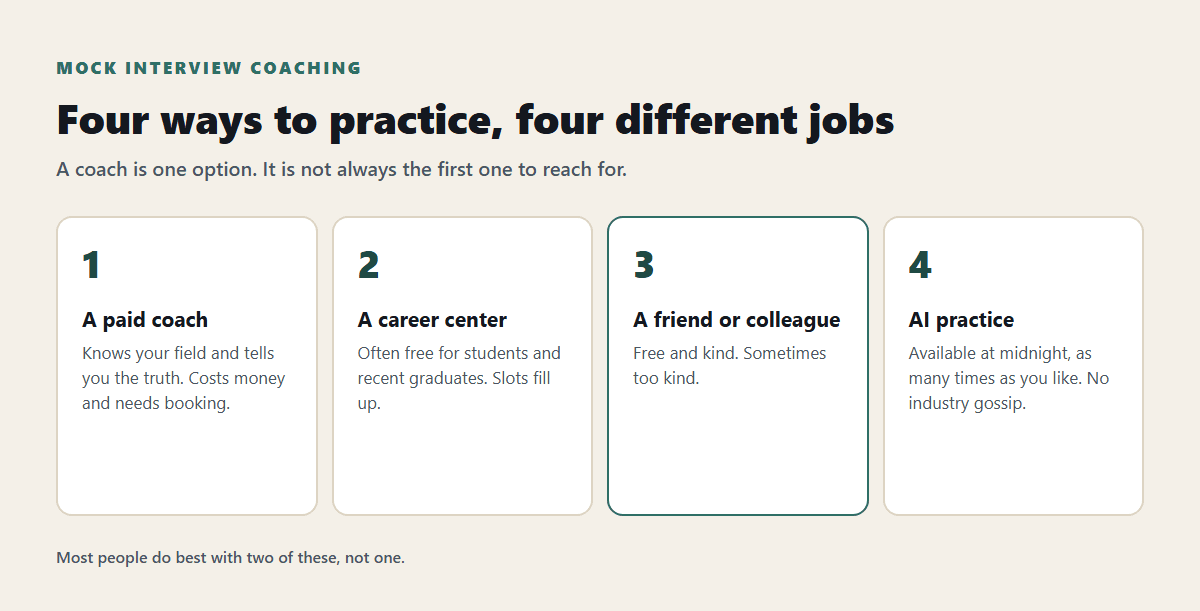
- A career center. Many schools and colleges offer them free to students and recent graduates.
- A coach. Paid, and often someone who has hired in your field. See whether mock interview coaching is worth it.
- A friend, a colleague or a family member. Free, and good if you hand them the questions and ask for honesty.
- Software. An AI interviewer that asks out loud and gives you a report afterward.
- Yourself. A list of questions, a phone camera, and the discipline to watch the recording.
The benefits of a mock interview
Three reasons, all of them simple.
Answers in your head are not answers out loud. Almost everyone thinks they know what they would say. Then they say it and it takes four minutes, or it trails off with no ending. You cannot find that out silently.
Nerves shrink with repetition. The first time you answer "tell me about yourself" under any pressure at all, your voice does odd things. The fifth time, it does not.
You cannot see your own habits. The filler words, the answer that never reaches its point, the story where you say "we" eleven times and "I" not once. Someone else catches these in minutes.
<!-- fanouts-2026-10-25 -->You find out how long your answers really are. Most people have never timed themselves. A story that feels like ninety seconds in your head is often three and a half minutes out loud, and the interviewer stopped listening at two. One mock interview with a clock fixes this faster than any amount of reading.
You hear the question you did not prepare for. Everyone rehearses "tell me about yourself." Almost nobody rehearses "what would you do differently?" or "walk me through a decision you got wrong." A mock interview surfaces the gaps while there is still time to fill them, and that alone takes a surprising amount of the fear out of the real one. If nerves are your main problem, interview anxiety: what actually helps goes deeper.
How to prepare for a mock interview
Treat it like the real one, or it will not tell you much.
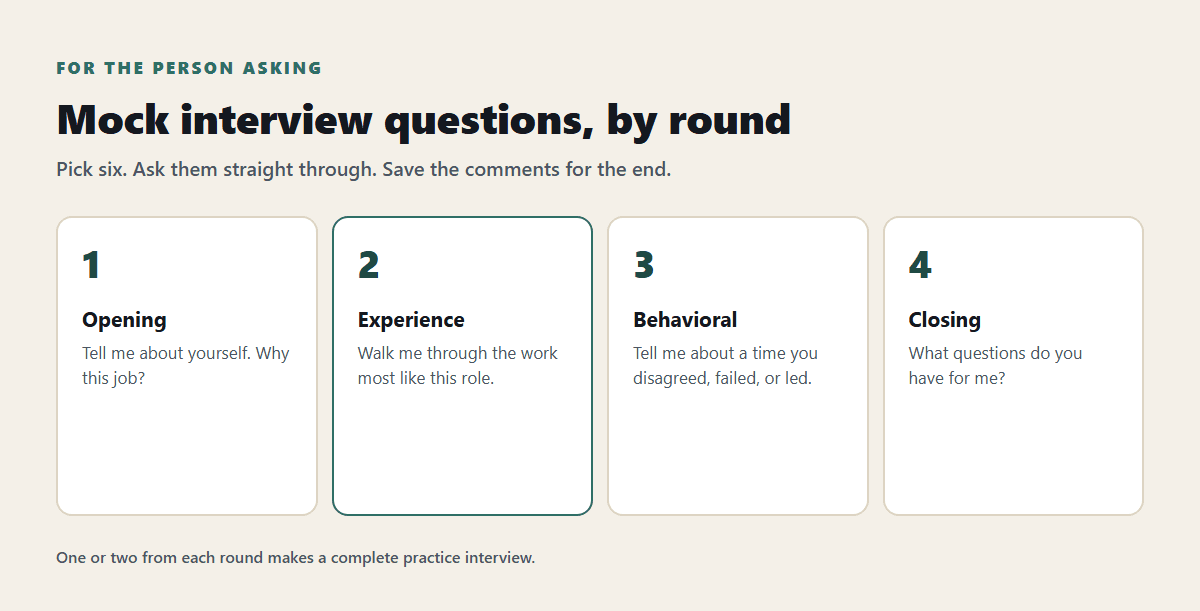
- Bring the actual job posting. The questions should come from it. If the person helping you needs a list, the free question generator will write one from the posting.
- Have four or five stories ready. Real situations from your work or studies, each one told in four parts. The STAR method is the usual shape.
- Set it up like the real format. If the interview will be on video, do the practice on video. If it is a panel, ask two people.
- Ask for the feedback you want. "Tell me where I lost you" gets better notes than "how was that?"
- Do not over-prepare. The mock interview is the preparation. Showing up a little rough is the point.
What a mock interview is not
It is not a test, and nobody passes or fails. It is not a script rehearsal either; memorized answers fall apart at the first follow-up question. And one is rarely enough. The first shows you the problems. The second shows you whether you fixed them.
If nobody is available
This is the usual obstacle. Career centers have waiting lists, friends are busy, and it is awkward to ask.
That is the gap RehearseAI fills. You paste the job posting, an AI interviewer asks the questions out loud and follows up, and you get a written report at the end. Every account gets 10 free practice minutes a month — one 10-minute interview, or shorter sits whenever you like, no credit card required. When you are ready to run a longer one with a person, how to run a mock job interview walks through it.
Quick answers
How long is a mock interview? Usually thirty to sixty minutes with feedback. A short one of five to fifteen minutes is still useful for a single question type.
What should I wear? For a first practice, anything. For the last one before the real interview, wear what you plan to wear on the day.
How many mock interviews should I do? Two or three for most roles. Stop a couple of days before the real one.
Is a mock interview the same as an informational interview? No. An informational interview is a real conversation where you ask someone about their job. A mock interview is practice for being asked.
<!-- related-guides -->Related guides
If this was useful, these are the next ones to read:
- Mock Interview Practice: How to Improve Your Answers and Timing: Most interviews are lost on pacing, not knowledge. How to get your answers into the sixty to ninety second window, and handle the follow-up without unraveling.
- Mock Interview Questions to Ask, Round by Round: Mock interview questions for whoever is playing the interviewer: a ready list by round, a set for high school students, the follow-ups that make it real, and what to listen for.
Sources
University career centers that explain what their mock interviews involve:
- Mock Interviews — The Career Center, University of Illinois
- Mock Interviews — Ohio University Career Services
- Mock Interviews — Loyola University Chicago Career Services
To score a practice run, use the mock interview rubric. More on why I built this.