RehearseAI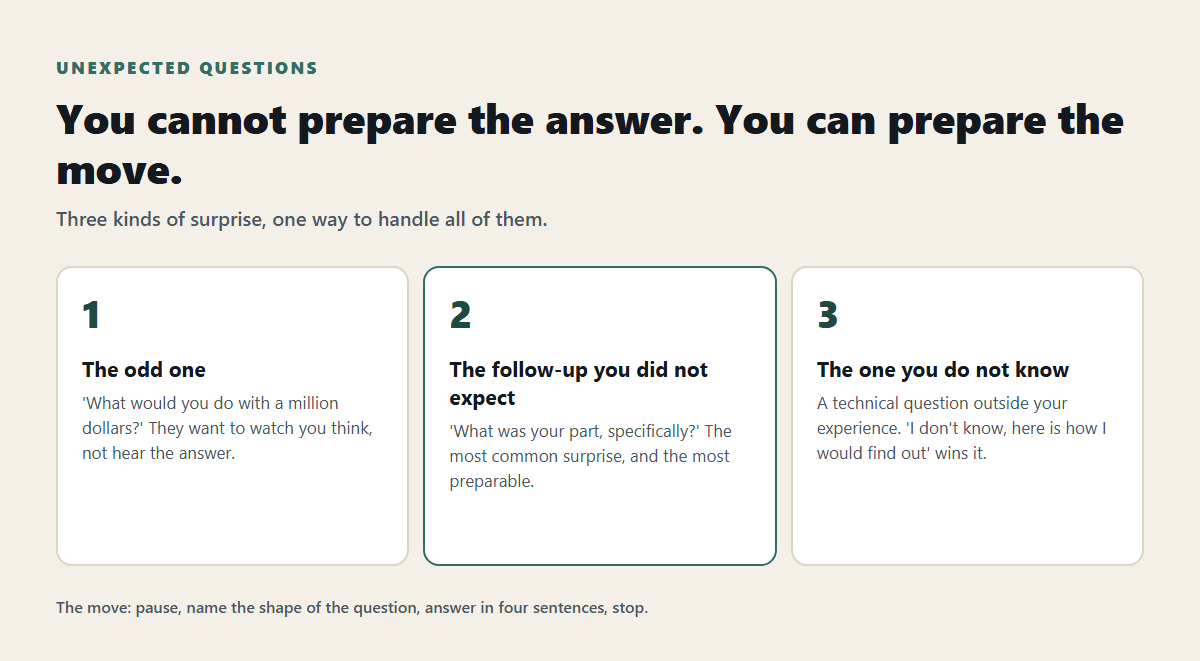
Everyone prepares for the questions they expect. Then the interviewer asks something else, and the preparation evaporates. "What would you do with a million dollars?" "What is something you believe that most people disagree with?" Or, far more often, the ordinary follow-up you did not see coming: "and what was your part in that, specifically?"
You cannot prepare the answer to a question you have not heard. You can prepare the move you make when it arrives, and the move is the same for every kind of surprise.
The three kinds of unexpected question
The odd one. The million-dollar question, the "which animal would you be", the brainteaser. These are rarer than the internet suggests, and they are not about the answer. The interviewer wants to watch you think under mild pressure. A calm, structured, slightly amused answer wins; a panicked search for the clever one loses.
The follow-up you did not expect. This is the real unexpected question, and it happens in almost every interview. You told a prepared story, and the interviewer asks a question the story did not cover: "What did your manager think?" "What would you do differently?" "Why did you choose that approach and not the other one?" Candidates who rehearsed a paragraph freeze here, because the follow-up is not in the paragraph.
The one you do not know. A technical question outside your experience, or a fact you simply do not have. The temptation is to bluff. In front of specialists, bluffing ends badly. In front of everyone else, it ends slightly less badly.
The move that handles all three
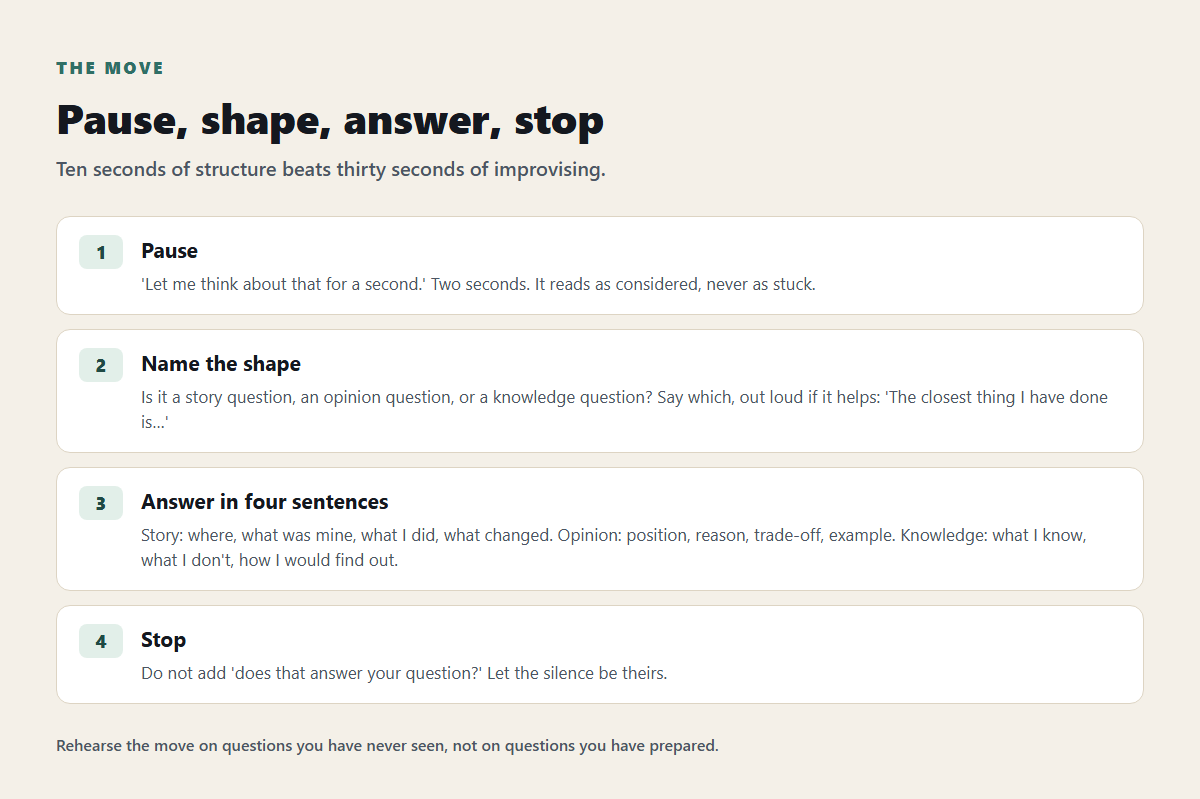
Pause. Two seconds. "Let me think about that for a second" is a complete sentence and you are allowed to say it. Almost nobody realizes that. A two-second pause reads as considered; a rush into the first thing you think of reads as nervous.
Name the shape. Every question is one of three shapes. A story question ("tell me about a time"). An opinion question ("what do you think about"). A knowledge question ("how does X work"). Odd questions are usually opinion questions in disguise. Unexpected follow-ups are usually story questions about a smaller piece of the story you already told. Deciding the shape, even silently, tells you what an answer looks like.
Answer in four sentences. For a story: where you were, what was yours to do, what you did, what changed, which is the STAR method. For an opinion: your position, your reason, the trade-off you accept, one example. For knowledge: what you know, what you do not, and how you would find out. Four sentences is enough for any surprise, and it stops you improvising a fifth, sixth and seventh.
Stop. Do not ask "does that answer your question?" Do not keep talking to fill the silence. The silence is theirs. If they want more, they will ask, and now you know the shape of what they want.
The unexpected follow-up deserves its own practice
Because it is the most common surprise, it is worth preparing directly. After each of your prepared stories, ask yourself the three questions that expose vagueness: "What was your part, specifically?" "What did your manager think?" "What would you do differently?" Answer each out loud in two or three sentences, then connect back to the outcome.
If your stories survive those three, they will survive most interviews. Most prepared stories do not survive them on the first try, which is exactly why this is worth twenty minutes.
How to practice being surprised
You cannot surprise yourself. Reading a list of "tricky interview questions" does not help, because by the time you are in the room you have read them and they are no longer surprising; the one you get will be different anyway.
What works is having someone else ask, without telling you what is coming. A friend with a list you have not seen. A recording where you pull questions from a hat. Or RehearseAI, which asks the questions the actual posting would produce, follows up when you dodge in ways you did not plan for, and tells you afterwards how long the pause was and whether the answer landed. Every account gets one free 5-minute interview a month, no credit card required, which is enough to be surprised three or four times.
Quick answers
What if I genuinely have no idea? Say so, then say how you would find out. "I have not worked with that. My first step would be…" is a complete, respectable answer.
Is it bad to pause before answering? No. Two seconds reads as thought. Ten seconds of silence reads as stuck, so use the words: "let me think about that for a second."
Should I ask them to repeat or clarify the question? Yes, if you are unsure what they mean. It costs nothing and often narrows a vague question into an easy one.
How do I handle a question that feels like a trick? Treat it as an opinion question: position, reason, trade-off, example. Most "trick" questions are just opinion questions with a strange setup.
Sources
The approach above lines up with what university career centers publish on interviewing; these are the ones I checked it against:
- Using the STAR method for your next behavioral interview — MIT Career Advising & Professional Development
- Interview Preparation Guide — UConn Center for Career Readiness
- Mock Interviews — The Career Center, University of Illinois
Story-shaped answers follow the STAR method. Follow-ups are also the third of the four tests in how to tell whether you are ready. More on why I built this.
Want to be asked, not to read? The free interview quiz takes two minutes — no account needed.