RehearseAI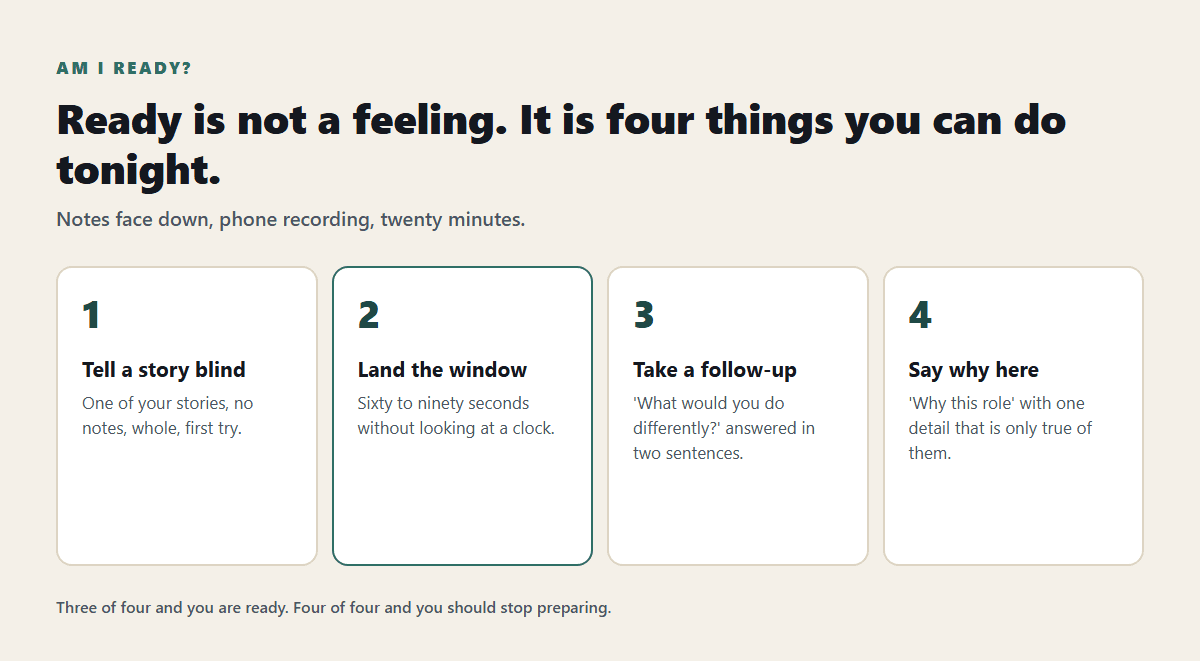
"Am I ready?" is the question everyone asks the night before, and it is usually answered with a feeling. Nervous means not ready. Calm means ready. Neither is true. Plenty of very ready people feel sick the night before, and plenty of calm people walk in and discover in the first question that they had only ever answered it in their head.
Here is how to tell whether you are ready for a job interview in a way that does not depend on how you feel: four tests you can run tonight, the five skills any honest readiness assessment is really measuring, and four numbers that show whether the practice is working.
The four tests
Twenty minutes, notes face down, phone recording.
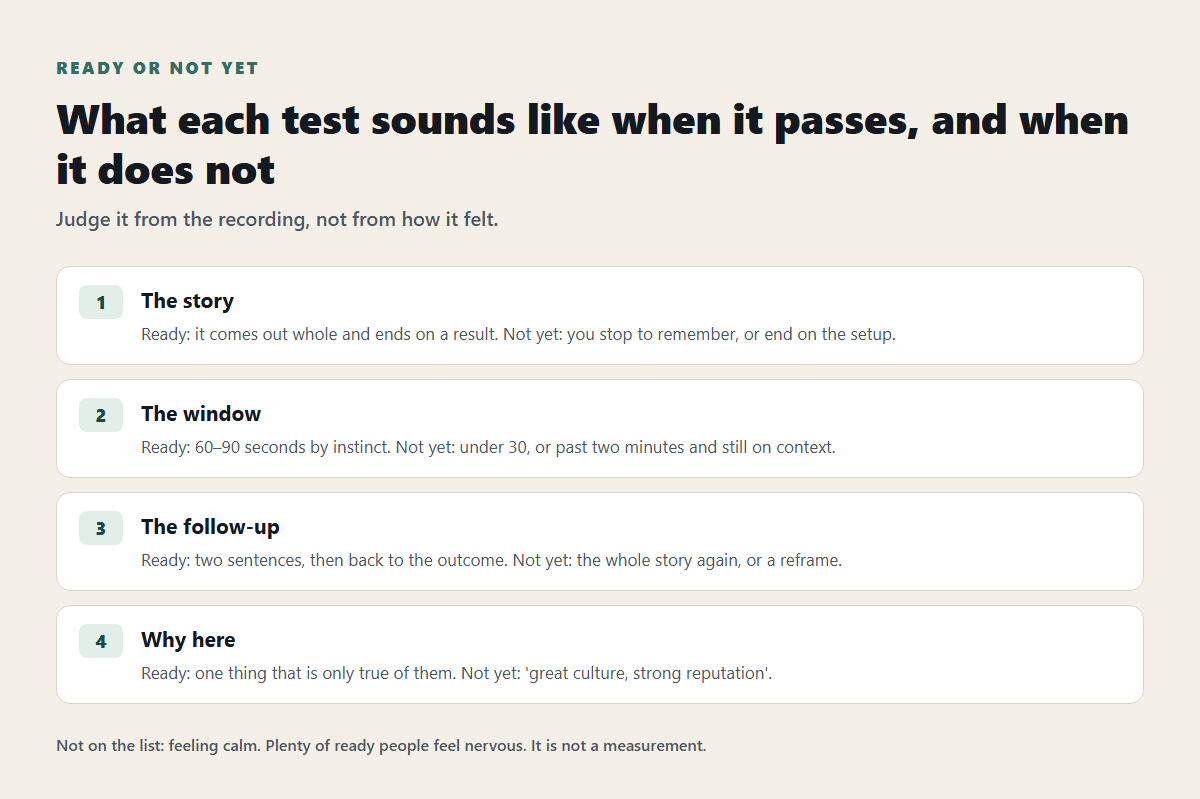
Test one: tell a story blind. Pick one of your behavioral stories, the kind that answers "tell me about a time…", and tell it out loud, first try. Ready sounds like: the story comes out whole, in order, and ends on what changed because of what you did. Not yet sounds like: you stop partway to remember what happened next, or the story ends on the situation without ever reaching the result. One more spoken run usually fixes it.
Test two: land the window. Time that story and one more, without looking at the clock while you speak. Ready is sixty to ninety seconds by instinct. Not yet is under thirty seconds, which reads as thin, or past two minutes and still describing the context. Almost nobody's guess about their own length is accurate, which is why this has to be a test and not a feeling.
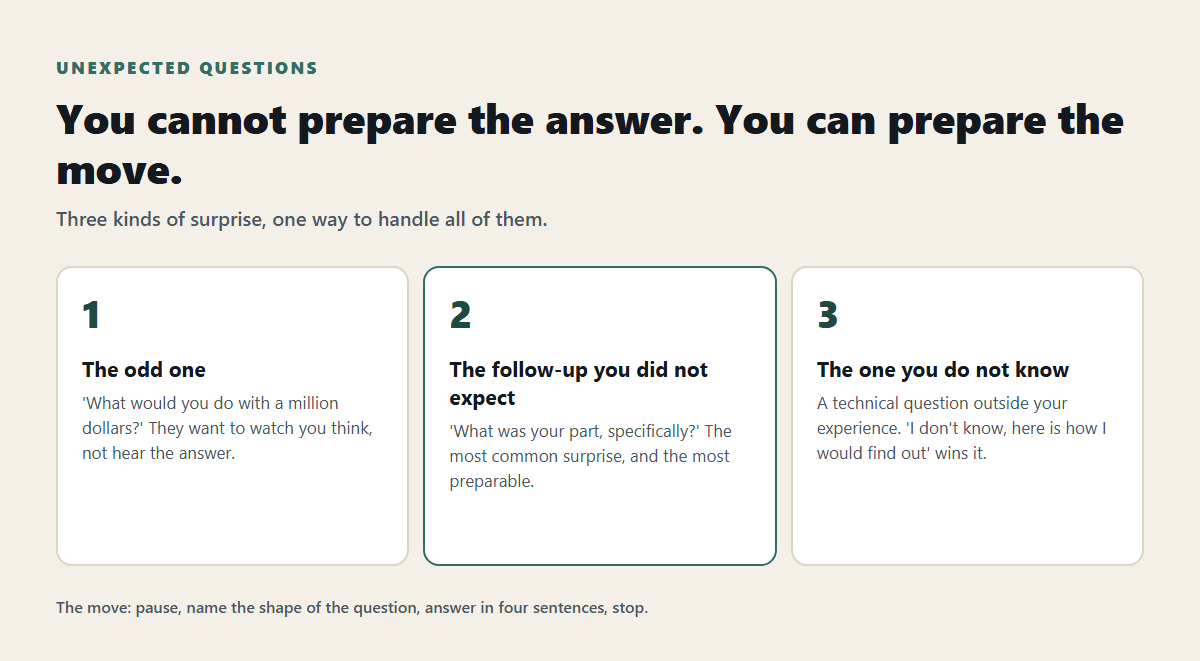
Test three: take a follow-up. After the story, ask yourself out loud, "what would you do differently?" and then "what was your part, specifically?" Ready is two or three sentences that answer the actual question and connect back to the outcome. Not yet is the whole story again from the top, a reframe ("well, given the constraints…"), or a freeze. This is the test most people skip and the one that most predicts the room.
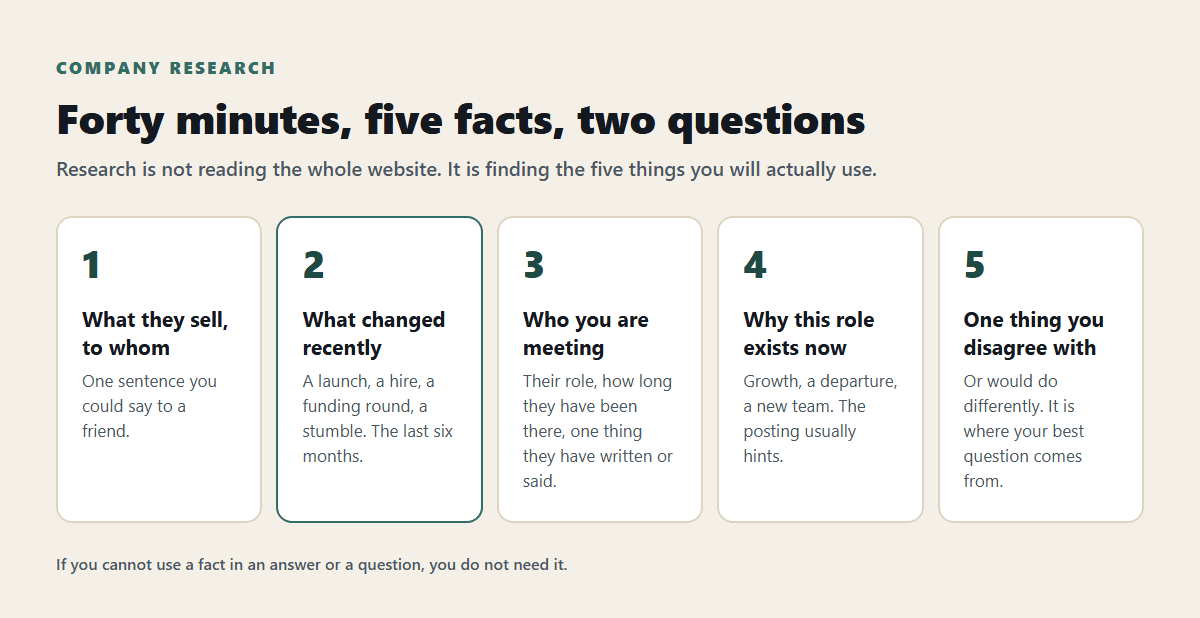
Test four: say why here. Answer "why this role, why us?" Ready is one detail that is only true of this company or this team. Not yet is "strong reputation, great culture, exciting growth", which tells the interviewer you sent the same paragraph to twelve companies. Ten minutes of reading fixes this one.
What a readiness assessment is really measuring
Strip away the format and every honest interview readiness assessment is evaluating the same five skills. The four tests above cover them; it helps to know what they are, because they tell you where to spend whatever time is left.
- Spoken recall. Can the story leave your head whole? Reading your notes and feeling prepared is a different act from producing the story with your mouth.
- Structure. Situation, task, action, result, in that order, with most of the time on the action. The STAR method makes this automatic; the assessment is whether it is there when you are not thinking about it.
- Timing. Sixty to ninety seconds, landed by instinct, on questions you did not specifically rehearse.
- Follow-up recovery. Two sentences on "what was your part?", then back to the outcome, instead of a restart or a reframe.
- Delivery. Pace, filler words, and whether you stopped when the answer was done. Invisible from the inside; obvious on a recording.
Two things an assessment should not measure: company trivia (one specific detail and one real question is all "why us" needs) and having an answer for every possible question (three or four real stories, told from different angles, cover nearly everything that is asked).
Measuring progress: four numbers, taken twice
If you have more than a night, the same recording becomes a measurement. Answer the same four questions near the start of your preparation and again near the end, and compare four numbers. The gap between the two recordings is your progress; everything else is a feeling.
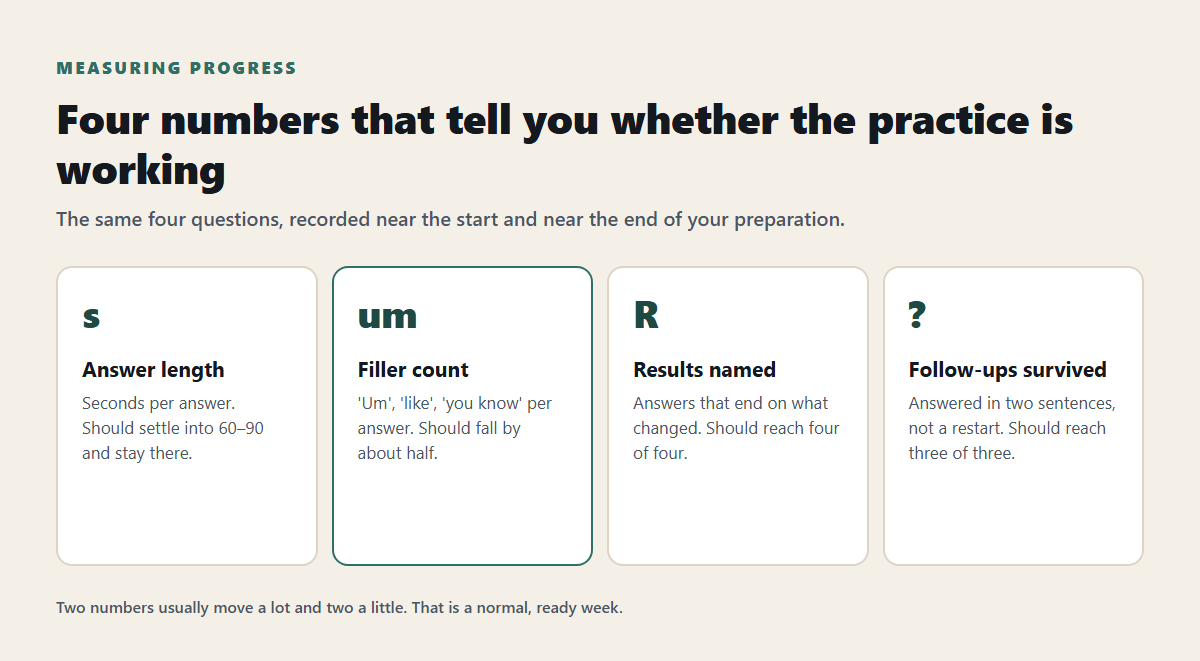
Answer length. Seconds per answer, averaged. First recordings are almost always outside the window, usually long. A good week settles into sixty to ninety and stays there.
Filler count. "Um", "like", "you know", per answer. Everyone has some; the trend is what matters, and a good week roughly halves it. The fastest fix is not to police the words but to pause instead. A one-second silence where the "um" used to be reads as thought.
Results named. Out of four answers, how many end on what changed? Most first recordings score one or two, because the answer runs out of time during the setup. This is the number that most directly predicts the interview, and it is fixed by cutting the opening so there is time for the ending.
Follow-ups survived. Out of three follow-ups, how many were answered in two sentences rather than a restart? This one moves once you rehearse the situation rather than the wording, and it is the best single sign that you are ready rather than merely rehearsed.
A normal, ready week: two of the four numbers moved a lot, two moved a little. Do not try to move all four at once; pick the worst one after the first recording and fix only that. Trying to correct pace, structure and filler simultaneously produces an answer that is worse than the one you started with.
Scoring it, and the sign that means stop
Three of the four tests passed, and you are ready. Spend whatever time is left on the one you missed, in one short session, and then stop.
Four of four, and you should stop preparing now. This is the part people find hardest to believe, but more practice from here does not make you better. It makes you stiffer, and you arrive trying to reproduce last night's version instead of having a conversation. Ready is when you can tell each story without your notes and land inside the window without watching a clock. Not when the answers are perfect. They will not be, and they do not need to be.
Fewer than three, and you are not unready, you are unrehearsed, which is a different and much more fixable thing. Do the missed tests again tomorrow, out loud, once each. Most people go from one of four to three of four in two short sessions, because the problem was never knowledge; it was that the knowledge had never left their head.
Feeling nervous is not on any of these lists, because it is not a measurement. Some of the most prepared candidates I ever interviewed had visibly shaking hands in the first minute and were excellent by the third. If you have passed three of the four tests, the nerves are just weather.
If you want the tests run for you and the numbers counted, RehearseAI asks the questions out loud for the role, follows up when you dodge, and reports afterwards on how long you took, the filler words, whether the answer landed, and how it sounded. Every account gets one free 5-minute interview a month, no credit card required, which is exactly enough for one measurement.
Quick answers
How long before the interview should I run the tests? Two or three days out. That leaves time for one short session on whatever you missed, and a day of nothing before the interview.
What if I pass the tests but still feel unready? Then you are ready and nervous, which is the normal state of a well-prepared person. Trust the recording, not the feeling.
Do I need video, or is audio enough? Audio gives you every number above. Video adds eye line and fidgeting, which matter, but they are the last thing to fix, not the first.
Is there a quicker version? The free interview quiz takes two minutes and checks whether you know the right moves. The tests above check whether you can make them out loud. Do both.
Sources
The tests and measurements above line up with what university career centers publish on interview preparation; these are the ones I checked it against:
- Preparing for Interviews — Tufts University Career Center
- Mock Interviews — The Career Center, University of Illinois
- Mock Interviews — Pomerantz Career Center, University of Iowa
Tests one and three are really tests of the STAR method. More on why I built this.
Two minutes, no account: the free interview quiz.