RehearseAI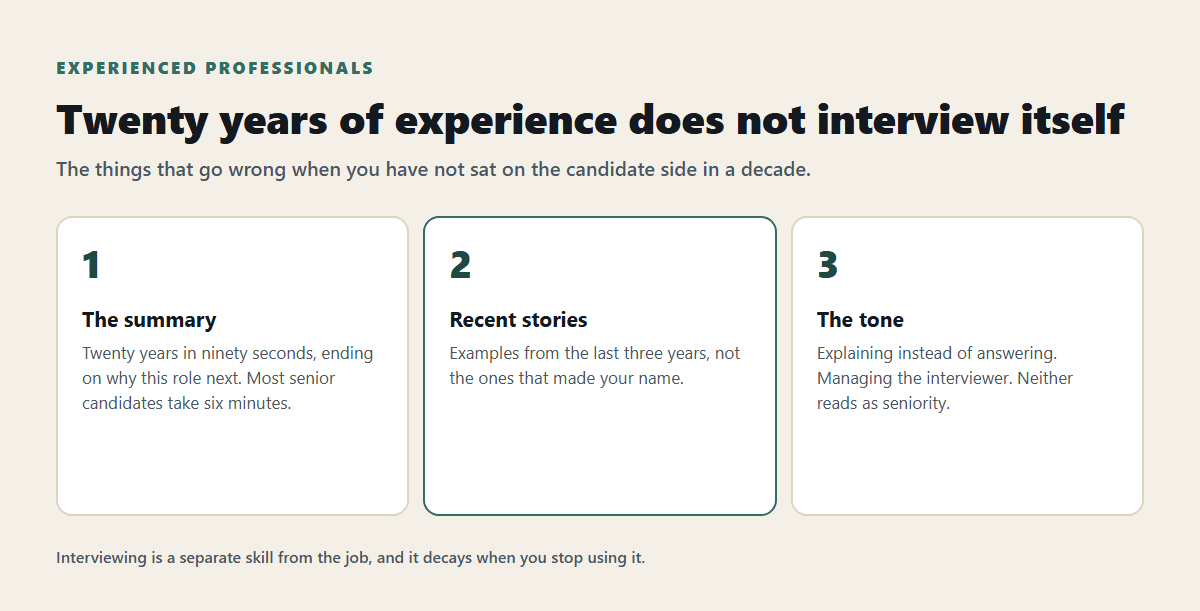
If you have not interviewed in ten years, you are walking into a different room than the one you remember. The questions are more behavioral. The panels are bigger. And, awkwardly, the skill of being interviewed has quietly decayed while you were busy being good at the job, because interviewing is a separate skill from the work and it does not maintain itself.
Experienced professionals do not usually lose interviews on competence. They lose them on habits: taking six minutes to summarize a career, reaching for a story from 2016, explaining the context instead of answering the question, or gently managing the interviewer the way they manage everyone else. None of that is a character flaw. It is what seniority sounds like when it has not been calibrated for a room where you are the one being evaluated.
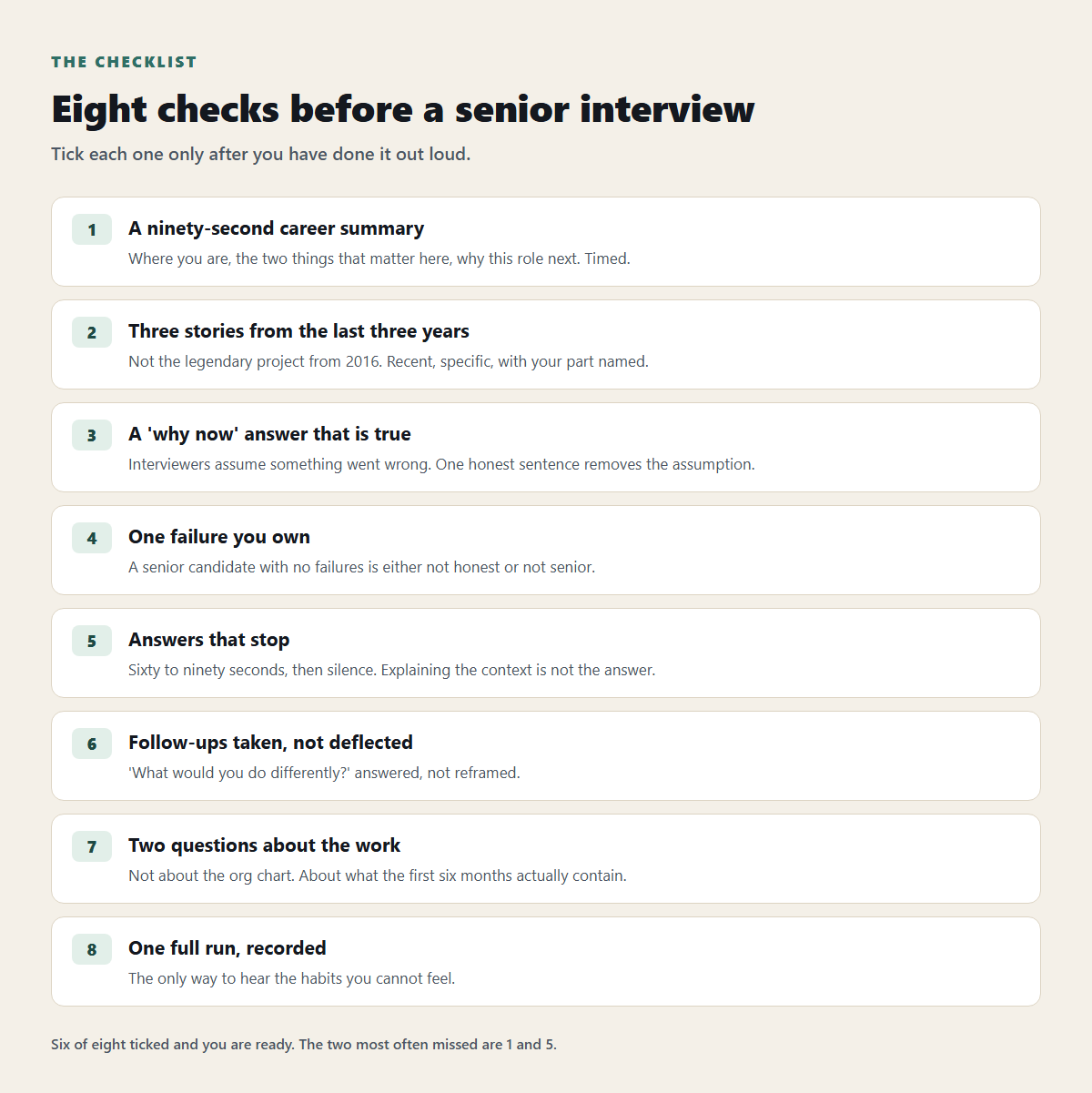
Here is an interview readiness checklist for experienced professionals. Tick each item only after you have done it out loud.
1. A ninety-second career summary
"Tell me about yourself" is where senior candidates most often go wrong, because there is so much to tell. Six minutes later the interviewer has your chronology and none of your point.
The check: can you cover where you are now, the two things in your history that matter most for this role, and why this role is next, in ninety seconds, timed? Write it as four lines, not a script, and say it into a recording. If it runs past two minutes, cut the chronology. They have your résumé.
2. Three stories from the last three years
You have a story that made your name. It is a great story. It is also from a while ago, and a panel hearing it will quietly wonder what you have done since.
The check: three specific situations from the last three years, each in four lines, where you were, what was yours to do, what you did, what changed. Your part named explicitly, not "we". The STAR method is the shape, and at senior level the "action" line needs to be about your decision, not your team's execution.
3. A "why now" answer that is true
Interviewers assume something went wrong when an experienced person is on the market. A restructure, a falling-out, a stall. Most of the time they are wrong, but the assumption sits there until you remove it.
The check: one honest sentence about why you are looking, and one about why this role. Not defensive, not a speech. "The company was acquired and the role I was doing no longer exists there. I want to do the same kind of work somewhere it is the priority." Done.
4. One failure you own
"Tell me about a time something went wrong" is coming, and senior candidates often answer it with a failure that was somebody else's, or a setback that was really a success in disguise. Panels hear this as either a lack of honesty or a lack of self-awareness, and neither is what they want in someone who will run things.
The check: a real failure, your part in it, and what you changed afterwards. It should be slightly uncomfortable to say. That is how you know it is the right one.
5. Answers that stop
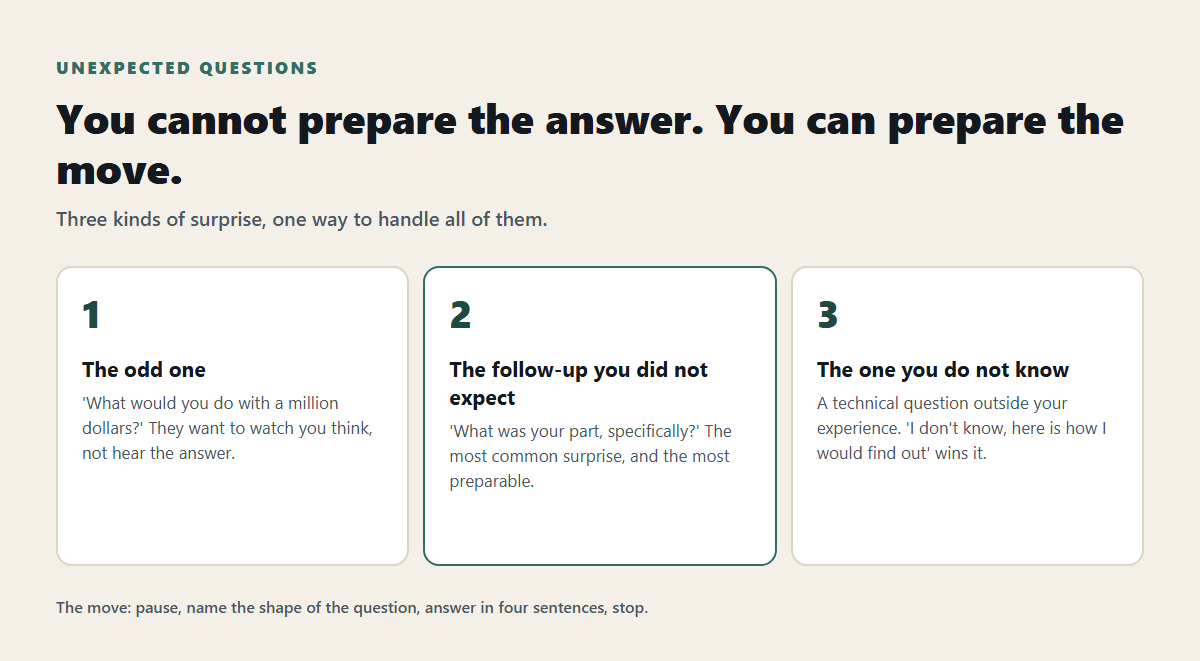
This is the item most often missed. Experienced people are used to explaining context, and in most of their working life that is valued. In an interview it reads as not answering. The question was "tell me about a time you had to make a call with incomplete information", and four minutes in you are still describing the market conditions.
The check: sixty to ninety seconds, then silence. Record four answers and time them. If they run long, the fix is always the same: cut the setup, keep the decision and the result.
6. Follow-ups taken, not deflected
"What would you do differently?" is a question senior candidates are unusually good at reframing. "Well, in that environment, the constraints were…" The panel notices.
The check: after each story, answer the three exposing follow-ups out loud in two sentences each. "What was your part specifically?" "What did your manager think?" "What would you do differently?" A direct answer to a hard follow-up is one of the strongest signals of seniority there is.
7. Two questions about the work
Not about the org chart, the reporting line, or the title. Those are negotiation questions, and they can wait. In the interview, the questions that land are about the work: what the first six months actually contain, what the last person in the role found hardest, what would make this hire a clear success a year in.
The check: two written down, about the work. Having none reads as not caring, at any level.
8. One full run, recorded
You cannot hear your own habits from the inside. The explaining, the six-minute summary, the reframed follow-up: they all feel fine while you are doing them.
The check: one full run through the questions above, recorded, listened back to with a pen. Note one thing to fix. Fix that one thing in one more short session. Then stop; more practice than that makes experienced people sound rehearsed, which is worse than sounding rusty.
If you would rather have the questions asked to you, RehearseAI runs the interview out loud for the role and stage, follows up when you dodge, and reports on length, filler and whether the answer landed. Every account gets one free 5-minute interview a month, no credit card required, which is enough for item 8.
Quick answers
How many of the eight do I need before I am ready? Six. The two most often missed are the ninety-second summary and answers that stop. Start there.
Should I mention my years of experience? Once, in the summary. After that, show it through recent, specific decisions. Repeating the number reads as insecurity about it.
How do I handle an interviewer who is much younger than me? Exactly as you would handle anyone else. Answer the question, stop, take the follow-up. Managing them is the one thing that will lose it.
Is it worth doing a mock interview at senior level? One, recorded. Not to rehearse answers, but to hear the habits you cannot feel.
Sources
The checklist above lines up with what university career centers publish on interview preparation; these are the ones I checked it against:
- Interview Preparation — Career Engagement, University of California, Berkeley
- Interview Preparation Guide — UConn Center for Career Readiness
- STAR Method of Interviewing — University of Washington Career & Internship Center
The three recent stories should follow the STAR method. More on why I built this — I spent twenty years on the hiring side and still lost final rounds as a candidate.
Two minutes on where you stand: the free interview quiz — no account needed.