RehearseAI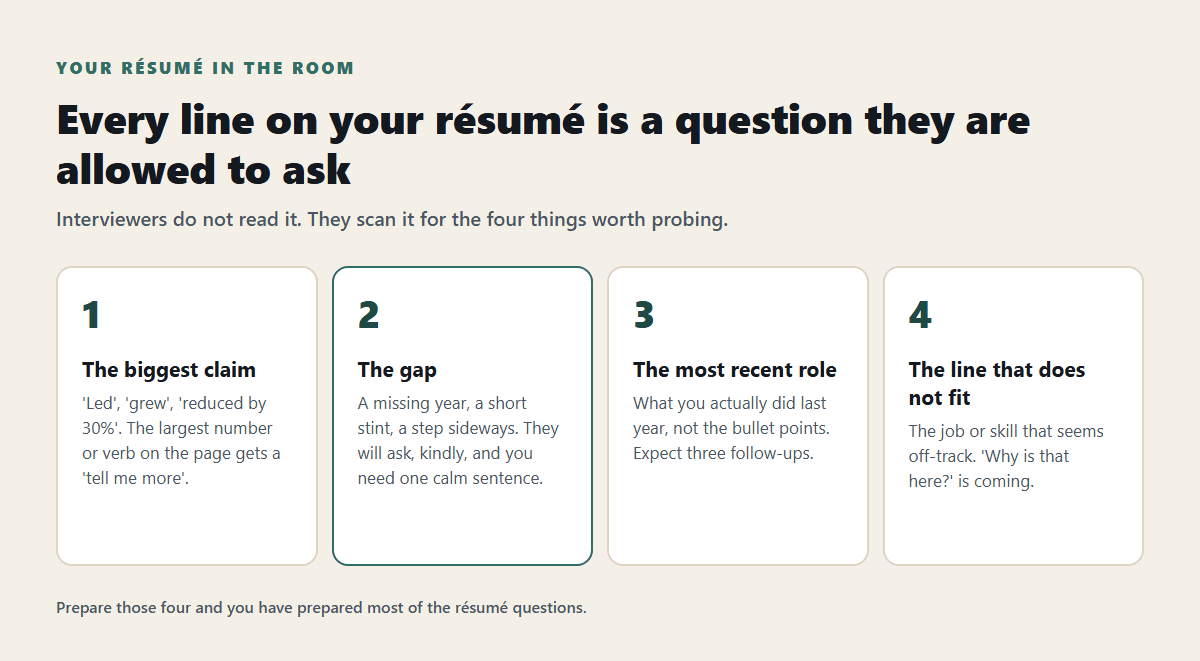
Here is something candidates rarely realize: the interviewer has usually spent about ninety seconds with your résumé, most of it in the two minutes before you walked in. They have not read it. They have scanned it for a handful of things worth asking about, and those things are almost always the same.
That is good news, because it means preparing for interview questions based on your résumé is a much smaller job than "be ready to discuss anything on the page." It is four lines, an honest audit, and a way to talk about the rest.
How interviewers actually read a résumé
Most interviewers are not recruiters. They are the hiring manager or a peer, with a full calendar, who printed your résumé or opened it on a second screen a few minutes ago. Having sat on that side of the table for twenty years, I can tell you the scan goes like this:
- The most recent role. What are you doing now, and does it look like this job? Nearly all the follow-ups come from here.
- The biggest claim. The largest number, the strongest verb. "Grew revenue 40%." "Led a team of twelve." "Reduced processing time by half." That line will get a "tell me more about that," and it is where overstated résumés fall apart.
- Anything that does not fit. A gap, a six-month stint, a sideways step, a job in a different field. Not as an accusation. As a curiosity they need settled.
- The line that matches the posting. Whatever on your page looks most like the job description. They want to know if it is as close as it looks.
That is the whole read. If you prepare those four, you have prepared for most of the résumé questions you will get.
Audit your own résumé first
Before the interview, read your résumé the way a skeptical stranger would, with a pen. Mark every bullet with one of four symbols.
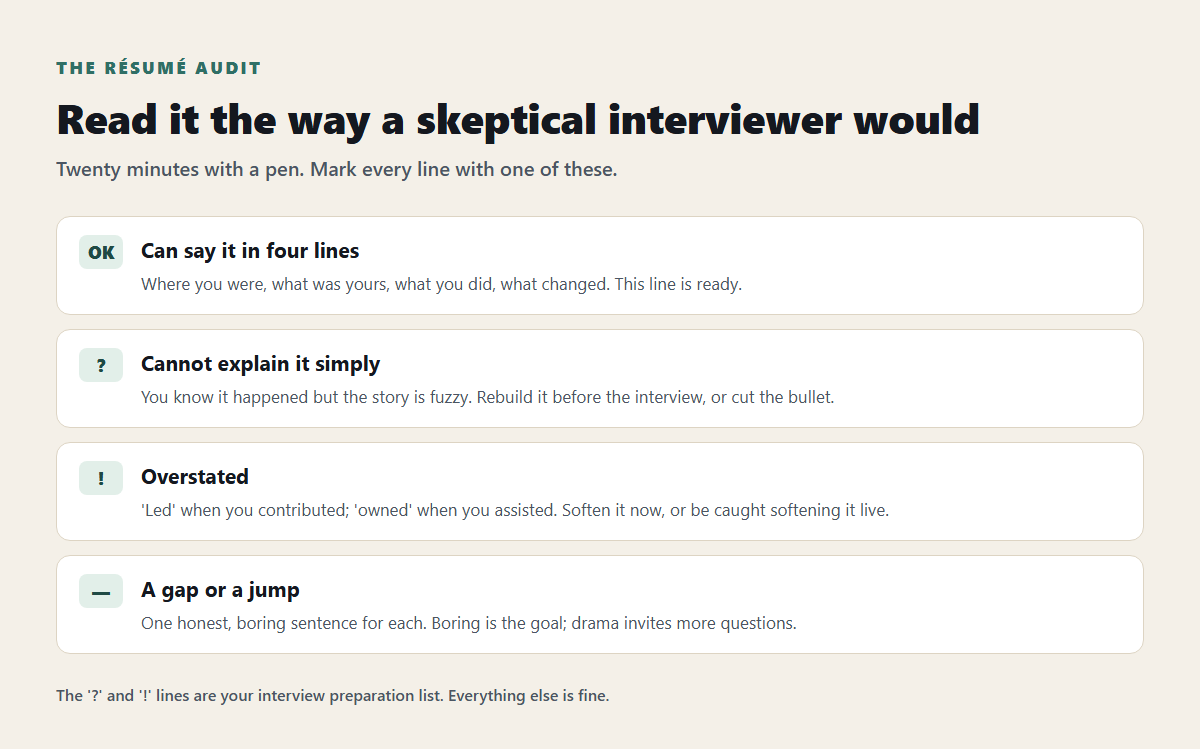
Fine. You can tell the story behind the line in four sentences: where you were, what was yours to do, what you did, what changed. Most lines should be here.
Fuzzy. You know it happened, but you cannot say it simply. This is more common than people admit, especially for roles from several years ago. Rebuild the story before the interview, or cut the bullet. A line you cannot explain is a liability, not an asset.
Overstated. "Led" when you contributed. "Owned" when you assisted. "Managed" a budget you tracked. Soften these on the résumé now. Being caught softening one live, under a follow-up, costs far more than the weaker word would have.
A gap or a jump. For each, write one honest, boring sentence. "I took eight months off to care for a parent." "The company restructured and my role was eliminated." "I moved into operations because I wanted to be closer to the customer." Boring is the goal. A dramatic explanation invites three more questions.
The fuzzy and overstated lines are your preparation list. Everything else is already fine.
Prepare the four lines properly
For each of the four lines the interviewer will probe, write the story in four sentences. That shape is the STAR method, and it matters more here than anywhere, because résumé questions always come with a follow-up: "what was your part, specifically?" A four-line story survives that. A bullet point does not.
Then say each one out loud, on a timer, aiming for sixty to ninety seconds. The biggest-claim story in particular tends to run long, because you are proud of it. Cut the setup. They already have the setup; it is on the page.
Handle the questions you cannot predict
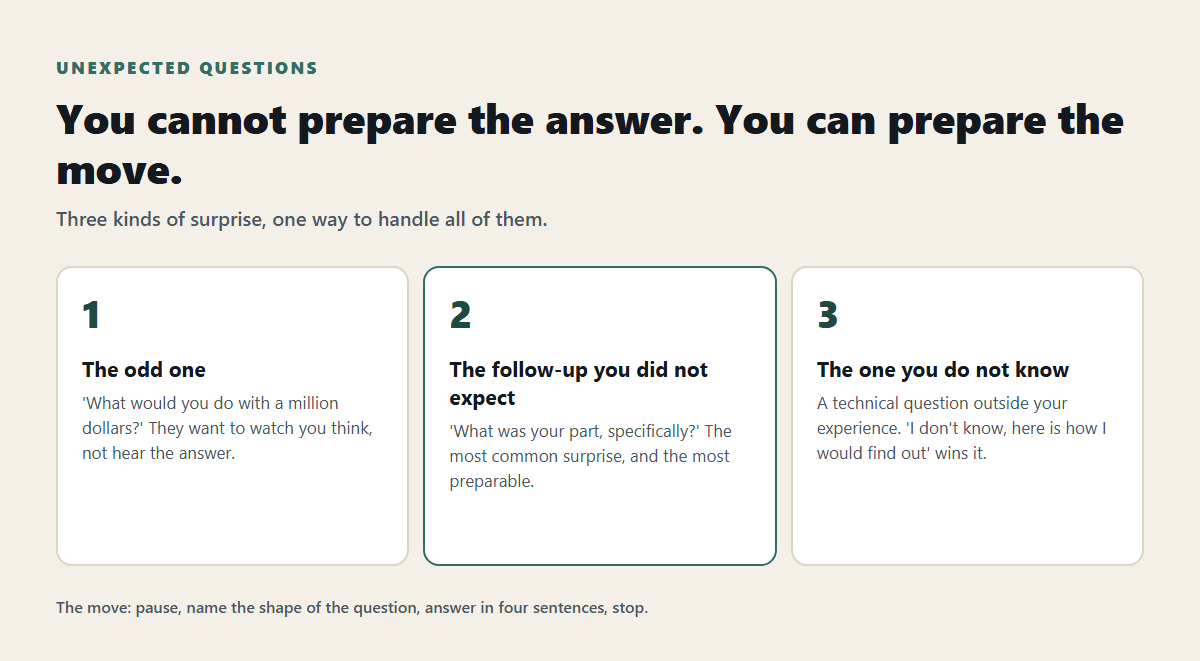
You will still be asked about a line you did not prepare. When that happens, do not improvise a bullet point. Pause, say "let me think about that for a second," and rebuild it with the same four sentences: where, what was mine, what I did, what changed. The shape will carry you even when the memory is thin, and the pause reads as considered rather than caught out.
If a line was genuinely small ("I supported the migration"), say so plainly: "That was a supporting role. My part was the data checks. The bigger story on that page is the one above it." Interviewers respect a candidate who sizes their own claims; it makes every other claim more believable.
Practice with the actual document in front of you
The best rehearsal for résumé questions is someone holding your résumé and asking about it, line by line, with follow-ups. A friend can do this in twenty minutes if you hand them the page and tell them to be difficult.
If nobody is free, RehearseAI does the same thing: you upload the résumé and the job posting, and the interviewer asks the questions that actually connect the two, follows up when you dodge, and tells you afterwards where the answer sagged. Every account gets one free 5-minute interview a month, no credit card required, which is enough to hear how your biggest claim sounds out loud.
Quick answers
Should I bring a copy of my résumé? Yes, two. One for you, one in case the interviewer's copy is the version you sent six months ago.
What if my résumé has a mistake on it? Say so before they find it: "One correction — that date should read 2023." It takes five seconds and removes a question mark.
How do I explain a job I was fired from? One sentence, no story: "That role ended when the company restructured" or "that was not a good fit, and here is what I learned." Then stop talking.
Do interviewers check every line? No. They check the four above and take the rest on trust. Your job is to make sure the four hold.
Sources
The approach above lines up with what university career centers publish on interview preparation; these are the ones I checked it against:
- Interview Preparation — Career Engagement, University of California, Berkeley
- Interview Preparation Guide — UConn Center for Career Readiness
- Using the STAR method for your next behavioral interview — MIT Career Advising & Professional Development
The four-line stories follow the STAR method. If the posting is the puzzle rather than the résumé, see preparing when the job description is unfamiliar. More on why I built this.
The free question generator writes the questions a posting will ask — no account needed.