RehearseAI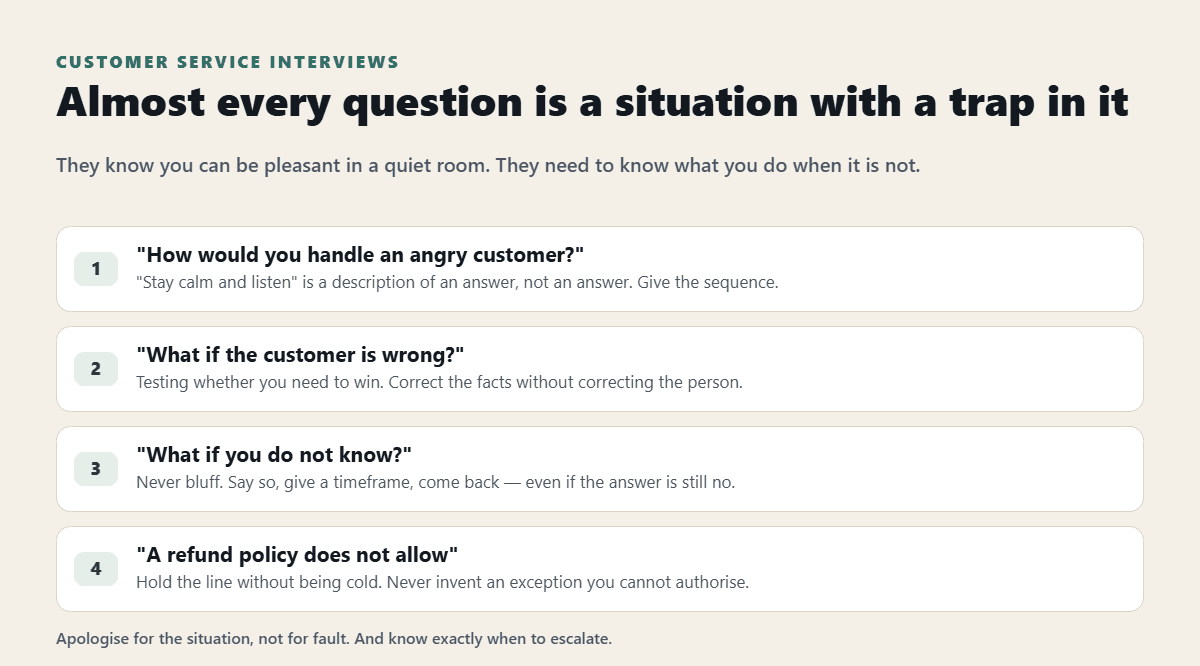
Customer service interviews are almost entirely scenario-based, and for a good reason. The employer already knows you can be pleasant in a quiet room. What they cannot tell from your CV is what you do when someone is shouting, the system is down, and the answer is no.
So nearly every question is a situation with a trap in it. Here are the ones that come up, and what each is really checking.
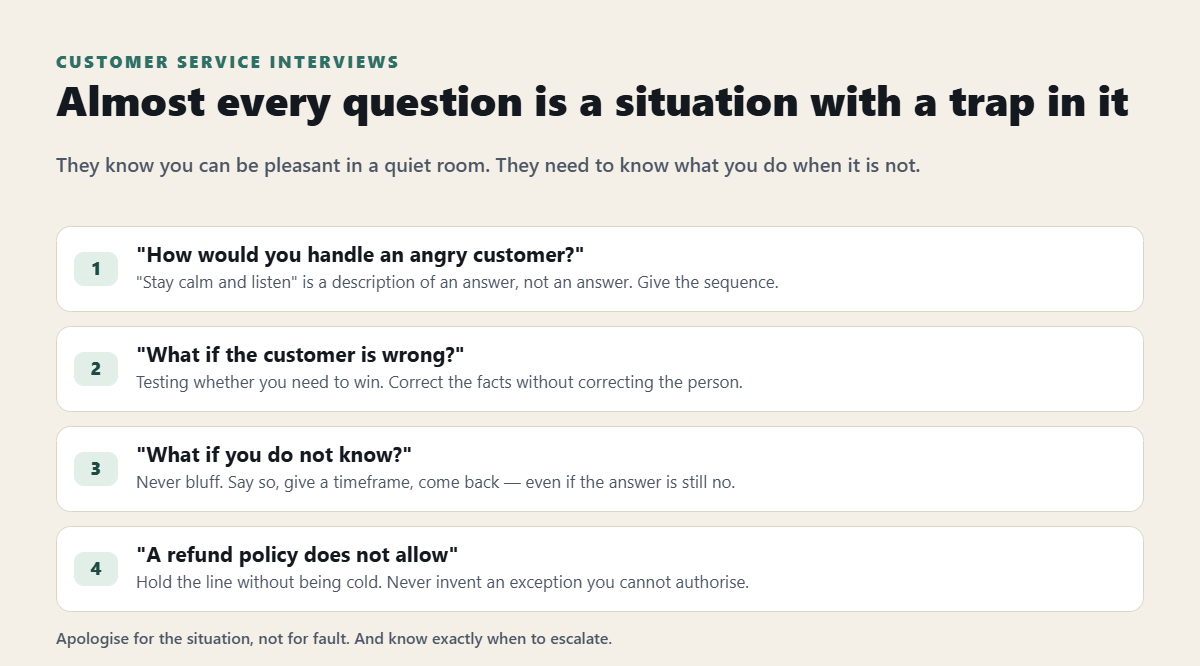
"How would you handle an angry customer?"
The most-asked question in the category, and the one most people answer with a slogan.
"I would stay calm and listen" is not an answer. It is a description of an answer. What lands is a sequence:
"I would let them finish without interrupting, because most people calm down once they have said the whole thing. I would apologize for the situation rather than arguing about how it happened. I would tell them specifically what I can do, not what I cannot. If it is outside what I am allowed to authorise, I would say so and bring in someone who can, rather than letting it go round again."
Two details do the work there: apologizing for the situation rather than admitting fault, and knowing when to escalate.
"What if the customer is wrong?"
They are testing whether you need to win.
Being right and being effective are different things. You can correct the facts without correcting the person — "I can see why that was confusing, here is how it actually works" — and get to the same place without a fight. Candidates who relish being right are a liability on a phone line.
"What would you do if you did not know the answer?"
Never bluff. Say you do not know, say you will find out, give a timeframe, and then actually come back — even if the answer is still no.
Add that you would write it down afterwards so you know it next time. That detail suggests you improve rather than just cope.
"A customer wants a refund that policy does not allow."
They want to see that you hold the line without being cold.
Explain what the policy is and why, offer whatever you genuinely can within it, and be honest that this specific thing is not something you can do. Escalate if they ask. What you must not do is invent an exception you have no authority to give, or promise a callback that never comes.
"Tell me about a time you turned an unhappy customer around"
Have one ready, and keep it specific: what they were unhappy about, what you did, how it ended. If the ending was not a happy one, that is fine too — some people cannot be satisfied, and an honest "they stayed annoyed, but they got a straight answer and I logged it" is more credible than a fairy tale.
"How do you handle several customers at once?"
Retail and support are interruption-driven. Show that you triage rather than panic: acknowledge the person waiting so they know they have been seen, finish what can be finished quickly, and be honest about waits rather than pretending.
The single best line here is that acknowledging someone costs three seconds and buys several minutes of patience.
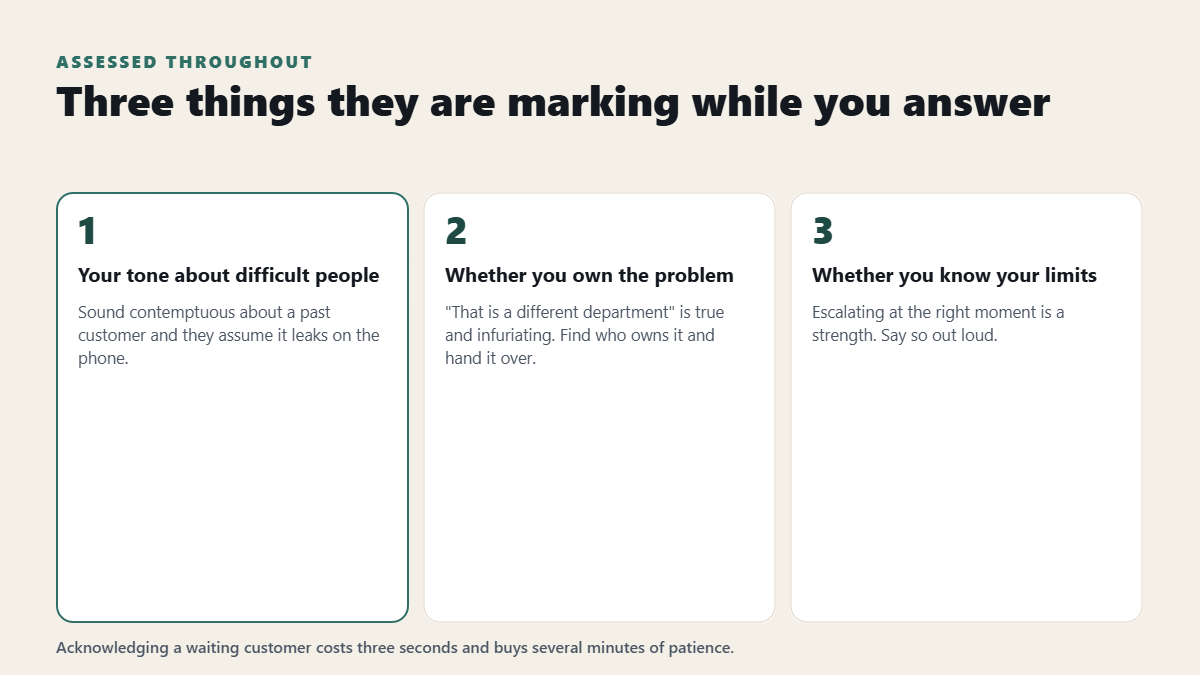
What they are quietly assessing all the way through
Your tone when you describe difficult people. If you sound contemptuous about a past customer, they will assume that leaks on the phone.
Whether you own the problem. "That is a different department" is technically true and reliably infuriating. Say you would find out who owns it and hand it over properly.
Whether you know your limits. Escalating at the right moment is a strength, and saying so out loud reassures them.
Rehearse three of these out loud
The angry customer, the refund you cannot give, and the thing you do not know. Ninety seconds each.
These are the three where the difference between a slogan and a sequence is most audible, and where saying it once out loud turns a vague answer into a specific one.
If you want the follow-up — "and what if they asked for your manager immediately?" — RehearseAI asks it out loud for the role and tells you afterwards how it sounded. Every account gets one free 5-minute interview a month, no credit card required.
Quick answers
How long is a customer service interview? Usually twenty to forty-five minutes. Contact centers often add a short role-play.
Will there be a role-play? Frequently. Treat it as real, speak out loud, and use the sequence above rather than narrating what you would do.
What if I have no customer service experience? Use anything with the public — hospitality, volunteering, a helpdesk at university. The behaviors transfer.
Do they ask about metrics? For experienced roles, sometimes: handle time, resolution rate, satisfaction scores. Know the numbers from your last job if you had them.
The "tell me about a time" questions fit the STAR method. More on why I built this.