RehearseAI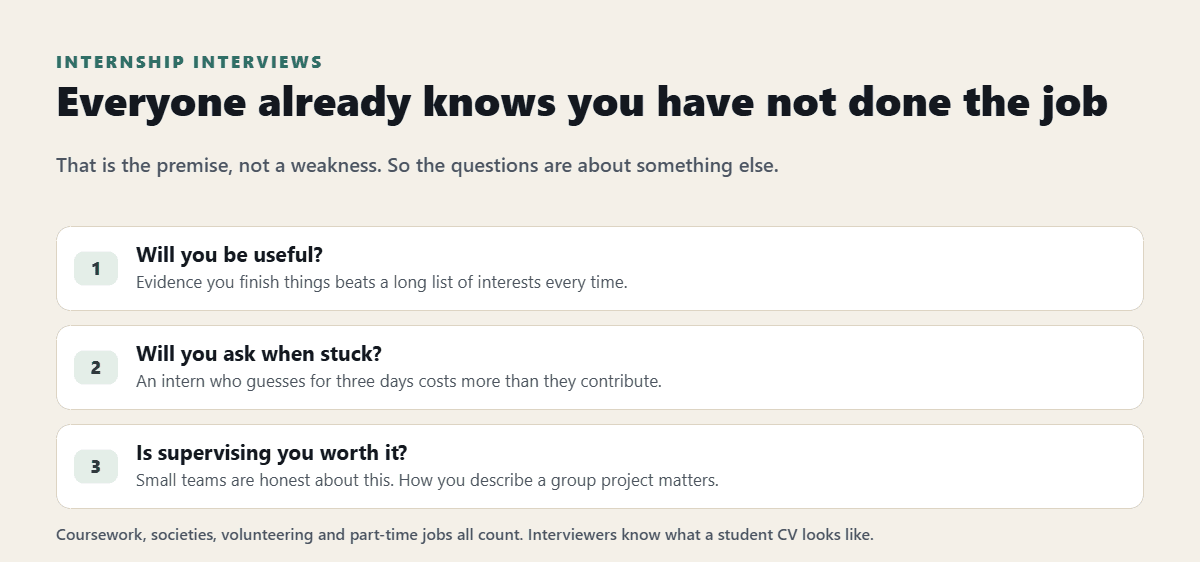
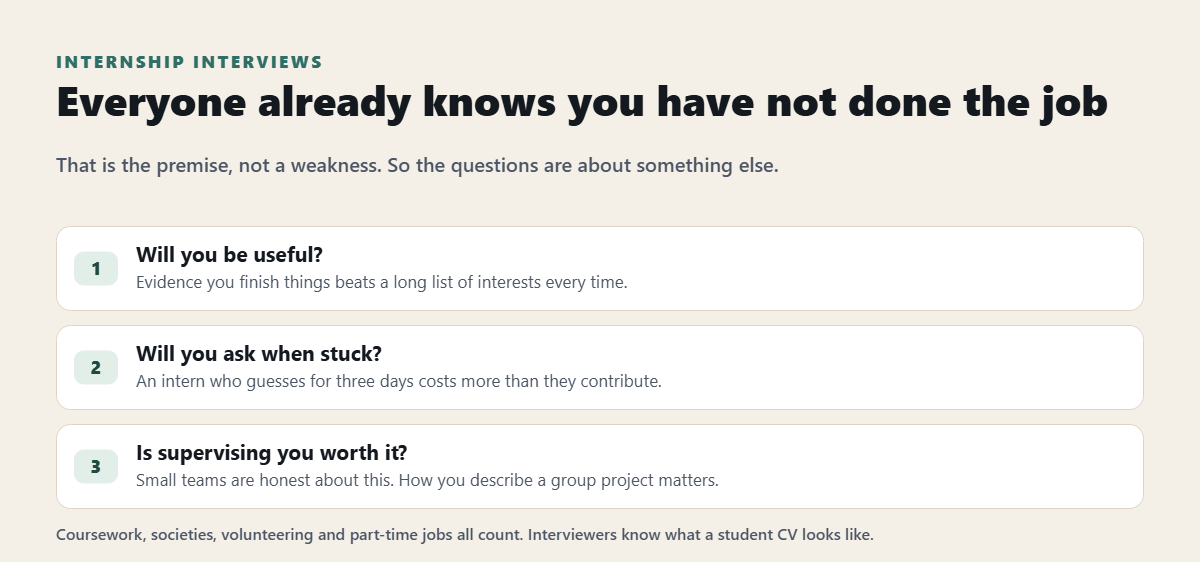
Internship interviews are the only interviews where everyone in the room knows you have not done the job before. That is not a weakness in your application — it is the premise of the whole thing.
Which means the questions are not really about experience. They are about whether you will be useful, whether you will ask when you are stuck, and whether supervising you will be worth somebody's time.
Once you see that, the answers get much easier to aim.
"Tell me about yourself"
Ninety seconds. What you are studying, what pulled you towards this field, one thing you have actually done about it, and what you want from the internship.
That third part is the one people skip, and it is where the answer earns its keep. A project, a society you ran, a side thing you built, a part-time job you took seriously. Something you did rather than something you are interested in.
"Why do you want to intern here?"
Same test as every "why us" question, and the same trap. Generic praise about being a leader in the industry is instantly recognisable as copy-paste.
Name something concrete: a product, a team, a piece of work they published, the specific kind of problem they work on. One real detail beats three sentences of admiration.
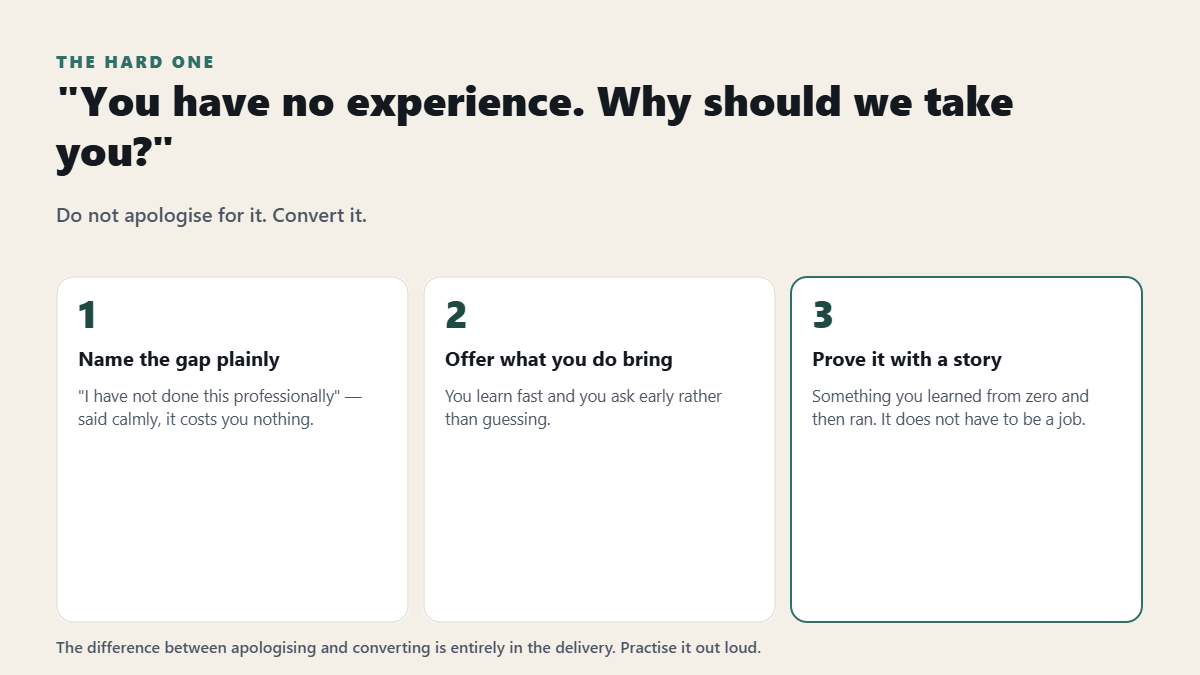
"You have no experience in this. Why should we take you?"
Sometimes asked bluntly, more often implied.
Do not apologize for it. Convert it:
"I have not done this professionally, so what I would bring is that I learn fast and I ask early rather than guessing. When I ran the student society's budget I had never used spreadsheets seriously — I found the person who had, sat with them once, and then ran it for two years without an error."
Evidence of learning something from zero is exactly what they want, and it does not have to be work experience.
"Tell me about a time you worked in a team"
University projects count. So do sports, societies, part-time jobs and volunteering. Interviewers know what a student CV looks like.
Give it a shape — what the group was doing, what your part specifically was, what happened. The most common mistake is describing what the team did without ever saying what you did.
"What do you want to get out of this internship?"
They are checking that you have thought about it, and that your expectations are realistic.
Good: learning how the work actually gets done, exposure to a specific kind of project, feedback on whether this is the career for you. Less good: implying you expect to be given a major project to own in week two.
What to ask them
This is where interns most often go blank, and it is a cheap win:
- What would I actually be working on day to day?
- Who would I report to, and how often would we meet?
- What does a successful intern look like here?
- Do interns usually get converted to full-time?
That last question is fair, useful, and entirely acceptable to ask.
The three things they are quietly assessing
Will you ask when you are stuck? Interns who guess for three days cost more than they contribute. Saying that you flag things early is genuinely reassuring.
Are you easy to have around? Small teams are honest about this. How you talk about a group project matters.
Will you finish things? Any evidence of following something through to a result is worth more than a long list of interests.
Practice the first ninety seconds
Internship interviews are often short, and the opener sets everything after it. If your "tell me about yourself" wanders, you spend the rest of the interview recovering.
Say it out loud three times. Time it. Then do the "no experience" question, because the difference between apologizing and converting is entirely in the delivery.
If nobody is free to run it with you, RehearseAI will ask the questions out loud for the role and stage, follow up when you dodge, and tell you afterwards how long you actually took. Every account gets one free 5-minute interview a month, no credit card required.
Quick answers
How long is an internship interview? Usually twenty to forty-five minutes, often a single round, sometimes with a short exercise.
Should I mention my GPA or grades? Only if they ask or if it is strong and relevant. Projects usually say more.
What if I have never had any job at all? Use coursework, societies, volunteering or something self-taught. What matters is evidence you finish things.
Is it OK to ask about pay? Yes, politely, usually towards the end. You are allowed to know what you are being offered.
Behavioral questions here fit the STAR method. More on why I built this.