RehearseAI
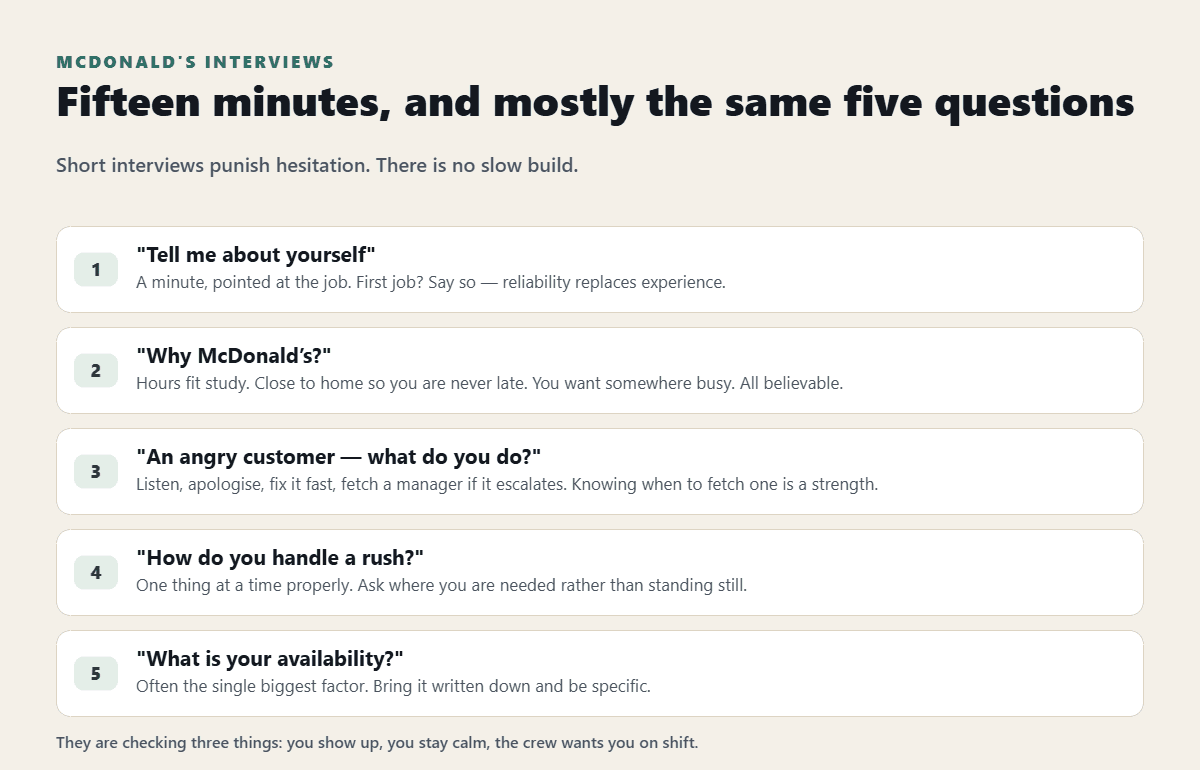
A McDonald's interview is usually short — often fifteen or twenty minutes, sometimes on the spot, frequently with the shift manager who will actually be working alongside you.
That shortness is the thing to plan around. You do not get a slow build. Whatever impression you make in the first few answers is largely the impression that decides it.
The good news: the questions are predictable, and what they are checking is simple. Can you show up, stay calm when it is busy, and be someone the rest of the crew wants on shift.
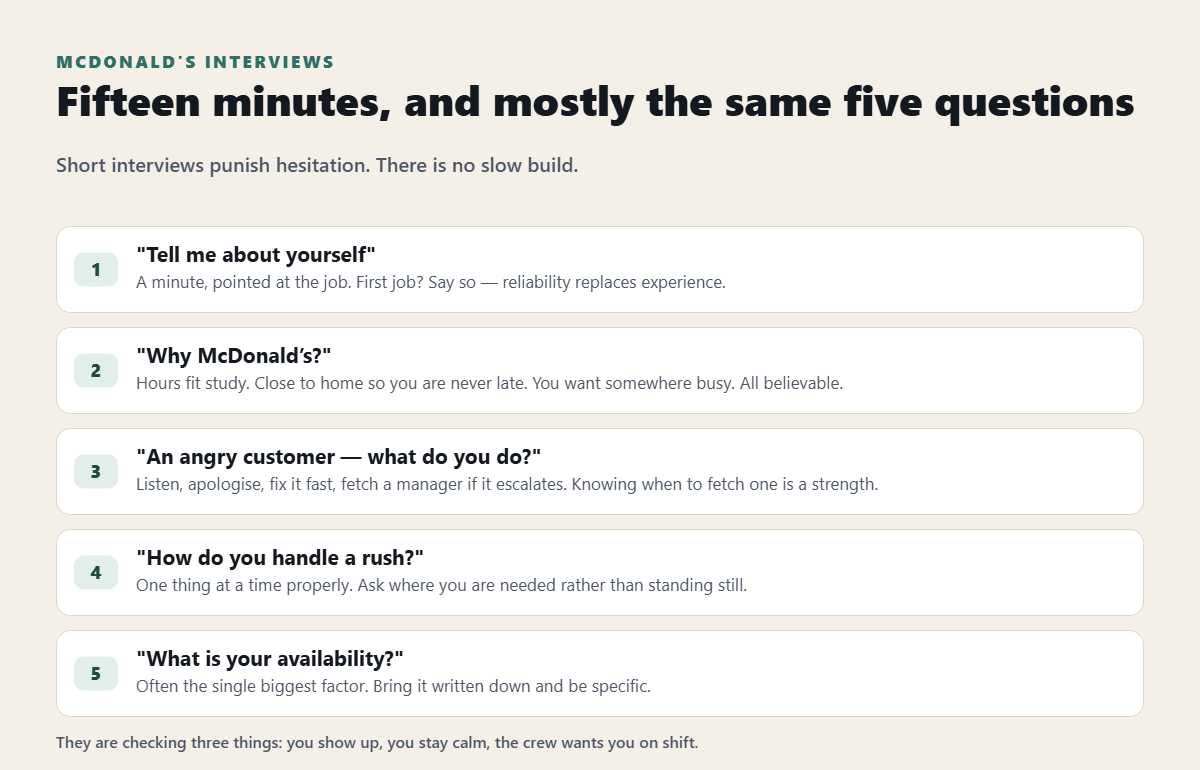
"Tell me about yourself"
Keep it to about a minute, and keep it pointed at the job. Where you are now, one thing that shows you are reliable, and why you want this role.
If this is your first job, say so plainly — they hire first-timers constantly. What replaces experience is evidence of dependability: school attendance, a sports team you never missed, looking after a sibling every afternoon. All of that counts.
"Why do you want to work at McDonald's?"
Give one honest, practical reason: the hours fit around school, it is close enough that you will always be on time, you want a busy place, or you want structured training.
Do not say "I need a job", even though everyone knows it is partly true. Do not invent a lifelong passion either.
Good, honest answers: the hours fit around study, it is close to home so you will always be on time, you want to work somewhere busy rather than somewhere slow, you have heard the training is structured. Any of these are fine, and all of them are believable.
"What would you do if a customer was angry about their order?"
Listen without interrupting, apologize for the mistake, fix the order quickly, and get a manager if the customer is still upset or it is something you cannot authorize.
The most-asked question, because it happens every shift.
They want a specific sequence, not "I would stay calm":
"I would listen without interrupting, apologize for the mistake rather than arguing about how it happened, fix it quickly — remake the item or refund it — and if they were still upset or it was something I could not authorize, I would get my manager rather than let it escalate at the counter."
Knowing when to fetch a manager is a strength, not a weakness. Say it out loud.
"How would you handle a really busy rush?"
Stay calm, do one thing at a time properly, keep talking to the crew, and keep the area clean during the rush rather than after it.
They are checking whether pressure makes you freeze.
Talk about doing one thing at a time properly rather than three things badly, keeping communication going with the person next to you, and asking where you are needed instead of standing still. Mentioning that you would keep the area clean during the rush rather than after shows you have thought about how the shift actually runs.
"Are you available weekends and evenings?"
Give your real availability, exactly and in writing: "Friday nights and Sunday mornings" beats promising every shift and calling out later.
Answer honestly and specifically. Availability is often the single biggest factor in who gets hired, and a vague answer worries them.
Bring your real availability written down. If you can work Friday nights and Sunday mornings, say exactly that. Being clear about what you cannot do is better than agreeing to everything and calling in later.
"Tell me about a time you worked in a team"
Use one short, real example from school, sports, a club or a family business: what the group was doing, what your part was, and how it turned out.
School projects, sports, a club, helping at a family business — all valid. You need a small, real story: what the group was doing, what your bit was, and how it turned out.
Six more questions that come up
The first six carry most of the weight. These are the ones that fill the rest of a fifteen-minute slot.
"What hours can you work?" Different from "are you available weekends": this one is about total hours. Say the number you can genuinely do each week, and whether it changes during exams or the summer. Managers plan the schedule around it.
"What does good customer service mean to you?" Keep it concrete. Getting the order right, saying hello like you mean it, fixing a problem without making the customer feel like the problem. One sentence about a time someone served you well works better than a definition.
"What would you do if a coworker was not pulling their weight during a rush?" Do the job in front of you, ask them directly for the specific thing you need ("can you take the drinks?"), and tell the shift manager only if it keeps happening. They are checking that you will not start a fight at the fry station.
"How do you take correction?" The honest answer is the good one: you listen, you fix it, you do not take it personally. Add a time someone corrected you at school or on a team and what you did next. Crew training is constant correction, and they want to know it will land.
"What would you do if you saw a coworker give away food or take money?" Tell the manager. Do not confront the coworker, do not ignore it. This is an integrity question and the only wrong answer is a hesitant one.
"Why should we hire you?" You will be on time, you will stay calm when it is busy, and you learn fast. Then one line of proof for each. Thirty seconds, no speech.
A sample "tell me about yourself" for a first job
"I'm a junior at Lewisville High School. I've never had a paid job, but I've run the concession stand at football games for two seasons, which means handling cash and a line of forty people at halftime. My attendance is clean and I've never missed a shift there. I'm looking for a job I can do after school and on weekends, and this location is ten minutes from my house, so I'll always be on time."
Fifty seconds. It answers the real question, which is "will you show up and can you handle a line."
If it is a group interview
Some locations interview three or four applicants at once, especially during hiring events. The format changes less than people fear.
- Say hello to the other applicants. Managers watch how you treat the people next to you, because that is how you will treat the crew.
- Answer at normal length. Do not shrink to one word because others are waiting, and do not take twice as long to stand out.
- When someone else gives the answer you had planned, say "same for me, and one thing I'd add is…" rather than repeating it.
- If there is a group task, take a part and do it well. Volunteering to keep time or write things down is a quiet way to lead.
What to bring
- Written availability. Days and hours, including anything that changes during the school year.
- Proof you can work. If you are under 18, some states require a work permit or age certificate, and the manager may ask whether you have one. Check your state's rules before the interview so you can answer in one sentence.
- A resume if you have one. Not required for crew roles, and it still helps.
- The names of one or two references. A teacher, a coach, a neighbor you worked for.
What actually gets people hired
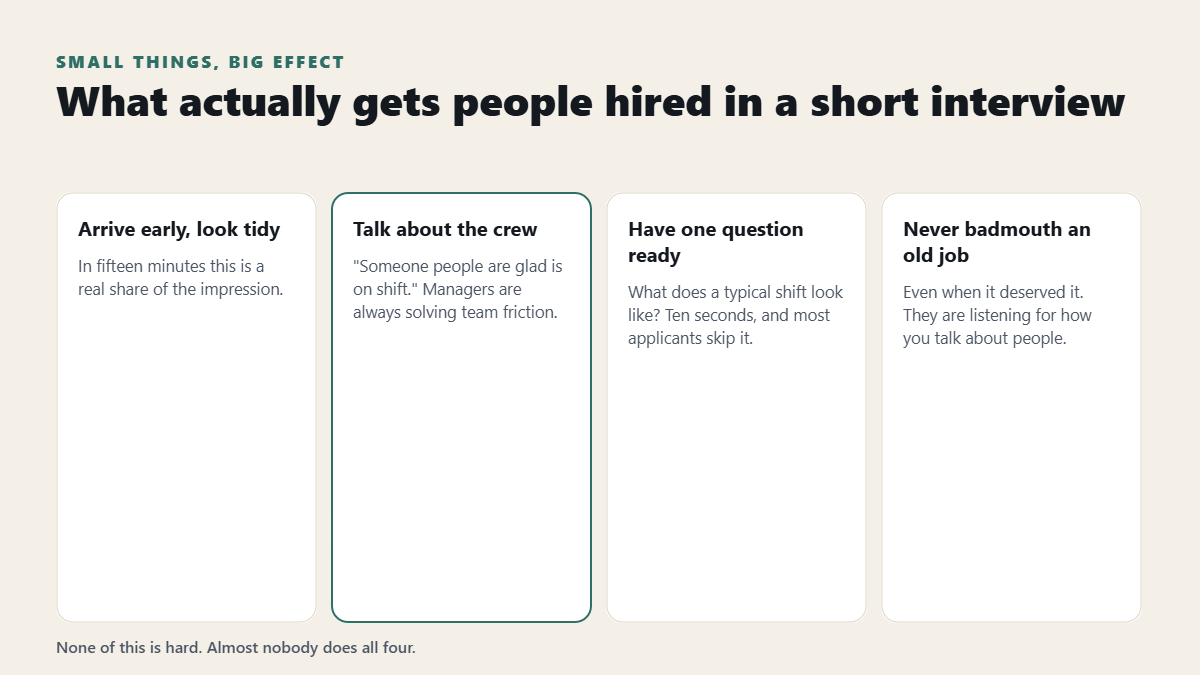
Showing up early and looking neat. In a fifteen-minute interview these are a meaningful share of the impression.
Talking about the crew, not just the customers. "I want to be someone people are glad is on shift" lands well, because managers are constantly solving for team friction.
Having one question ready. Ask what a typical shift looks like, how training works in the first month, or what makes someone good at this job. It takes ten seconds and separates you from most applicants.
Not badmouthing a previous job. Even if it deserved it.
Practice saying it, not just reading it
Short interviews punish hesitation more than long ones do. There is no time to recover from a rambling first answer.
So take the three questions above that matter most — tell me about yourself, the angry customer, and your availability — and say each one out loud twice. That is genuinely all the preparation this interview needs, and almost nobody does it.
If you want a proper run-through, RehearseAI will ask the questions out loud and tell you afterward how you sounded — pace, filler words, whether the answer actually landed. Every account gets 10 free practice minutes a month — one 10-minute interview, or shorter sits whenever you like, no credit card required, and five minutes is enough for this.
What happens after a McDonald's interview?
Many locations move quickly, so a reply can come back the same day or within a few days. Because the interview itself is often only fifteen to twenty minutes, the next step is usually a short callback or message rather than a long hiring process.
If a manager gave a timeline, wait for that window to pass before checking in. When you do follow up, keep it brief and polite, and ask whether anything else is needed to finish the process.
Quick answers
How long is a McDonald's interview? Usually fifteen to twenty minutes. Some locations interview on the spot.
What should I wear? Clean and neat — a plain shirt and pants is plenty. A suit is not expected.
Do I need a resume? Not always, but bring one. It looks prepared and it saves them time.
How soon will I hear back? Often within a few days, sometimes the same day. It is fine to ask when you should expect to hear.
How long should you wait before following up after a McDonald's interview? Wait until the timeline the manager gave has passed. If no timeline was given, a brief check-in after a few days is reasonable.
What if I have no work experience at all? Say it plainly and point at reliability instead. Most crew members started with no experience either.
What questions do they ask at a McDonald's interview? Almost always these six: tell me about yourself, why do you want to work at McDonald's, what would you do if a customer was angry about their order, how would you handle a busy rush, are you available weekends and evenings, and tell me about a time you worked in a team.
<!-- related-guides -->Related guides
If this was useful, these are the next ones to read:
- Common Interview Questions and How to Answer Them: The 15 most common interview questions, what each one is really checking, and the answer shape that works for it, with links to the full answer for the hard ones.
- Starbucks Interview Questions and Answers: The questions a Starbucks barista interview usually asks, honest answers that work, and the small things that matter in a short, friendly interview.
- Chick-fil-A Interview Questions and Answers: The questions a Chick-fil-A team member interview usually asks, honest answers that work, and why this interview cares more about how you treat people than about experience.
- Walmart Interview Questions and Answers: The questions a Walmart interview usually asks store associates, honest answers that work, and how to prepare for the customer and teamwork scenarios.
Sources
The advice above lines up with what McDonald's and university career centers publish; these are the pages I checked it against:
- McDonald's Restaurant Global Careers — McDonald's
- Interview Preparation — Career Engagement, University of California, Berkeley
- 3 steps to be prepared for interviewing — MIT Career Advising & Professional Development
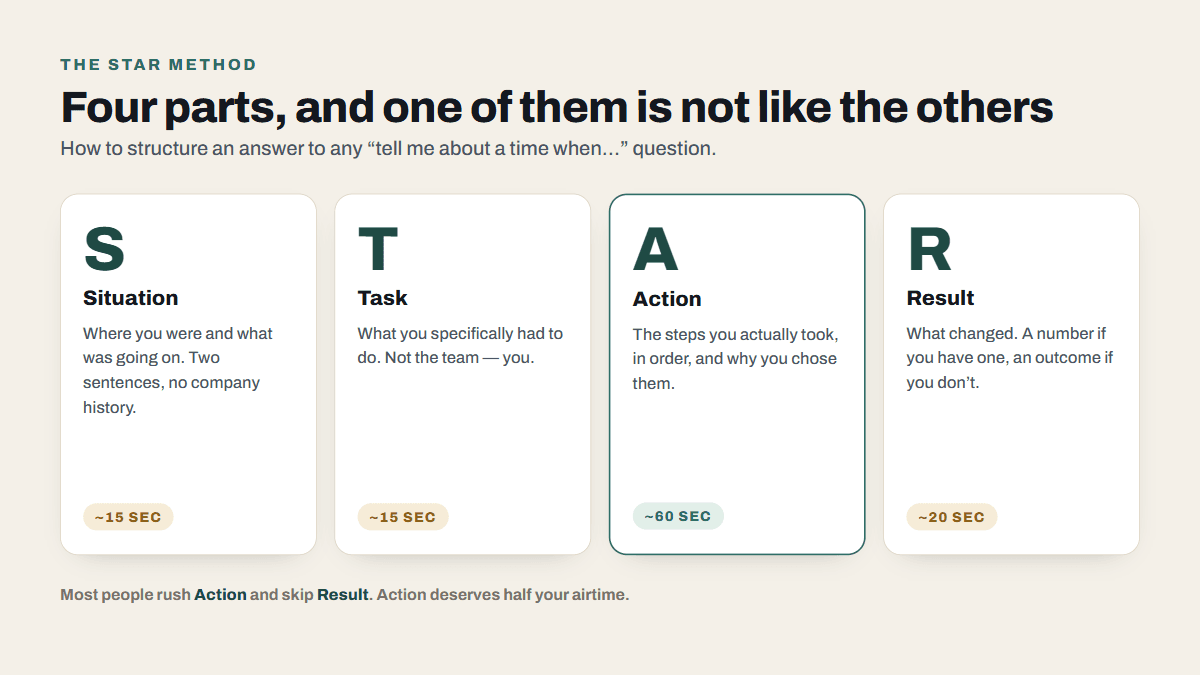
If they ask "tell me about a time…", the STAR method is the shape to use. More on why I built this.
<!-- quickwins-2026-10-27 -->The customer questions McDonald's asks come up in every front-line interview: customer service interview questions and answers.
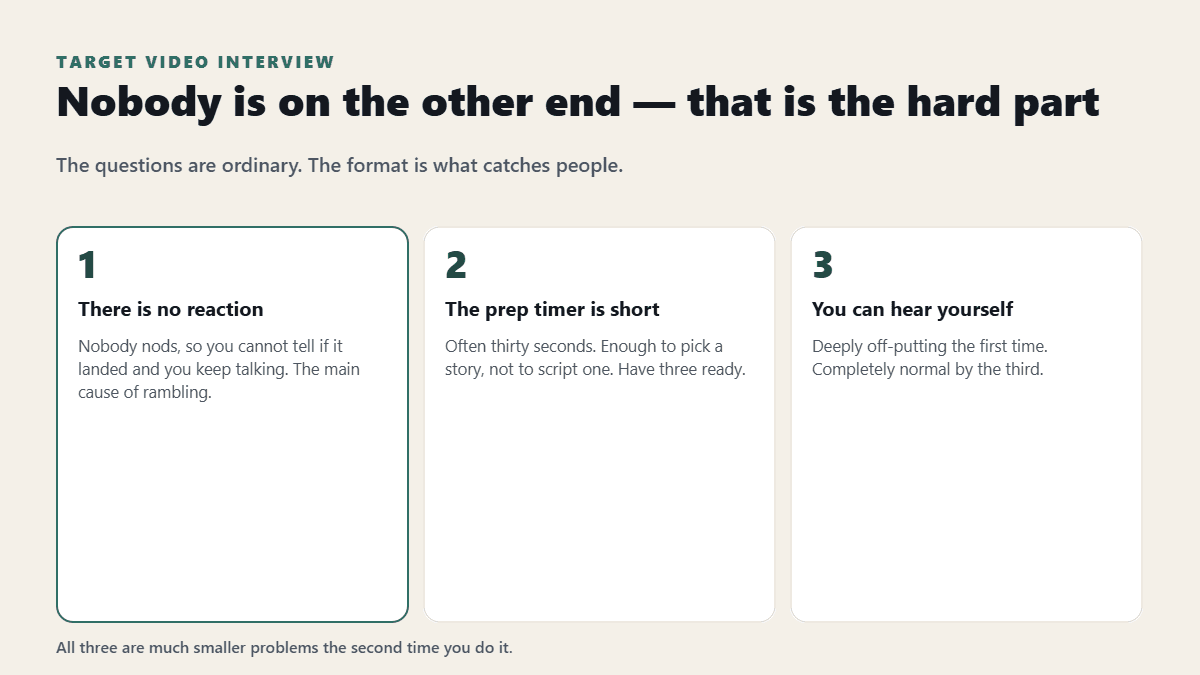
Applying at Target too? Its hiring usually includes a recorded video interview: Target video interview questions and setup.