RehearseAI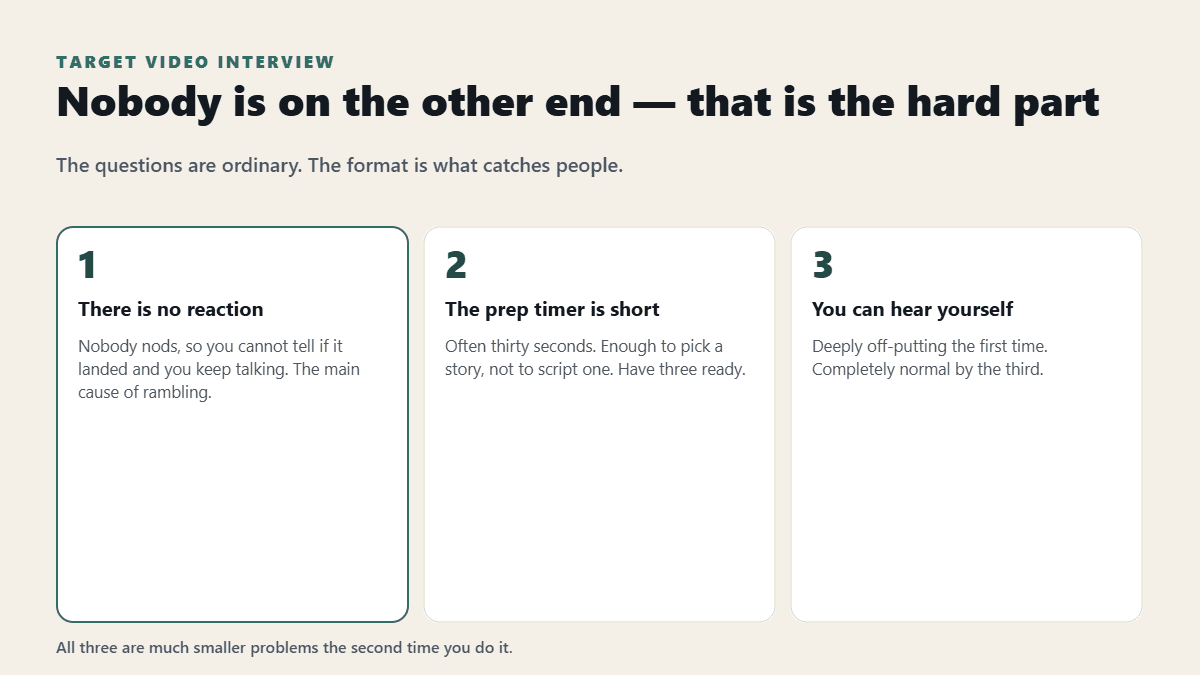
Target's hiring process usually includes a video interview, and it catches people out for a reason that has nothing to do with the questions.
In most cases nobody is on the other end. You read a prompt, a countdown starts, you get a short window to think, and then you are recording yourself talking to a camera in your own bedroom. Some formats allow a retake, some do not.
It is a strange thing to do, and it is much less strange the second time. Which is the whole argument for practicing once before it counts.
The questions Target's video interview actually uses
They are behavioral, and they map onto how a store shift really works.
"Tell me about a time you gave great customer service." They want a specific occasion, not a philosophy. What the guest needed, what you did, how it ended.
"Tell me about a time you worked with a difficult team member." Checking whether you handle friction directly and without contempt. Do not make the other person a villain.
"Describe a time you had to handle several things at once." Retail is interruption-driven. Show that you prioritize deliberately rather than just moving fast.
"Tell me about a time you made a mistake." Say a real one, and land on what you did about it. Perfection is not the answer they are checking for.
"Why Target?" Something specific beats general praise. The way the store runs, an experience you had as a guest, the schedule fitting your studies. Anything true and concrete.
"What would you do if you saw a guest struggling to find something?" The correct answer is walking them there rather than pointing. Say it exactly that way — it is the standard almost every retailer trains.
The format is the hard part, not the questions
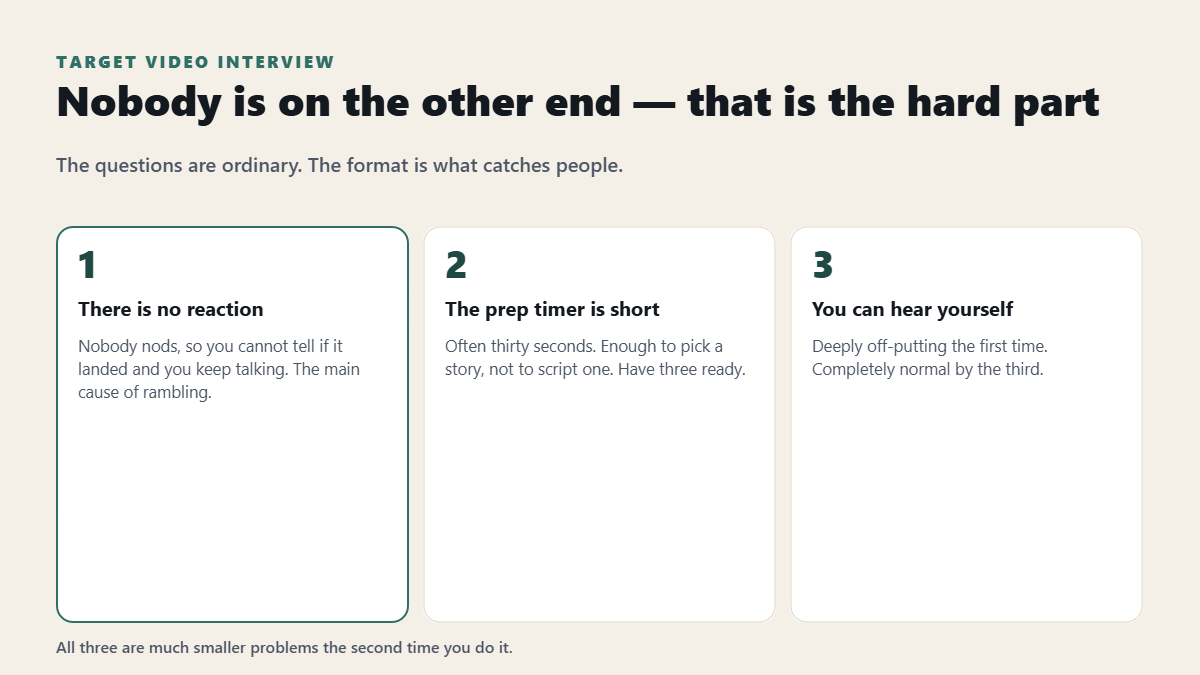
Three things make a video interview harder than a conversation:
There is no reaction. Nobody nods. You cannot tell if it landed, so you keep talking. This is the single biggest cause of rambling answers, and knowing about it in advance mostly fixes it.
The prep timer is short. Often thirty seconds. That is enough to pick your story, not enough to script it — which is why having three stories ready beforehand matters more than anything else.
You can hear yourself. Deeply off-putting the first time and completely normal by the third.
Setting up so the recording helps you
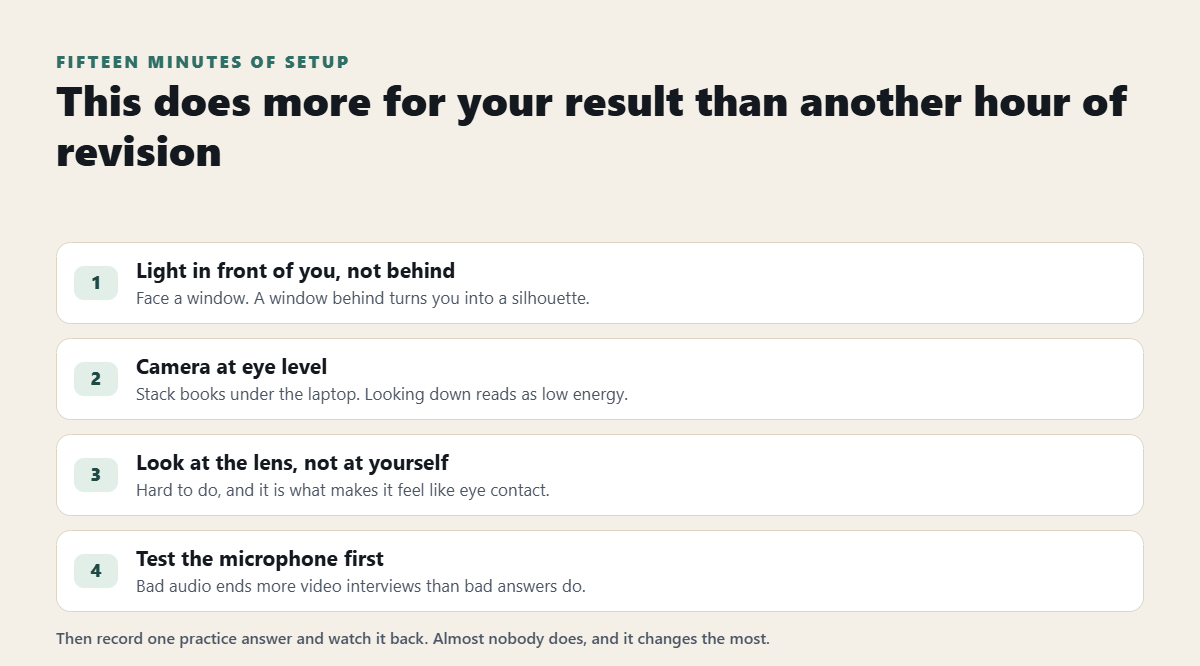
Fifteen minutes of setup does more for your result than another hour of revision:
- Light in front of you, not behind. Facing a window is ideal. A window behind you turns you into a silhouette.
- Camera at eye level. Stack books under a laptop. Looking down at a webcam is unflattering and reads as low energy.
- Look at the lens, not at yourself. Hard, and it is what makes it feel like eye contact.
- Quiet, plain background. Tidy is enough. No filters.
- Test the microphone first. Record ten seconds and play it back. Bad audio ends more video interviews than bad answers.
Prepare three stories, not six answers
You cannot predict the exact wording, so do not try. Pick three real situations — one where you helped someone, one where you dealt with friction, one where something went wrong — and know each in four lines.
Almost every question above can be answered from one of those three, depending on which part you lean on. That is far more useful under a thirty-second timer than a set of memorized paragraphs.
Do one recorded run first
This is the part that actually changes the outcome, and almost nobody does it. Record yourself answering "tell me about a time you gave great customer service" on your phone. Watch it back once.
It will be uncomfortable. You will notice you looked down, or said "um" nine times, or finished in twenty seconds. All of that is fixable in one more take — but only if you have seen it before the real thing.
If you would rather have proper questions and feedback than judge yourself, RehearseAI runs the interview out loud for the role and tells you afterwards about pace, filler words and what you actually said. Every account gets one free 5-minute interview a month, no credit card required.
Quick answers
How long is Target's video interview? Usually fifteen to twenty-five minutes, with a handful of questions.
Can I retake an answer? Some formats allow one retake, some do not. Read the instructions on the first screen — they tell you.
How long should each answer be? Sixty to ninety seconds. Under thirty feels thin; over two minutes usually rambles.
Can I have notes off-camera? A few bullet points are fine. Reading is obvious on video, so keep it to prompts.
What should I wear? A plain, clean top. No logos, no busy patterns — they distort on camera.
The stories here follow the STAR method. More on why I built this.