RehearseAI
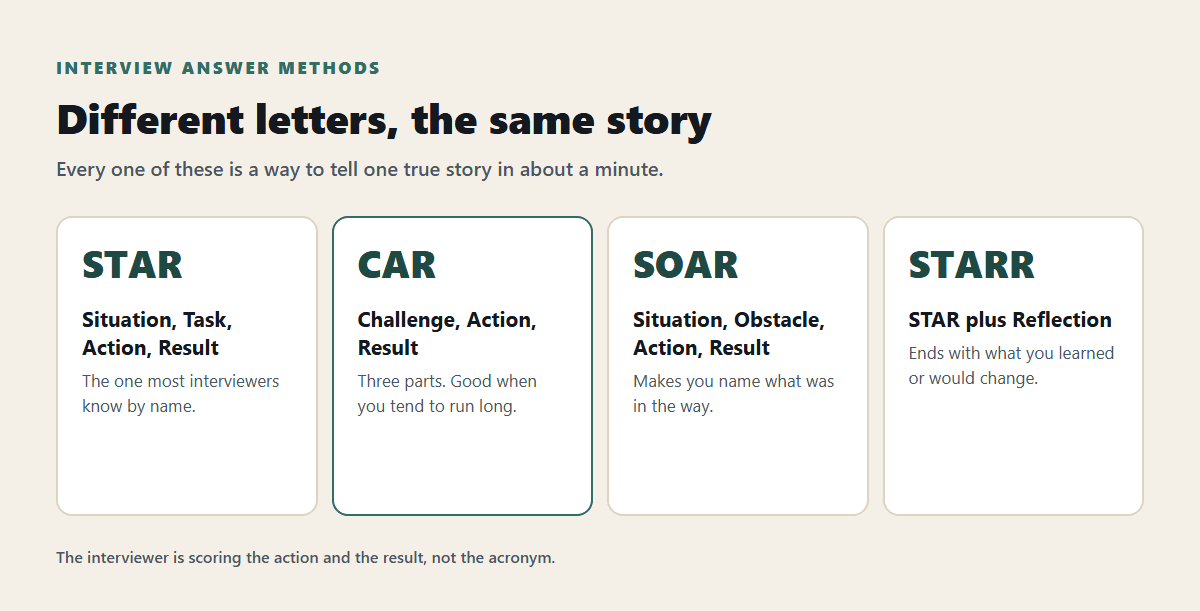
If you have searched for the CAR interview method or the SOAR method, you have probably also met STAR, STARR and SMART, and started to wonder whether you are supposed to learn all of them. You are not. They are the same idea with the letters moved around.
Here is what each one stands for, where each one helps, and how to pick.
The short version
Every one of these methods is a way to answer a "tell me about a time" question with one true story: what was going on, what you did, and how it ended. The differences are small and they are about emphasis.
The CAR interview method
CAR stands for Challenge, Action, Result.
- Challenge. The problem or goal, and why it mattered. One or two sentences.
- Action. The two or three things you personally did.
- Result. What changed, with a number if you have one.
CAR folds the "situation" and the "task" into a single opening. That makes it the shortest of the methods, and the best fit if your answers tend to run long. A minute is plenty. Some career centers teach a CARR version, with a second R for what the result means for the job you are applying for.
The SOAR interview method
SOAR stands for Situation, Obstacle, Action, Result. Some versions say "objective" instead of "obstacle."
SOAR asks you to say out loud what was in the way: a short deadline, a missing budget, a colleague who disagreed. That one extra beat changes how the story lands. "I delivered the report" is fine. "I delivered the report after the data source was cut off two days before the deadline" tells the interviewer what you were up against.
Use SOAR when your stories sound too smooth, or when the question is about a setback, pressure, or a difficult person.
The STARR method
STARR is STAR with a second R for Reflection: what you learned, or what you would do differently.
This one earns its extra letter on questions about mistakes and failures. When someone asks about a time you got it wrong, the story is only half the answer. The part they are listening for is what you took from it. One sentence is enough: "Since then I confirm the deadline in writing on day one."
The SMART interview method
SMART is the odd one out, because people use it to mean two different things.
The usual meaning comes from goal-setting: Specific, Measurable, Achievable, Relevant, Time-bound. In an interview, that version is useful for questions about the future, such as "what would you do in your first ninety days?" or "where do you want to be in three years?" A SMART answer names a specific goal, how you would measure it, and by when.
You will also see a storytelling version: Situation, Metrics, Actions, Results, Tie-in, where the tie-in connects the story back to the job. It is STAR with a reminder to include numbers and to finish by pointing at the role.
If an interviewer or a career counselor tells you to "use SMART," it is fair to ask which one they mean.
And STAR itself
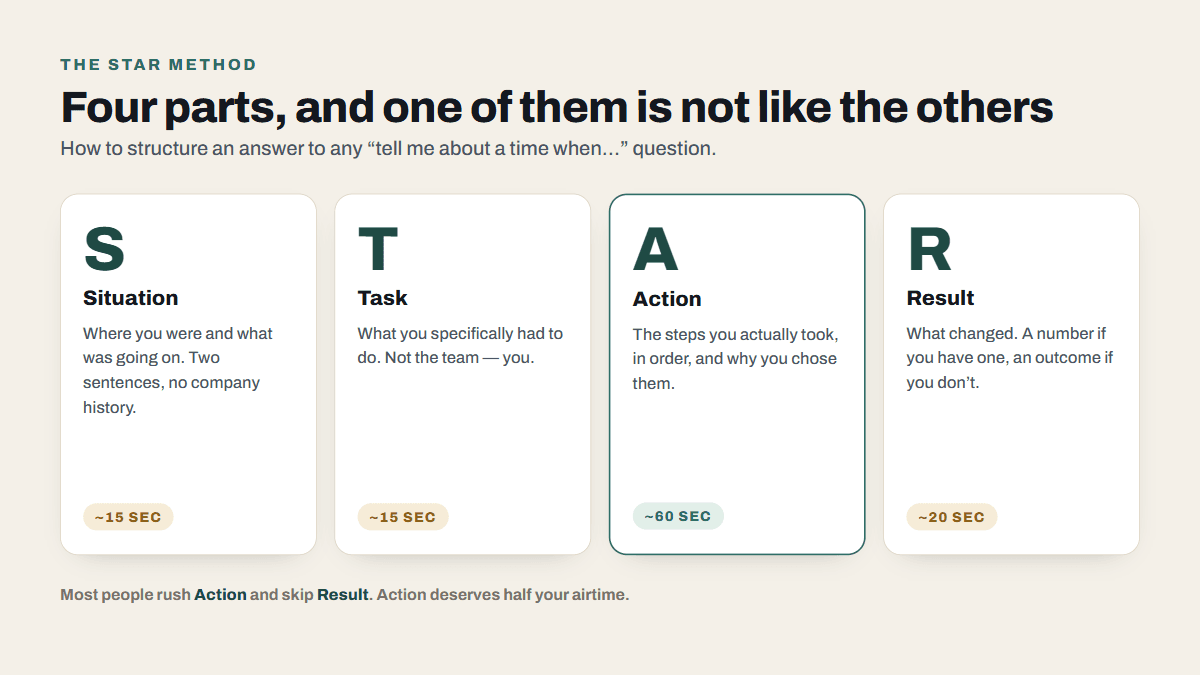
STAR stands for Situation, Task, Action, Result. It is the version most interviewers know by name, and some will even say "please answer using STAR." If you only learn one, learn this one. The full walk-through is in the STAR method, step by step, and there are worked answers in STAR method examples.
Which one should you use?
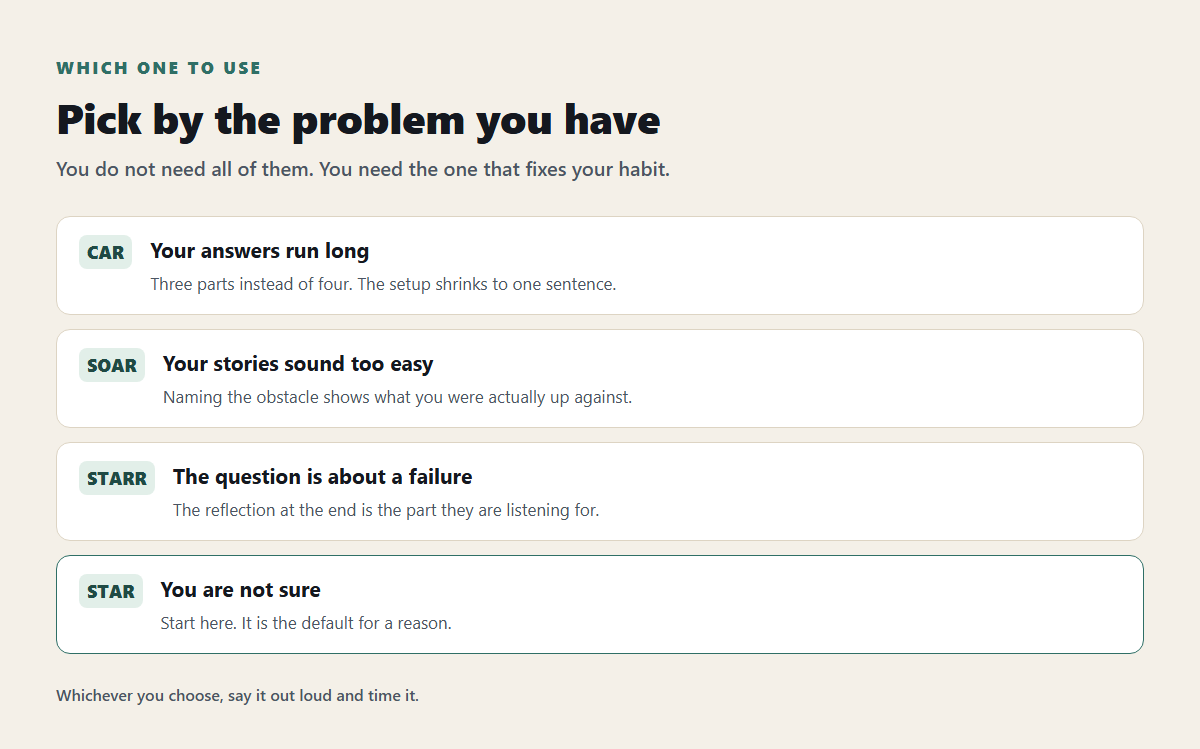
Pick by the habit you are trying to fix, not by which acronym sounds most impressive:
- You talk too long. Use CAR.
- Your stories sound too easy. Use SOAR.
- The question is about a mistake. Add the reflection from STARR.
- You are not sure. Use STAR.
Then stop thinking about the letters. In twenty years of interviewing people, I never once wrote down which framework a candidate used. I wrote down what they did and what happened because of it. The action and the result are the answer. Everything else is the frame.
<!-- fanouts-2026-10-25 -->How long a STAR answer should take
Whichever acronym you use, a spoken behavioral answer should land between ninety seconds and two minutes. Shorter, and the interviewer has nothing to follow up on. Longer, and they have stopped tracking the story and started waiting for it to end.
A split that works out loud:
- Situation and task: 20 to 30 seconds. Who, where, what was at stake. One or two sentences, not the history of the company.
- Action: about a minute. This is the part they are grading. What you did, in order, with "I" rather than "we."
- Result: 15 to 20 seconds. What changed, with a number if you have an honest one, and what you would do differently if that is true.
Most answers that run long are front-loaded: the setup takes ninety seconds and the action gets squeezed into two rushed sentences. Say the answer once with a timer running, note where the first minute ended, and cut the setup until the action starts before then.
The part that matters more than the method
A method only helps if the answer survives being said out loud. On paper, every story fits its acronym neatly. Spoken, the setup runs long, the action gets rushed, and the result is forgotten.
So practice by speaking, with a timer. Say the story once, check the time, and say it again. If you want something that asks follow-up questions the way a real interviewer does, RehearseAI does that, and every account gets 10 free practice minutes a month — one 10-minute interview, or shorter sits whenever you like, no credit card required.
Quick answers
Is CAR better than STAR? No, it is shorter. If your STAR answers already fit in ninety seconds, there is nothing to gain by switching.
Will an interviewer mind which one I use? No. They hear a clear story or they do not. The only exception is when they ask for STAR by name.
Can I mix them? Yes. A STAR answer with an obstacle named and a one-line reflection is simply a good answer.
How many stories do I need? Five or six that you can tell well cover most behavioral questions.
<!-- related-guides -->Related guides
If this was useful, these are the next ones to read:
- Situational Interview Questions and How to Answer: Situational interview questions ask what you would do, not what you did. Here are the common ones, a four-step way to answer any of them, and worked examples.
- Tell Me About Yourself: Sample Answer: The four-part shape for tell me about yourself, a full worked sample answer, the four ways it usually goes wrong, and how to adjust it by situation.
- The Biggest Weakness Interview Question: What the biggest weakness question actually tests, why the perfectionist answer fails, and the four-part structure that works without damaging you.
Sources
Career centers and university programs that describe these methods:
- Challenge Action Result: CAR Statements — Michigan State University Extension
- Interviewing — George Washington University Career Services
- Using the STAR method for your next behavioral interview — MIT Career Advising & Professional Development
The questions these methods are built for are in behavioral questions for interview practice. More on why I built this.
The free question generator writes the questions a posting will ask — no account needed.